1961 Jaguar E-Type
The E-Type's first year: two coupés sent to Geneva and a roadster driven out overnight, the American debut in New York, a slow start at Browns Lane, and the early cars collectors now look for, with outside bonnet (hood) latches and flat floors.
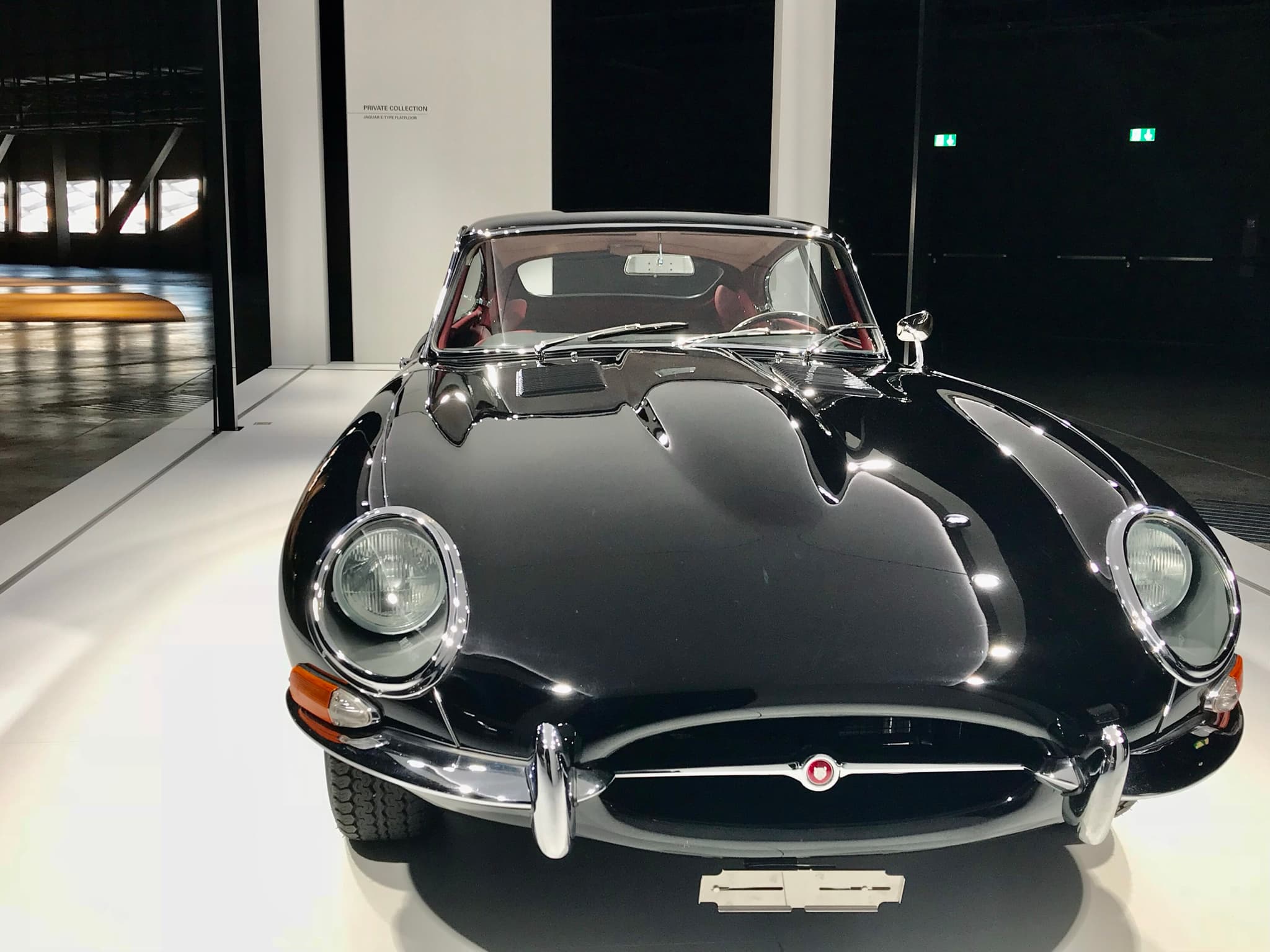
About the pictureA Series 1 3.8 coupé at Grand Basel in 2018, labelled a flat-floor car by its exhibitor; not one of the 1961 launch cars.
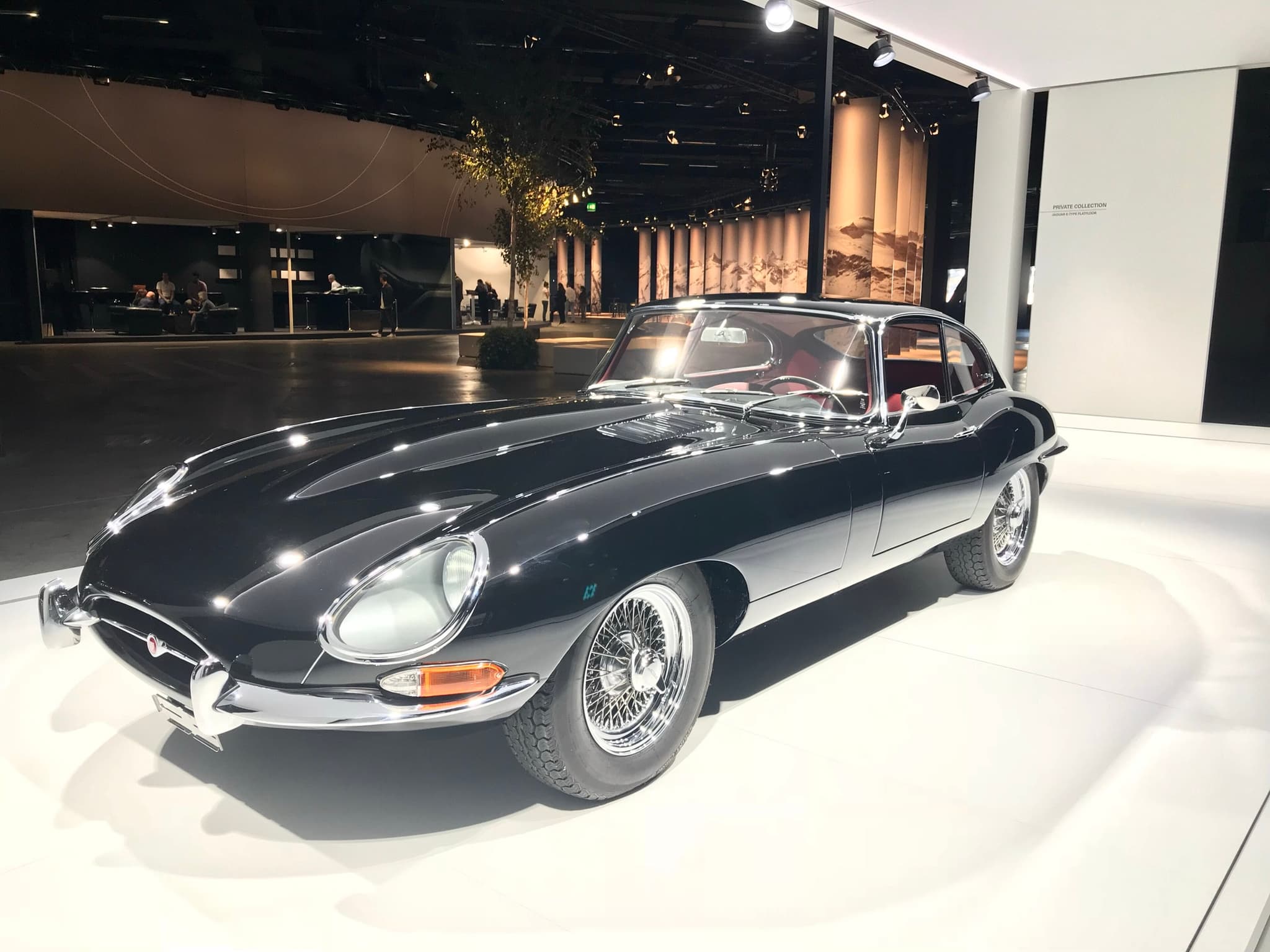
On a hill road outside Geneva, on 15 March 1961, journalists took their first rides in Jaguar's new sports car, which the company had just shown them at the restaurant of the Parc des Eaux-Vives. The Geneva motor show opened to the public the next day. Within three weeks the car was in New York, and within five it had won its first race.source 1source 2source 3
The launch, day by day
The cars were ready only just in time. Jaguar's own records, as the Jaguar Clubs of North America's judges' guide gives them, show the first roadster numbers beginning on 1 February and four cars for the New York show dispatched on 28 February, before the two coupés for Geneva left Coventry in March.
- 1961
The press drive
About a week before the launch, Bill Boddy of Motor Sport tries the car near Coventry.
- 1961
14 March
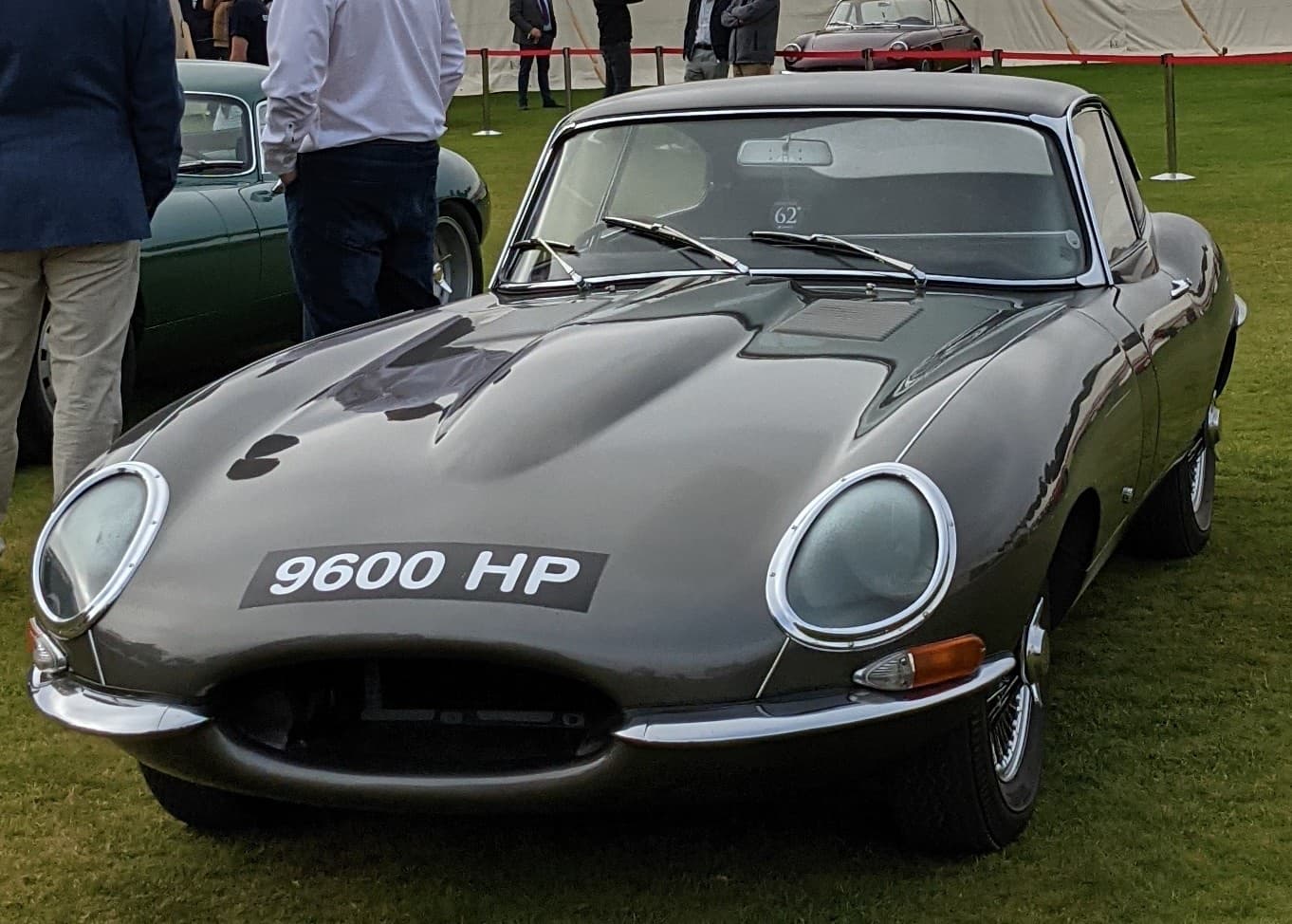
Bob Berry of Jaguar's press office leaves for Geneva in the coupé 9600 HP.
- 1961
15 March
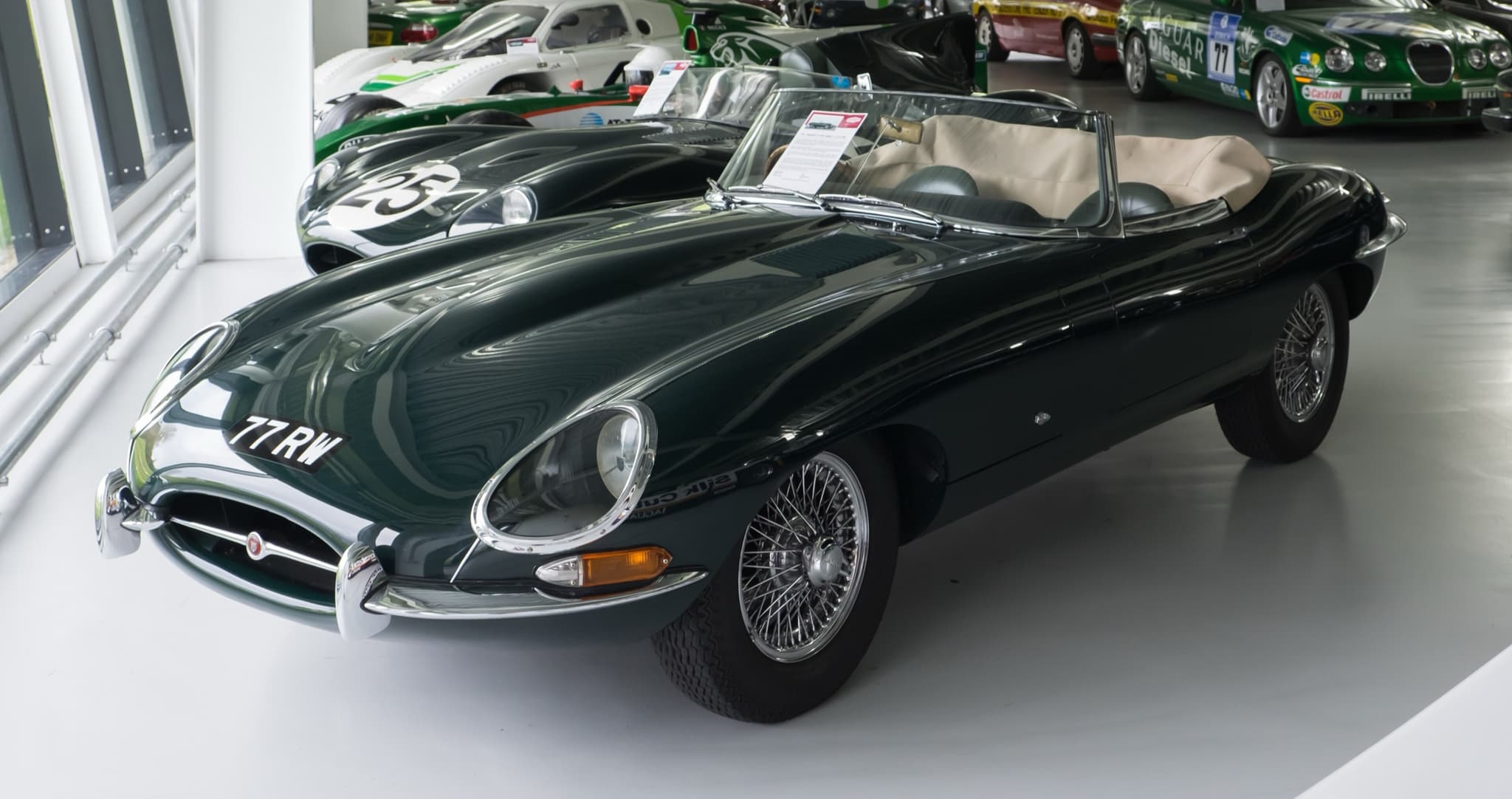
The press presentation at the Parc des Eaux-Vives; that night Norman Dewis sets out from Coventry in the roadster 77 RW.
- 1961
16 March
The Geneva show opens; 77 RW arrives in the morning.
- 1961
22 March
The Motor publishes its test of 77 RW.
- 1961
1 April
The American debut, at the New York International Automobile Show.
- 1961
15 April
Graham Hill wins at Oulton Park in ECD 400, the first race an E-Type started.
Boddy was won over before the car was even public. He tried it near Coventry a week before the announcement, and wrote:
I felt glad to be an Englishman standing in Coventry viewing this amazing new British car!
New York had four pre-production cars, two roadsters and two coupés, which by the judges' guide were roadsters 875002 and 875003 and coupés 885003 and 885004. According to the Jaguar Heritage Trust, six cars were sold within half an hour of the show opening and over 2,000 orders were taken. In America the car was the XK-E, and Jaguar XKE tells its American story.source 4source 2source 5source 6source 1source 7source 3source 8source 9
Geneva: three cars
Jaguar sent two coupés to Geneva, and the roadster 77 RW followed overnight. The first coupé, 885005, was the display car: the Heritage Trust describes it revealed on the morning of 15 March by lifting a large wooden crate, as the only E-Type for static display inside the hall. The second, 9600 HP, was the press car. It had been registered on 10 February, and Bob Berry drove it from Coventry, by the Trust's account catching the midnight ferry from Dover, meeting fog in France and arriving with 20 minutes to spare.
The press wanted more drives than one car could give, so Sir William Lyons telephoned the factory and asked for the open car. Norman Dewis drove 77 RW, number 850003, the third car in the right-hand-drive roadster series, through the night of 15–16 March, in what the Heritage Trust calls a 17-hour overnight run, and on arrival he and Berry gave demonstration runs to the press, dealers and guests.
The two demonstrators were also the two road-test cars. Before the show 77 RW had been lent to Charles Bulmer of The Motor, who drove it to Italy and back, and The Motor published its test on 22 March. The Autocar tested 9600 HP. Both were works-prepared cars, and the speeds they reached became the E-Type's legend; the specifications set them beside what the press found later.source 4source 5source 6source 7source 1source 3
The first cars
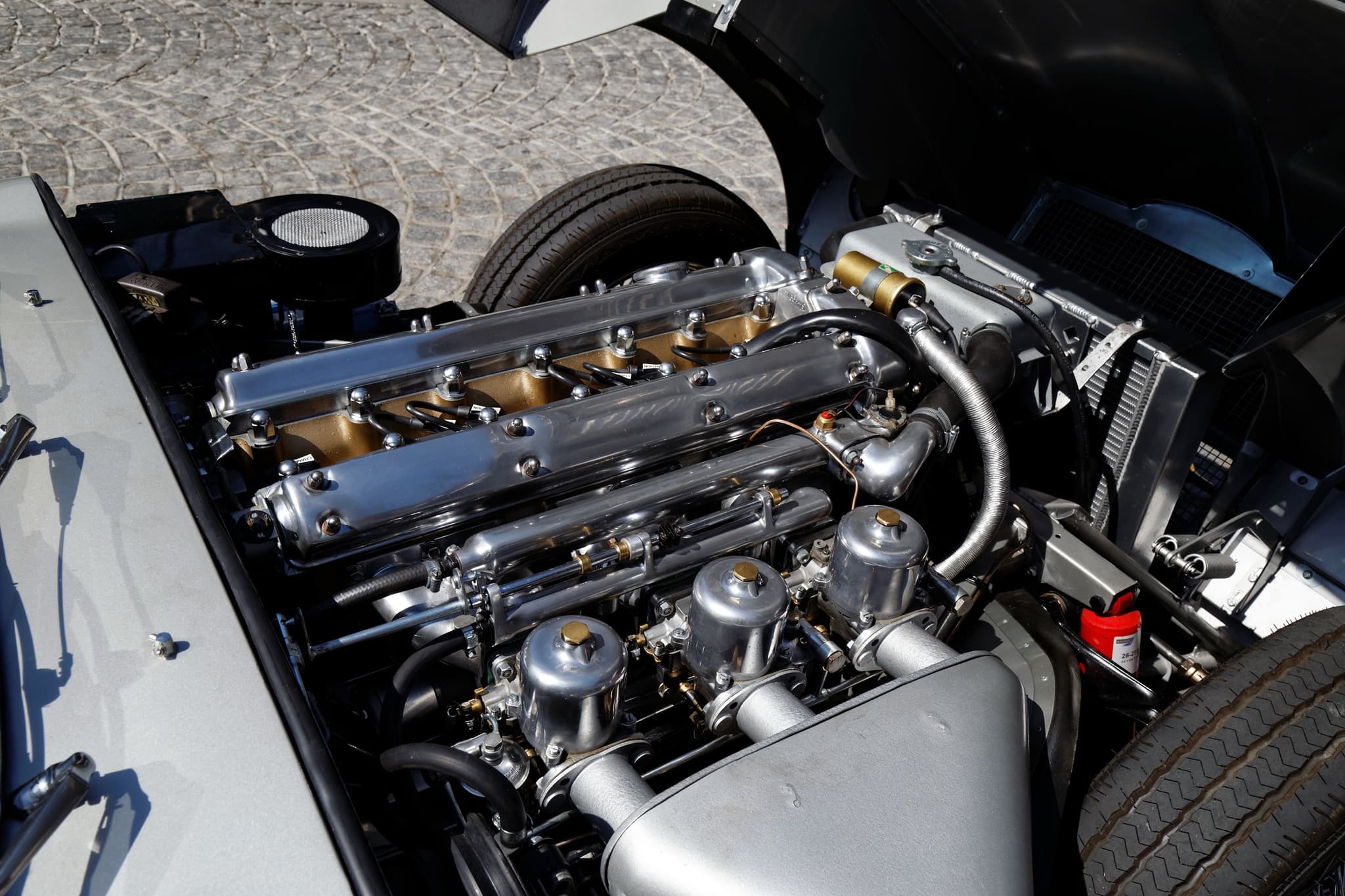
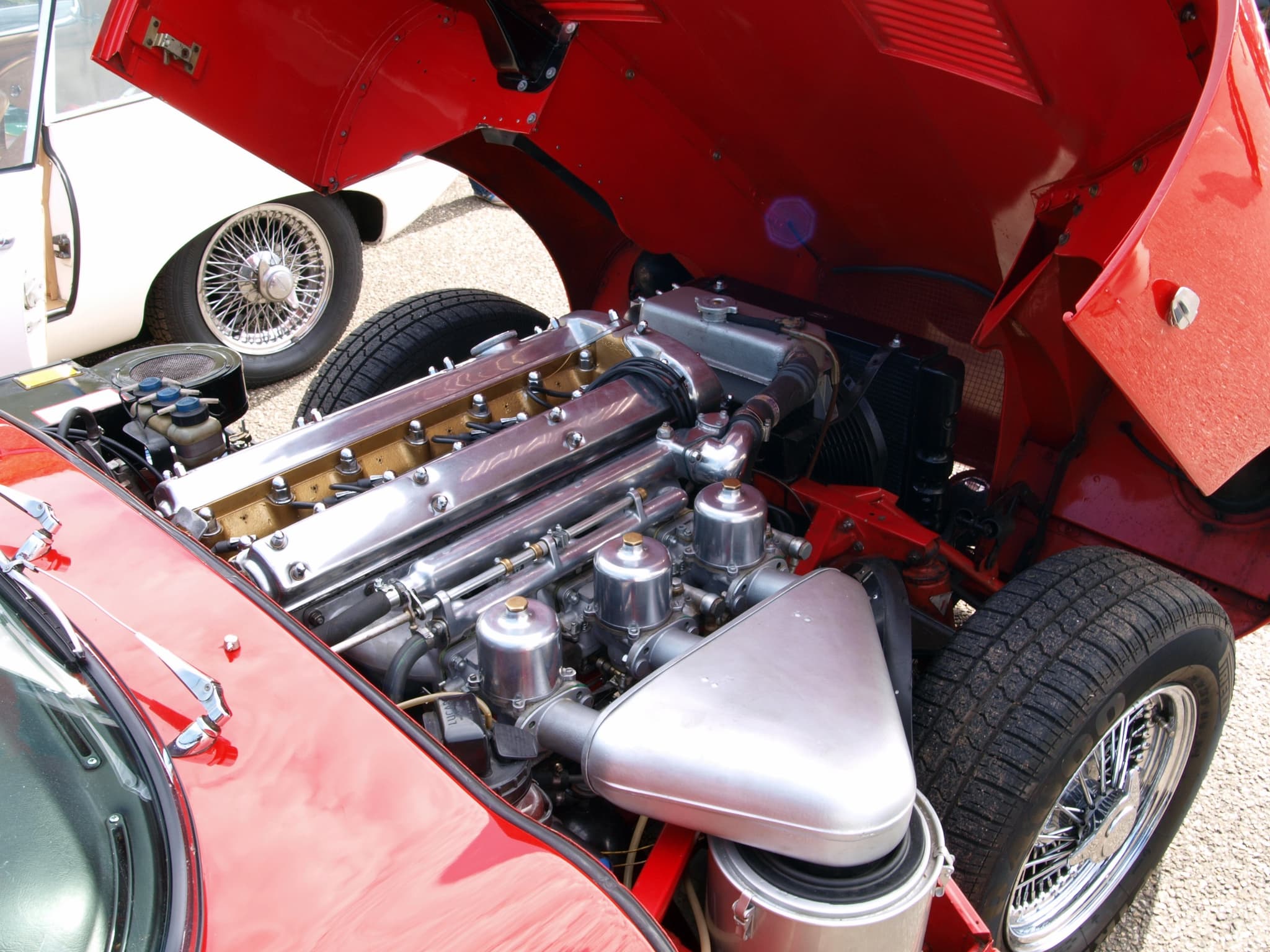
The E-Type of 1961 had the 3.8 six from the XK150S, with three SU carburettors, a four-speed gearbox (transmission) with synchromesh on second, third and top, disc brakes all round, inboard at the back, and independent rear suspension. The body, Boddy noted, was "designed and styled entirely in this country". Its prices with purchase tax are in the specifications; in 1989 Motor Sport reckoned the coupé had cost less than half as much as an Aston Martin DB4GT.
Production was slow to start. The Heritage Trust records that by August 1961 only 372 roadsters and 11 coupés had been completed, and that by the end of the year 2,160 cars had left the factory: 1,729 roadsters and 431 coupés. The car numbers Jaguar issued in 1961 run higher, to about 2,328 by our arithmetic on the Trust's tables: numbers issued are not cars completed. Cars went to export markets before British ones: home-market deliveries waited until July, when the first right-hand-drive coupé was built. Automotive News reported that September that XK-E output had not begun until midyear.
The car was altered before the year was out. Jaguar's own list of first-year changes, as Motor Sport printed it in 1972, has a self-adjusting handbrake, shields to keep water out of the front hubs, bonnet catches moved inside the car, and a heated rear window as an extra on the coupé; and from October the chrome finisher along the top of the roadster's doors was modified.source 2source 5source 10source 11source 12source 4source 13
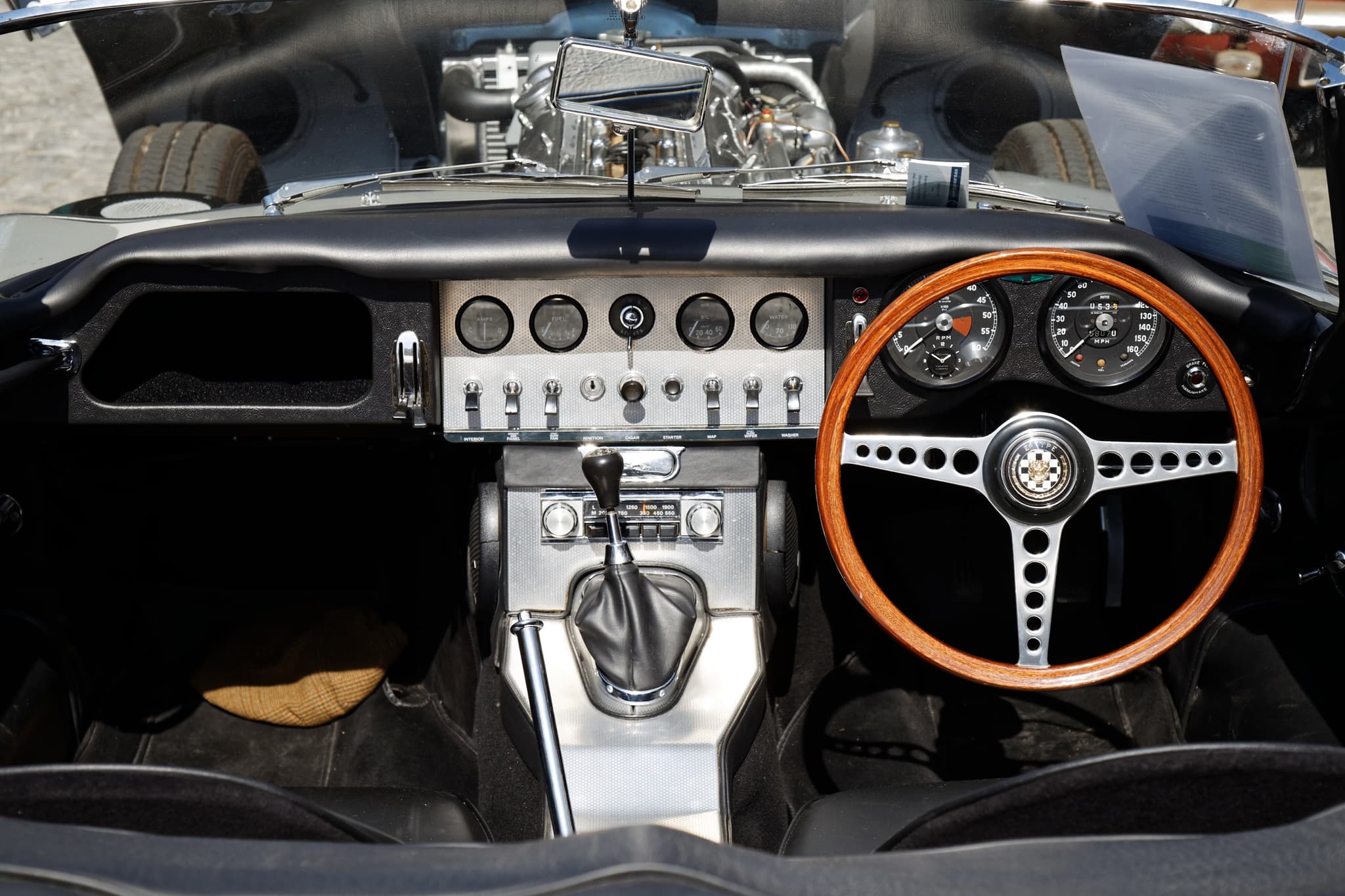
The outside-latch and flat-floor cars
Two features mark the earliest E-Types, and they changed at different points. Jaguar's service bulletins, as the Jaguar Clubs of North America reproduce them, give the car numbers.
The first 500 cars had external bonnet locks, worked by a T-handle key: 91 right-hand-drive and 385 left-hand-drive roadsters (to 850091 and 875385), and four and 20 coupés (to 860004 and 885020). From October 1961 the latches were inside the car.
The floors stayed flat for longer. The first 2,616 cars had flat floors, with the exhaust pipes visible below the body: 357 and 1,581 roadsters (to 850357 and 876581), and 175 and 503 coupés (to 860175 and 885503). Footwells, with the seats set further back, came in at 850358, 876582, 860176 and 885504. Jaguar's bulletin is dated June 1962, but by our arithmetic on the Heritage Trust's tables those numbers fall early in the year, in January or February 1962. So every outside-latch car has a flat floor, but most flat-floor cars, 2,116 of them by the same arithmetic, have inside latches.
The judges' guide adds its own warning: bulletins were sometimes issued before a change and sometimes after it, so a single car may differ. A car's number places it in these runs, and a Heritage Certificate gives its build date; Jaguar E-Type Chassis Numbers explains both.source 4source 10source 12
Sources
Sources are given as plain text; their addresses are on the sources page.
- Primarymade at the time, by the maker or by people who were there
- Referenceserious later work: clubs, specialists, magazines, books
- Databaseresults and listings, entry by entry
- Jaguar Land Rover (Jaguar media newsroom), "Jaguar Celebrates 50 Years of Iconic E-type" (press release), 24 Jan 2011, facts for editors: the Parc des Eaux-Vives, 15 March 1961; the demonstration runs; facts for editors; facts for editors: Dewis's drive. Primary
- Bill Boddy, "The New 3.8-Litre Jaguar E-Type G.T.", Motor Sport, Apr 1961, p. 35, p. 35, the announcement of 15 March; p. 35, the press drive near Coventry; p. 35, the specification and the body. Primary
- Motor Sport, "Jaguar E-type: the end of production and end of an era – but not of a legend", May 1975, p. 29, the Geneva show, 16 March; *The Autocar*'s test of 9600 HP. Primary
- Jaguar Clubs of North America, Series 1 E-Type Judge's Guide (draft), part 1: Intro–Exterior, Draft, version of 21 Jul 2026, introduction: the launch cars, their dispatch dates and New York; introduction: 885005, 885002 and 850003; roadster door finisher, SDB P.43; pp. 5 and 9: the bonnet locks (SDB P.46, SB N.8) and the floors (SDB P.51); the notice on bulletins. Reference
- François Prins, "Evolution of the E-Type", Jaguar Daimler Heritage Trust, "US Debut and Demand"; "The Next Prototypes"; "The Next Prototypes": 9600 HP registered, the display coupé and its crate, Bulmer's run; "E-Type Production": 1961. Reference
- Jaguar Daimler Heritage Trust, "E-Type Evolution Exhibition", the Geneva Motor Show, 1961: Berry's drive; the Geneva Motor Show, 1961. Reference
- Jaguar Daimler Heritage Trust, "1961 Jaguar E-type 77 RW: The First E-type OTS", the overnight run and *The Motor*'s test; the two demonstrators; the overnight run; *The Motor*, 22 March 1961. Primary
- Motor Sport, "Oulton Park debut for E-Types", May 1961, p. 24, the race report. Primary
- racingsportscars.com, National Open Oulton Park [GT] 1961, results, results, 15 April 1961. Database
- Jaguar Daimler Heritage Trust, Research Guide No. 001F: Chassis Number Runs and Change Points by model – Jaguar E-type, Issue 3, January 2023, 3.8 table: first numbers by year; 3.8 table: the first numbers of 1962. Primary
- William Kimberley, "The Jaguar E-Type 3.8, 4.2 & V12", Motor Sport, Apr 1989, p. 81, p. 81, the July 1961 sales; against the DB4GT. Reference
- Bill Boddy, "On the road with the V12 E-type Jaguar", Motor Sport, Jan 1972, p. 36, Jaguar's list of first-year changes; Jaguar's list: the bonnet catches in the first year, the footwells in the second. Primary
- Automotive News (Crain Communications), via Internet Archive, "Port-of-Entry Prices on Imported Cars", 11 Sep 1961, vol. 37 no. 3828, import price list, the XK-150 and the XK-E. Primary