Jaguar XKE
In America the E-Type was the Jaguar XK-E, usually written XKE, and from 1971 simply the Jaguar V12. How it reached New York in 1961, what it cost, how the federal rules changed it year by year, and how two in three E-Types came to be sold there.
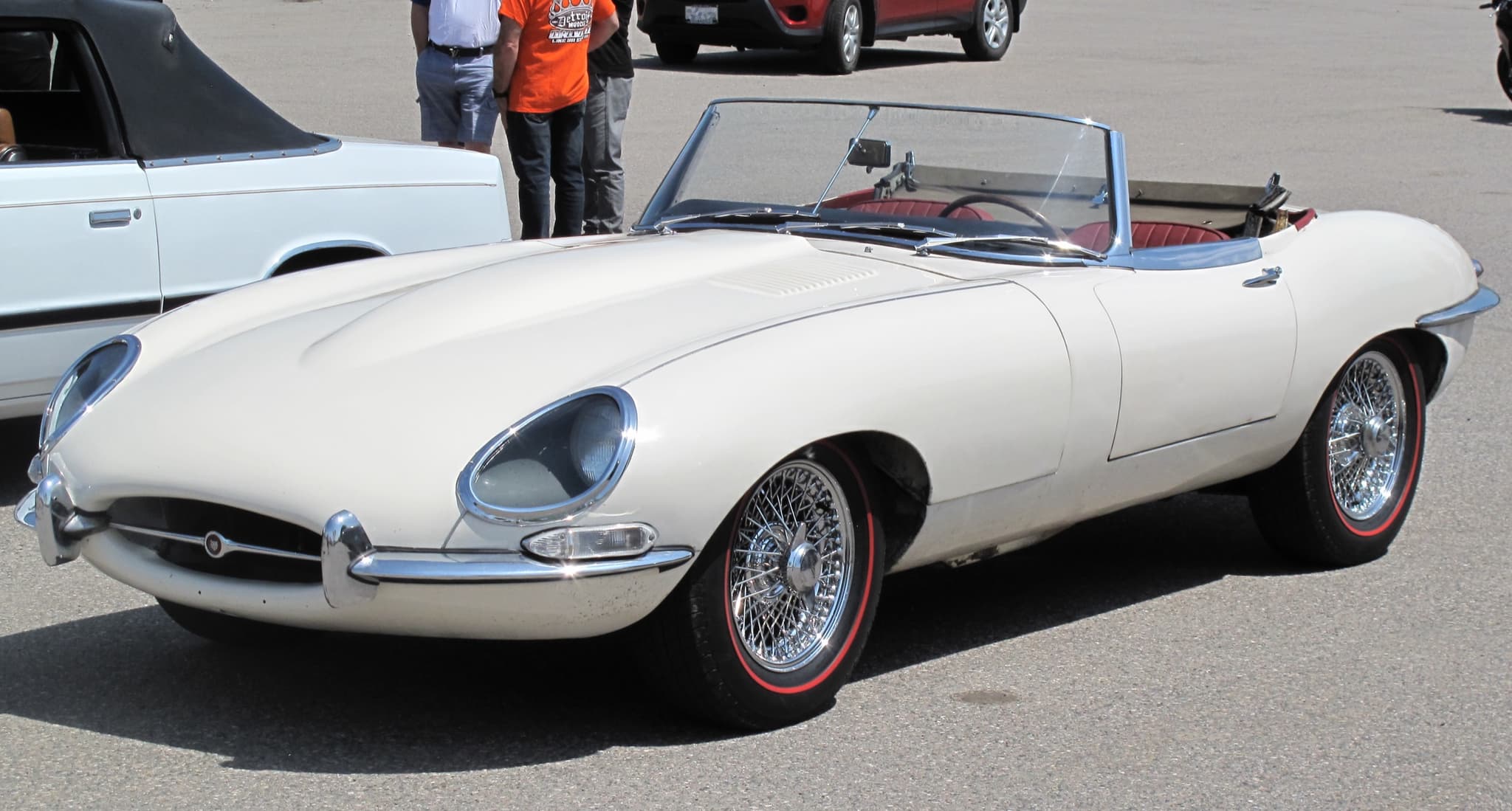
On 1 April 1961, a little over two weeks after Geneva, the E-Type went on show in New York, and Motor Trend introduced it to its readers under the name America would use: "The new car is designated as the XK-E, a successor to the XK-150". For the next ten years Americans bought the XK-E, usually written XKE, and from 1971 the Series 3 came to them as the Jaguar V12. They bought more of it than anyone: by Jaguar's own count, 49,032 E-Types went to the United States.source 1source 2source 3
The name
The name was a choice. John Dugdale, who ran Jaguar's publicity in America, recalled in his book Jaguar in America why the American side, with its advertising agency Cunningham & Walsh, wanted to keep the XK letters of Jaguar's earlier sports cars:
…who wanted to continue XKE for marketing reasons; and we did so. It was much more effective to splash XKE on a showroom poster; XK meant a great deal in America after more than 20 years.
So it was the XK-E in the price lists and the road tests of 1961, Car and Driver's among them, and Jaguar Cars Inc. used both spellings itself: "XK-E" in the price panel of its advertisements for 1967 and "XKE" in their text. When the Series 3 came, the name went: from 1971 Jaguar's American advertising sold the car as the Jaguar V12, without the XKE name, AROnline's Chris Cowin records.source 1source 4source 5source 6source 7source 2
New York, April 1961
The car's American debut was the New York International Automobile Show at the Coliseum, on 1 April 1961. Industrial Design reported that "The E-type Jaguar was the hit of this year's show, favorite of press and public". The importer was Jaguar Cars Inc., of 32 East 57th Street, New York. Jaguar had set up its own North American company in 1954, with Johannes Eerdmans as its president, where Max Hoffman in the east and Charles Hornburg in the west had been its distributors; by September 1961 Eerdmans could tell Automotive News that "The XK-E models have met with dramatic acceptance here".
Acceptance was easier than supply. The same paper reported that XK150 production had stopped early in the year and that "XK-E output did not begin until midyear", so American buyers waited for their cars.source 8source 9source 4source 10
Prices new in America
The first list price is Automotive News's of 11 September 1961: an East Coast port-of-entry price, with ocean freight, excise tax and import duty paid and a heater as standard. The specifications tables give it. Other figures were printed that year, on other bases or none:
| Source | Roadster | Coupé | What it was |
|---|---|---|---|
| St. Louis Post-Dispatch, 15 April 1961 | "about $5500" | A newspaper's estimate, before prices were fixed | |
| Jaguar Heritage Trust | $5,595 | $5,895 | An earlier figure, undated |
| Motor Trend, July 1961 | $6,095 | $6,320 | As printed; its basis is not stated |
Jaguar's own advertising gave later prices. Its list "Jaguar Cars for 1967", of suggested retail prices at an East Coast port, slightly higher on the West Coast, priced the roadster at $5,384, the coupé at $5,580, the 2+2 at $5,870 and the 2+2 automatic at $6,120. A Series 2 advertisement that Dugdale reproduces reads "The Jaguar XKE Convertible Roadster. Modestly priced at, $5534". The V12 convertible of March 1971 cost $6,950, and Gunnell's Standard Catalog of Jaguar gives the V12 2+2 at $7,325. The Corvette was the cheaper car, as the rivals page shows.source 4source 11source 12source 13source 7source 6source 2source 14
The American cars, year by year
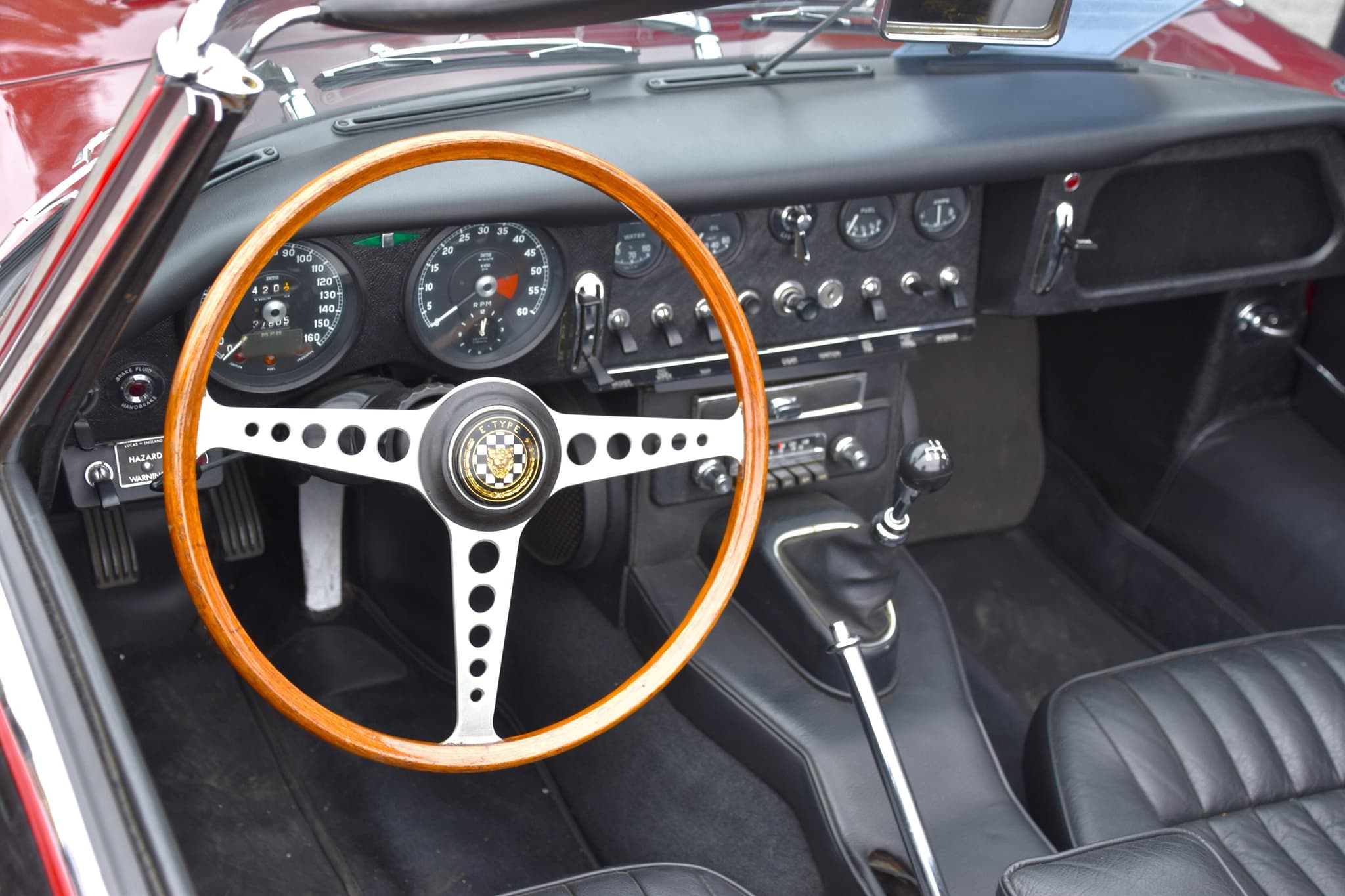
The American E-Type was never quite the British one. The 4.2 had lower gearing for America as standard, and from the 1968 model year the federal government's rules on safety and exhaust emissions changed the car again and again. The by-year page sets out every change; these are America's:
| Model year | What changed for America |
|---|---|
| 1961 | The New York debut on 1 April; deliveries from the middle of the year |
| 1966 | The 2+2, built partly to earn dollars |
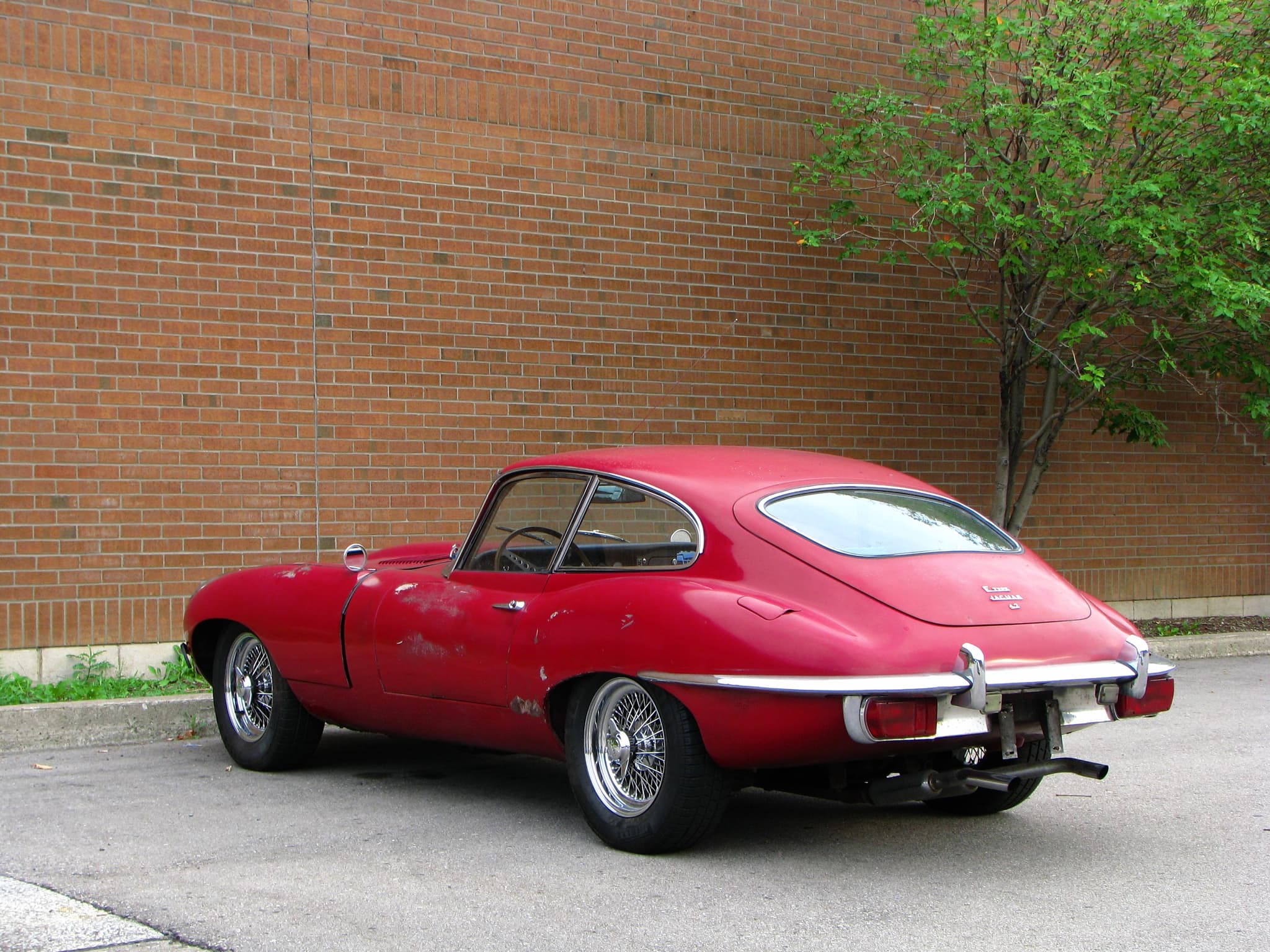
| 1968 | The federal rules: open headlamps and rocker switches, which every market later shared, and, for America alone, two Zenith-Stromberg carburettors and emission controls, 246 hp in Gunnell's figure; Jaguar "offered only the hastily revised 'Series 1½' E-type range", Cowin writes |
| 1969–70 | The Series 2, with safety features Gunnell says had been seen only on American cars |
| 1971 | Late Series 2 cars carry a 2R prefix; in March the V12, presented to the American press at Palm Springs, with Sir William Lyons there, Dugdale recalls |
| 1972 | The UC prefix |
| 1973 | The UD prefix; big rubber overriders (bumper guards) at the front; the last 2+2 cars built that summer |
| 1974 | The UE prefix; overriders front and rear; the roadster only |
Production ended on 12 June 1974, and Dugdale recalls that American sales were meant to stop by the end of the year, "but a few were shipped out through the turn of the year".
Canada
Canada took 2,439 E-Types, by Jaguar's figures. Jaguar's Canadian sales of all models had never passed 1,000 a year before the 1970s, Cowin writes, and the E-Type was still in British Leyland Canada's range in 1971. No source read gives a Canadian-only specification. Canada shared America's federal tyre pressures on the V12, which Motor Sport noted held it below its top speed, and the V12's exhaust had been engineered from the start, the magazine reported, for the American, Canadian and Swedish markets.
The XK-E's place in American culture, from Harold and Maude to the Museum of Modern Art, is on the popular culture page.source 3source 20source 21source 22
Sources
Sources are given as plain text; their addresses are on the sources page.
- Primarymade at the time, by the maker or by people who were there
- Referenceserious later work: clubs, specialists, magazines, books
- Motor Trend, "Jaguar's XK-E", May 1961 (vol. 13 no. 5), p. 56, "Jaguar's XK-E", the announcement; "The new car is designated as the XK-E". Primary
- Chris Cowin, "History: Exporting British cars to the USA – Part Two", AROnline, 31 May 2025, updated 21 Oct 2025, 1971: "the Jaguar V12"; 1971: the Series 3's American name; 1971: the convertible's price; 1970–74: the Series 2, Palm Springs, the overriders, the convertible only; Jaguar's American sales, 1970–75. Reference
- Motor Sport, "Jaguar E-type: the end of production and end of an era – but not of a legend", May 1975, p. 29, p. 29, the cars that went to the USA; p. 29, the cars by market; p. 29, the cars that went to Canada. Primary
- Automotive News (Crain Communications), via Internet Archive, "Port-of-Entry Prices on Imported Cars", 11 Sep 1961, vol. 37 no. 3828, the import price list, "XK-E"; Eerdmans's words; "XK-E output did not begin until midyear"; the importer's directory entry; the import price list's heading and the XK-E. Primary
- Car and Driver, "Road Research Report: Jaguar XK-E" and "Dual Test: Jaguar XK-E vs. 1962 Corvette", Dec 1961 (vol. 7), the report's and the dual test's titles. Primary
- John Dugdale, Jaguar in America, Britbook Publishing, 1993, the choice of the XKE name; the advertisement "Modestly priced at, $5534"; Lyons at Palm Springs; the run-out of 1974. Reference
- Jaguar Cars Inc. (advertisement in Newsweek), "Jaguar Cars for 1967" (advertisement), Newsweek, vol. 69 (1967), "Jaguar Cars for 1967": XK-E in the price list, XKE in the text; "Jaguar Cars for 1967", the price panel. Primary
- Jaguar Clubs of North America, "Jaguar Model Guides: The E-type", the New York show, 1 April 1961; "over 3/4 of the 72 000". Reference
- Industrial Design, Industrial Design, May 1961, May 1961 (vol. 8 no. 5), the New York show report. Reference
- Chris Cowin, "History: Exporting British cars to the USA – Part One", AROnline, 31 May 2025, updated 20 Feb 2026, the 1950s: Hoffman, Hornburg and Jaguar Cars of North America; 1968: "the hastily revised 'Series 1½' E-type range"; 1966 sales; the 1969 peak; the network's needs. Reference
- St. Louis Post-Dispatch, St. Louis Post-Dispatch, 15 April 1961 (the Jaguar XK-E at the New York show), 15 Apr 1961 (vol. 83 no. 104), "about $5500". Primary
- François Prins, "Evolution of the E-Type", Jaguar Daimler Heritage Trust, the New York section's prices. Reference
- Gordon Wilkins, "Driver's Report: A First Test of the Jaguar XK-E", Motor Trend, Jul 1961 (vol. 13 no. 7), pp. 70–71, p. 71, the closing line's prices. Primary
- John Gunnell, Standard Catalog of Jaguar, Krause Publications, 2007, the price tables: the 2+2 of 1971; the American rating from 1968; the Series 2's safety features. Reference
- Motor Sport, "The 4.2-Litre Jaguar E-type" ("A lengthy road test of the 150 m.p.h. E-Type"), Jan 1965, p. 23, the data panel, the American axle ratio. Primary
- Jaguar Daimler Heritage Trust, Research Guide No. 001F: Chassis Number Runs and Change Points by model – Jaguar E-type, Issue 3, January 2023, the 2R, UC, UD and UE prefixes; the last 2+2 cars. Primary
- Road & Track, Road & Track, October 1973 (road-test summary table), Oct 1973, the New York International Show report. Primary
- William Kimberley, "The Jaguar E-Type 3.8, 4.2 & V12", Motor Sport, Apr 1989, p. 81, p. 81, "Introduced at the New York Motor Show". Reference
- Denis Jenkinson, "Driving the V12 Jaguar", Motor Sport, Apr 1971, p. 64, p. 64, "78% of the V12 cars". Primary
- Chris Cowin, "History: Exporting British cars to Canada – Part One: Commonwealth Preference?", AROnline, 2 Aug 2025, Jaguar's Canadian sales; British Leyland Canada's range of 1971. Reference
- Bill Boddy, "On the road with the V12 E-type Jaguar", Motor Sport, Jan 1972, p. 36, p. 36, the federal tyre pressures "in America and Canada". Primary
- Bill Boddy, "The new Jaguar V12", Motor Sport, Apr 1971, p. 61, p. 61, the emission work for the USA, Canada and Sweden. Primary