Jaguar E-Type Restoration
What restoring an E-Type involves, from stripping the car to its three structural parts to the paperwork that proves the work: where the body, frame and engine work lies, what the references are for originality, and what a magazine put on the main jobs in 2026.
About the pictureA finished, restored Series 1 engine bay, not a restoration in progress.
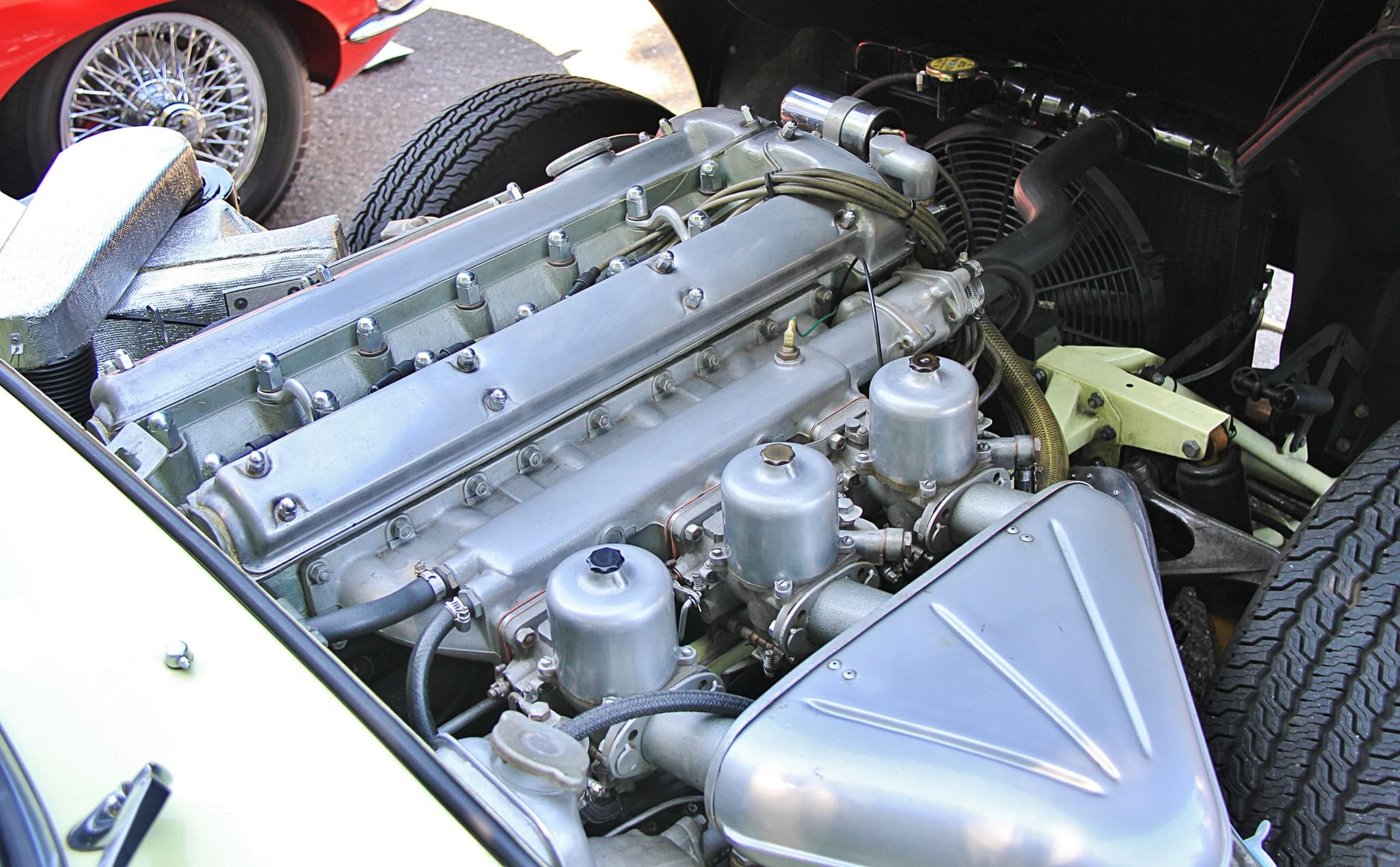
The E-Type is a welded steel shell whose closed box sections rust from the inside, and in the 1970s, Motor Sport recalled in 1989, repairing it "needed specialised equipment", so many were patched up as cheaply as possible. An insurer's buyer's guide of 2023 expects most cars to have been restored to some degree by now, and a restoration today is often the correction of an earlier one.
This page sets out what the work involves and where it lies. The checks a buyer makes are in the buyers guide, and the parts suppliers and clubs are on the parts page.source 1source 2
How the car comes apart
Jaguar designed the E-Type in three structural parts, and a restoration follows them. In the middle is the monocoque, the welded steel centre section. Bolted to its front bulkhead is a frame of square Reynolds steel tubes carrying the engine, the front suspension and the bonnet (hood), which is hinged at the frame's front end and comes off whole. Under the floor, the rear suspension, its differential and its inboard brakes sit in a steel cage held on rubber mountings, which drops out as one unit. The front frame is itself built of side-members and a cross-member, and Motor Sport explained the point of that in 1961:
These are bolted together and replacement of any of the individual units does not necessitate removal of the whole assembly.
So a restorer can unbolt the frame and the rear cage, lift the engine and gearbox (transmission) out together, as even a new clutch demands, and be left with the shell. A full restoration then runs in stages: record every number and order the car's Heritage Certificate; strip it; replace the front frame's tubes where they have corroded, rather than patch them; repair the shell, keeping it true; then paint, rebuild the mechanical parts, wire it, retrim it and put it back together.source 3source 4source 5source 2
Where the work lies
The shell takes the most. Motor Sport's account of an early roadster's restoration in 1989 found "The outer sills were rotten and needed replacing as were the panels that made up the centre-section under the car"; the boxes of the sills (rocker panels) and centre section rust from within, the floors go, especially on open cars, and so do the rear arches, the mountings of the rear cage, the boot (trunk) floor, the door bottoms and the scuttle. A coupé adds the seam between its outer and inner rear wings (fenders) and the tailgate. Replacement panels exist, though on the very earliest cars they may need altering: the 1989 restorer's had to be modified, because, it appeared, his car was "a little shorter than later Jaguars". The work needs equipment that keeps the shell true, one restorer's guide warns, and "most body shops likely won't have the skills".
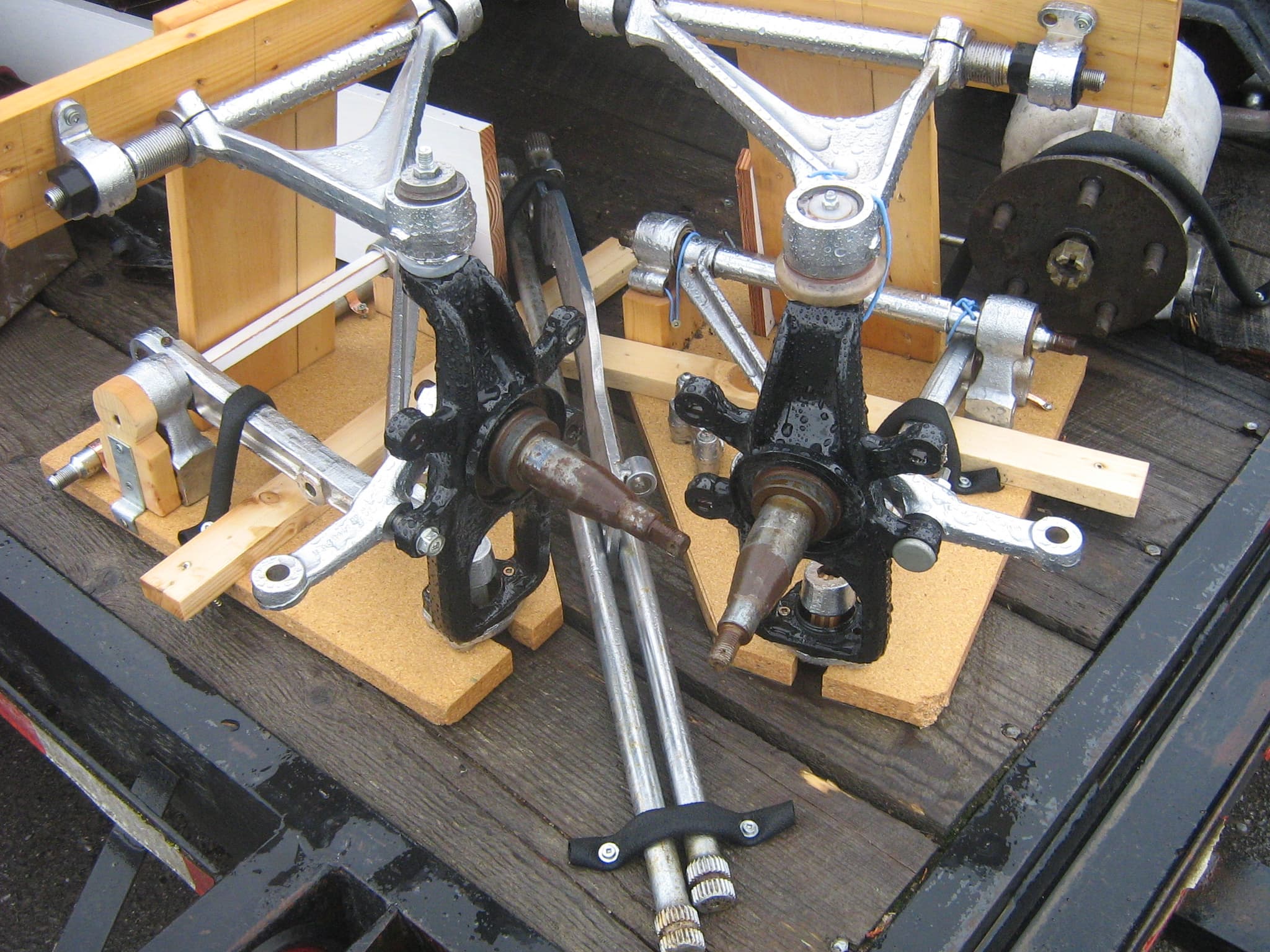
The mechanical work is more straightforward. The XK six is durable if it has been maintained, and rebuilding it is a specialist's job. The rear cage, once out, gives access to its bushes, radius arms, bearings, drive shafts and the inboard discs. Wire wheels can be rebuilt and re-chromed, as the 1989 roadster's were, and every piece of trim is made new; that restorer re-polished the patterned aluminium of the early car's tunnel, console and centre panel. Jaguar's own parts service, Goodwood's guide notes, supplies E-Type parts "up to and including replacement engine blocks".
Prestige & Performance Car gave these as typical costs in Britain in 2026, its figures for that year:
| Job | Typical cost in 2026 |
|---|---|
| An XK engine rebuild by a specialist | £10,000 to £15,000; more for a concours or uprated engine |
| A full retrim of a roadster or coupé | From about £5,000 to £10,000 |
| A rebuilt differential | £1,500 to £2,500 |
| New rear brake discs, with the rear cage dropped | £1,500 to £2,500 |
Originality and the record
A restorer aiming at the original car has good references. The Jaguar Heritage Trust's Heritage Certificate gives the car's original colour and trim, its dates and its first destination from the factory's records, and the Trust's paint-code service gives the original paint's name and code, with the codes other paint makers use; in October 2026 the paint code cost £50 plus VAT and postage. Jaguar's colour lists are on the colours page. The certificate records the car as built and, the Trust says, does not confirm its identity, originality or condition today.
For the finest detail, the Jaguar Clubs of North America's judges' guide to the Series 1 sets out what their concours judges look for, from the car-number plate and the four styles of dashboard to the flat and recessed floors and the inside and outside bonnet latches, and it reproduces Jaguar's own change points from the factory's bulletins. Its appendix on fasteners shows how far the detail goes: the factory used bolts by several makers, Bees, Rubery Owen and GKN among them, with black heads on early cars and plated ones later. The guide also treats a Heritage Certificate as overriding Jaguar's colour charts, and it cites Anders Clausager's Factory Original Jaguar E-Type for some of its dates.source 7source 8source 9source 10source 2
Upgrades
Many restorations improve the car as well as renew it, and the buyers guide lists the usual changes. Motor Sport's 1989 roadster was given a pair of Kenlowe fans, "as the earlier cars were prone to overheating", and an engine balanced, lightened and polished, with D-type camshafts and bigger inlet valves, which gave about 35 bhp more than standard on a rolling road. The article also says the car was given "a servo, a feature only introduced on the 4.2"; in fact the 3.8 had a Dunlop bellows servo from 1961, and the 4.2 brought a new type.
Original and improved cars are both legitimate. What matters is the record: a restorer should note every change and keep the parts that came off. Cars taken further, with modern engines, gearboxes and suspension, are on the restomods page; Jaguar Classic's own restorations, its Reborn cars, are on the Reborn page.source 1source 3source 11source 2source 12source 13
Specialists and clubs
The clubs help their members with the work. The Jaguar Enthusiasts' Club offers technical advice and pre-purchase inspections, and the Jaguar E-type Club keeps a technical library and arranges specialist discounts, which it says "helps those members restoring, maintaining or upgrading their cars". The parts page has the clubs and the parts suppliers.source 14source 15
Sources
Sources are given as plain text; their addresses are on the sources page.
- Primarymade at the time, by the maker or by people who were there
- Referenceserious later work: clubs, specialists, magazines, books
- Uncheckedencyclopaedias and enthusiast sites: cited beside a good source, named in the sentence, or marked Unchecked
- William Kimberley, "The Jaguar E-Type 3.8, 4.2 & V12", Motor Sport, Apr 1989, p. 81, p. 81, the 1970s and the restoration of an early roadster; p. 81, the sills, the centre section, the panels, the wheels and the aluminium trim; p. 81, the servo, the fans and the engine rebuilt to about 300 bhp. Reference
- Goodwood Classic Solutions (classic car insurance), "Jaguar E-Type (Series 1)" (buyer's guide), 13 Mar 2023, updated 22 Dec 2023, "most cars will have had some degree of restoration"; the clutch, "an engine-out job"; the structure and the engine; Jaguar's own parts; the documentation of restoration work; the upgrades. Reference
- Bill Boddy, "The New 3.8-Litre Jaguar E-Type G.T.", Motor Sport, Apr 1961, p. 35, p. 35, the construction: the monocoque, the front frame and the rear suspension unit; p. 35, the Dunlop bellows servo of 1961. Primary
- Jaguar Cars Ltd, Coventry, Jaguar "E" Type range Series 2 (sales brochure), UK, 10/1968, the body construction. Primary
- Jamie King, "Jaguar E-type Series 1 and Series 2 buyer's guide", Prestige & Performance Car, 19 Mar 2026, the clutch, the rear brakes and the engine frame; the engine frame, the body, the engine, the trim and the 2026 costs. Reference
- E-Type UK (restorer and dealer, Hadlow, Kent), "Jaguar E-Type Buying Guide", the body jig and alignment. Unchecked
- Jaguar Daimler Heritage Trust, "Heritage Certificates", what a certificate records and does not confirm. Primary
- Jaguar Daimler Heritage Trust, "Paint Codes", the paint-code service and its fee, October 2026. Primary
- Jaguar Clubs of North America, Series 1 E-Type Judge's Guide (draft): Appendices, Draft, version of 21 Jul 2026, pp. 167 ff., Appendix A, the colour bulletins; Appendix C, the bolt makers; the page footer on certificates. Reference
- Jaguar Clubs of North America, Series 1 E-Type Judge's Guide (draft), part 1: Intro–Exterior, Draft, version of 21 Jul 2026, the index; the change points from Jaguar's bulletins. Reference
- Motor Sport, "The 4.2-Litre Jaguar E-type" ("A lengthy road test of the 150 m.p.h. E-Type"), Jan 1965, p. 23, p. 23, the 4.2's new servo. Primary
- Jaguar Clubs of North America, "When Three Plus Four Became Five! …or, How I Learned the New Math!" (E-type 5 Speed Conversion), an owner's five-speed conversion. Reference
- Jaguar Clubs of North America, "Technical & Originality" (library index), the conversion articles. Reference
- Jaguar Enthusiasts' Club (jec.org.uk), "About Us", the club's technical advice and inspections. Reference
- Jaguar E-type Club, Jaguar E-type Club: home page and "About Us", the technical library and specialist discounts. Reference