Jaguar E-Type Interior
Leather bucket seats, a wood-rimmed wheel and a row of switches across an aluminium panel: the E-Type's cabin as Jaguar built it, series by series, from the hard seats of 1961 to the rocker switches of the Series 2 and the dished wheel of the V12.
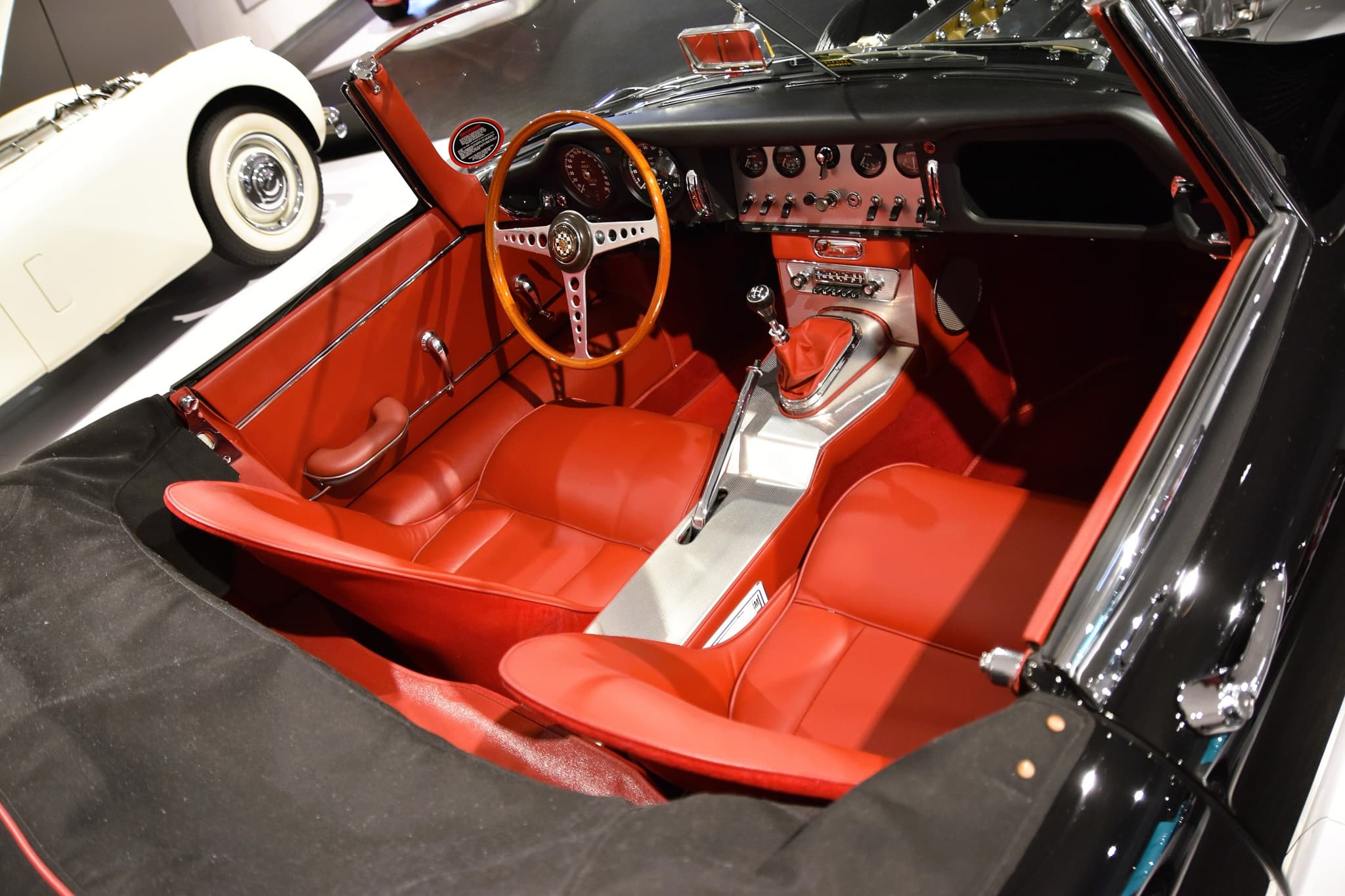
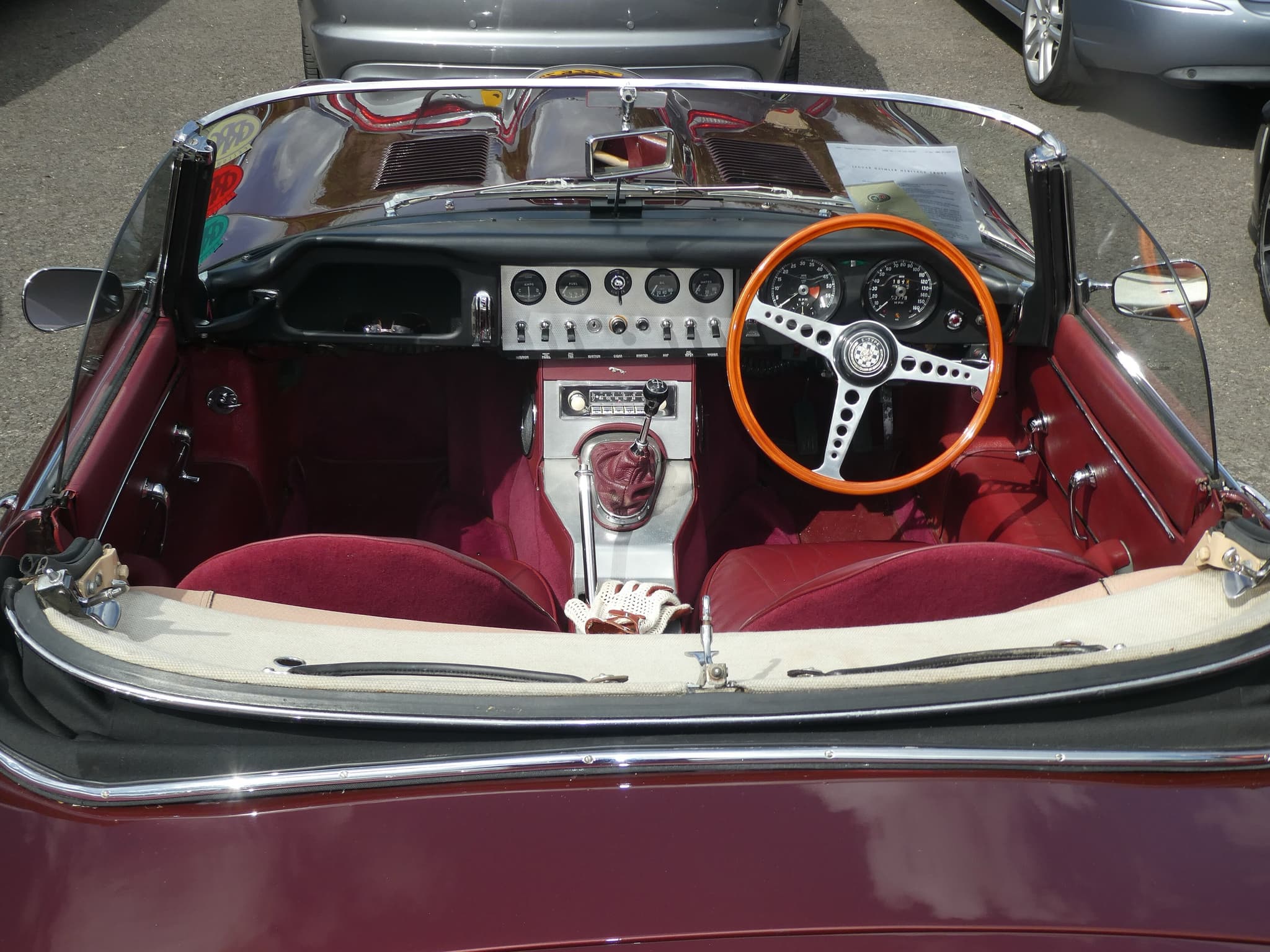
The first E-Type's cockpit was a sports car's: two leather bucket seats, a wood-rimmed wheel adjustable for height and rake, a big speedometer and rev counter in front of the driver, and across an aluminium centre panel a row of small dials and labelled switches. Jaguar spent the next 13 years making it more comfortable, roomier and, in America, safer, and by the V12 of 1971 the cabin was a grand tourer's.source 1source 2source 3
The 3.8, 1961 to 1964
Bill Boddy of Motor Sport described the first cars in April 1961: seats in "Vaumol leather over Dunlopillo foam rubber", a wheel with a wood rim and "triple drilled metal spokes", a Smiths speedometer and a rev counter with a clock set into it, and in the middle "the central engine-turned panel" with gauges for water temperature, oil pressure, fuel and the dynamo's charge. "The engine-turned finish is carried on round the vertical radio panel and along the transmission tunnel." Along the bottom edge of the facia ran a line of lettered flick switches, for wipers, washers, the fan, the lights and the map light, beside the ignition key and a starter button. The coupé had a big luggage floor behind the seats, with a panel that lifted to stop cases sliding forward, reached through its side-hinged rear door.
Car and Driver, testing a roadster at the end of 1961, admired the bucket seats' looks and not much else about them:
Any slouching introduces you to the framework, and it's hard.
Pedal room was "scarce", there were no door pockets and no shelf behind the seats, and the magazine would have liked the tunnel upholstered rather than faced with the "pebble-grained aluminum" of the instrument panel. Denis Jenkinson, who later owned E-Types, "thought the seats were pathetic". Jaguar was already at work: in the car's second year, Motor Sport recalled in 1972, "the seats set back to give more leg room, footwells introduced, and the angle of the brake pedal altered", and in the third year stowage arrived between the seats. The footwells ended the "flat floor" of the first cars, which the 1961 E-Type page describes.source 1source 4source 5source 6
The 4.2 and the 2+2, 1964 to 1968
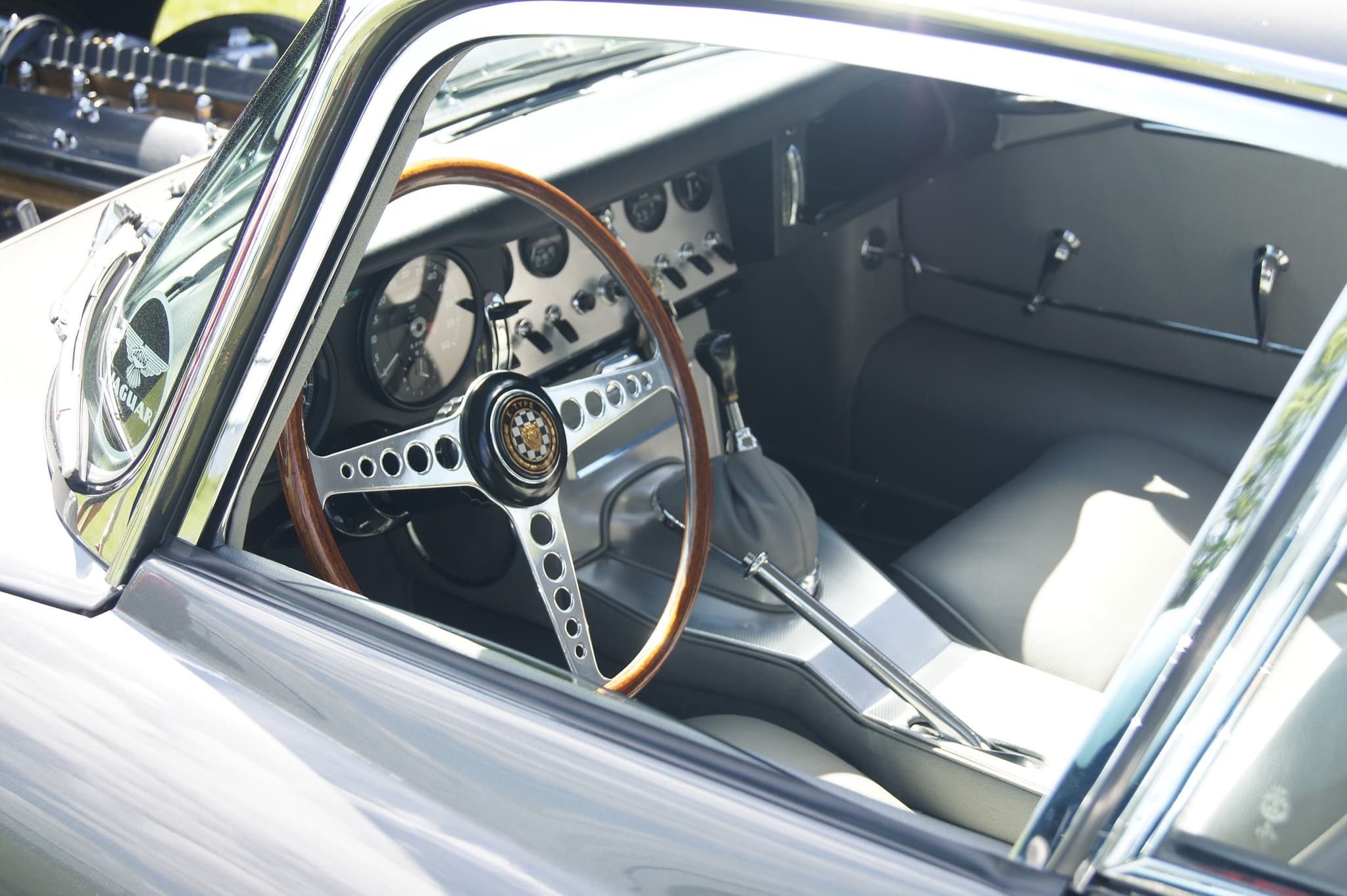
The 4.2 of October 1964 brought new seats, with a curved back that gave, Motor Sport found, "the necessary support in the small of the back which is lacking in the 3.8 model":
The seat, is comfortable over long journeys and the driver does not start to squirm with irritating backache after 100 miles or so.
The thicker seat back made a cramped cockpit more cramped. Tall drivers' legs fouled the wheel rim, the feet did not sit squarely on the clutch and brake, and heat came through the bulkhead and the tunnel. The coupé's rear compartment was trimmed more richly and better sound-proofed. The alternator made a heated rear window worth having, Jenkinson wrote, "an item that is not necessary until you've had the use of one", and he covered his thin wood rim with a leather sleeve because it grew slippery in the heat. He also valued the box between the seats, "enormously useful" on the two-seater.
The 2+2 of 1966 gave the cabin a taller roof, longer doors and a pair of rear seats. The front seats' runners were raised 13 mm (½ in) and the floor lowered to leave room for rear passengers' feet, and the box between the seats was shorter, which Jenkinson thought made it "almost useless". From 1966 the clutch pedal's angle could be adjusted, and in 1967 the hood (soft top) of the open car changed from canvas to a plastic material, Everflex.source 7source 8source 5source 9source 6source 10
The Series 1½ and the Series 2, 1967 to 1970
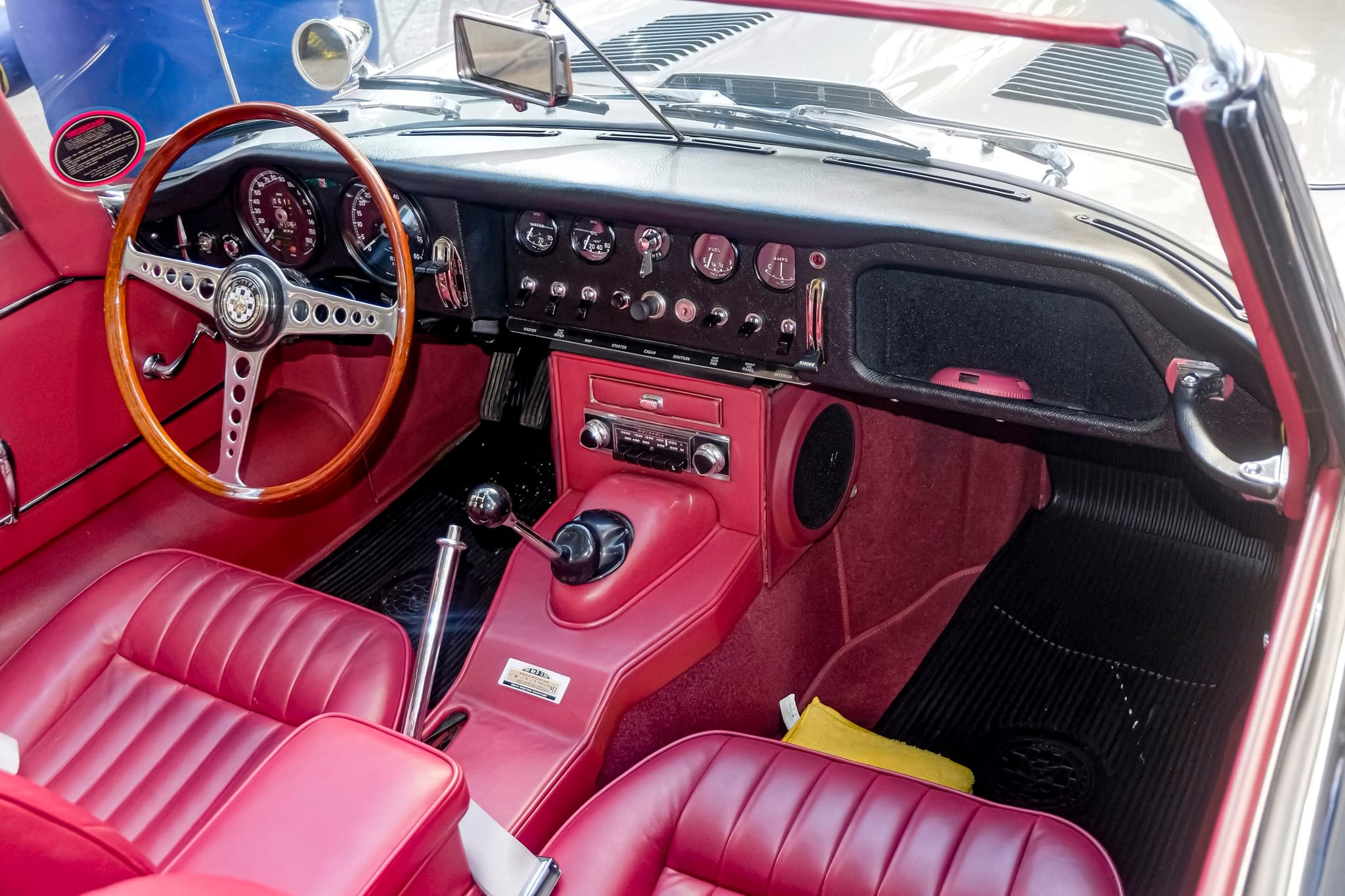
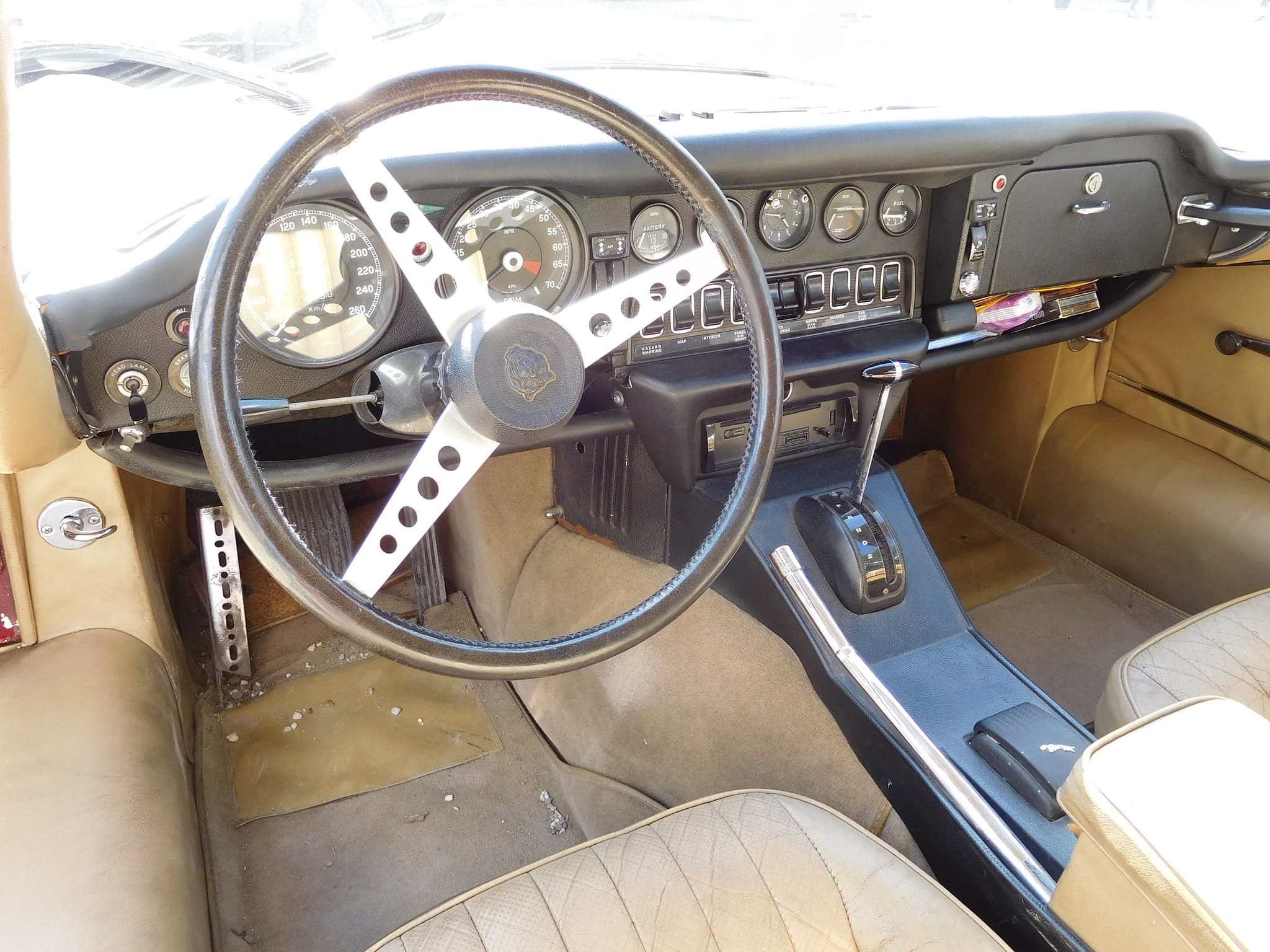
The biggest change to the dashboard came with the rules America brought in for 1968. On the late Series 1 E-Types now called "Series 1½", the Jaguar Clubs of North America list the federal changes inside the car: rocker switches in place of the toggles, recessed door handles, a locking glove box, a hazard-warning switch, the horn and flasher on the indicator stalk, a steering lock, head restraints, shoulder belts, reclining seat hinges, air conditioning as an option, and seat faces of vinyl instead of leather. Which of these reached British cars at the same time, their list does not say.
Jaguar's British brochure for the Series 2 confirms most of them for British cars: "All switches on instrument panel are of the smooth contoured rocker type", with recessed choke and heater controls, a padded screen rail, recessed door handles, a lockable glove box, a single lever for horn, flasher and indicators, and a collapsible steering column with an energy-absorbing sleeve. The seats were still "finest quality Vaumol leather", and the facia and screen rail had a matt finish against reflections. In the 2+2 the top of the rear seat back slid forward to lengthen the boot (trunk) floor, adding a quarter to its luggage space, Jaguar said. Motor Sport's word for the new switches, in 1972, was "tumbler-type".source 2source 10source 6
The Series 3, 1971 to 1974
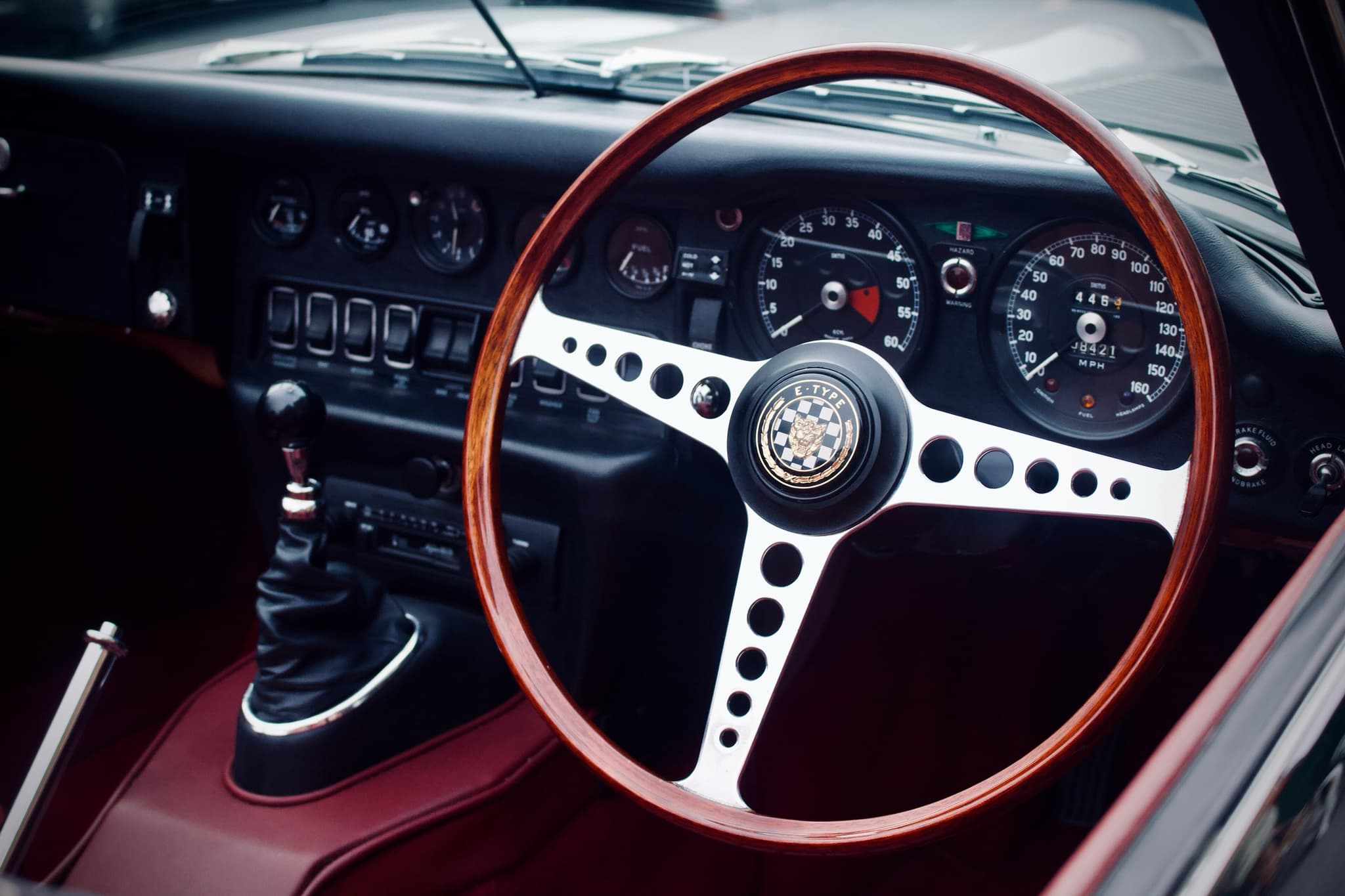
Jenkinson sat in the V12 in 1971 and found only two obvious changes: a rev counter red-lined higher and a smaller steering wheel, dished, with a leather-covered rim. The roadster gained a shelf behind the seats that lifted to reveal compartments on each side of the tunnel. He liked the 2+2's driving position less, "the seat being too high and too flat", and Boddy, testing one in 1972, found it "cramped, with little tight elbow space and no place for the left foot when it is off the clutch pedal", its heater controls fiddly and its minor controls out of date. Its rear seats were "better for children than a couple of adults".
Jaguar's American brochure of March 1971 listed the cabin: "Semi-reclining bucket seats leather-faced with ambla panels on non-wearing surfaces", the rest of the interior trimmed in Ambla, fitted carpet, a lockable glove box and console, inertia-reel belts, and a smaller wheel with "satin-finished aluminum alloy spokes and a rim covered in hand-stitched leather". Air conditioning, a radio and tinted glass were options in America.
The last 50 roadsters, finished in June 1974, carried a plaque on the dashboard with a facsimile of Sir William Lyons's signature, the Jaguar Heritage Trust records; Motor Sport added in 1975 that the last car's plaque was worded differently. The V12 page tells their story.source 11source 6source 3source 12source 13
Trim colours
Jaguar's colour lists name the trim for each paint. In America in December 1961 they were Black, now smooth-grained instead of pebble-grained, Red, Light Blue, Dark Blue, Grey, Tan, Suede Green, Beige and, new that month, Maroon; Biscuit was dropped. By August 1965 Light Tan had joined them, and black trim had become something only E-Type buyers could choose, with three of the paints, a rule the chart for the 1968 model year repeated. For the V12 the American brochure says only that the trim was matched to the paint. Which trim and paint a particular car left the factory with is on its Heritage Certificate, and the colours page sets out Jaguar's lists in full.
Today, Prestige & Performance Car wrote in March 2026, "every piece of hard and soft trim for an E-type cabin is available from specialist suppliers"; the restoration page says what a full retrim involves.source 10source 3source 14
Sources
Sources are given as plain text; their addresses are on the sources page.
- Primarymade at the time, by the maker or by people who were there
- Referenceserious later work: clubs, specialists, magazines, books
- Bill Boddy, "The New 3.8-Litre Jaguar E-Type G.T.", Motor Sport, Apr 1961, p. 35, p. 35, the cockpit; p. 35, the seats, wheel, instruments, switches and luggage space. Primary
- Jaguar Cars Ltd, Coventry, Jaguar "E" Type range Series 2 (sales brochure), UK, 10/1968, the interior equipment; the interior: switches, controls, seats and the 2+2's rear squab. Primary
- British Leyland Motors Inc., Leonia, New Jersey, "The Ultimate Cat": Jaguar V-12 E-type (sales brochure), USA, 1971, the specification page, the interior; the specification page, the seats, trim, wheel and options; the specification page, the interior trim. Primary
- Car and Driver, "Road Research Report: Jaguar XK-E" and "Dual Test: Jaguar XK-E vs. 1962 Corvette", Dec 1961 (vol. 7), the cockpit, the seats, the pedals and the stowage. Primary
- Denis Jenkinson, "Two years with the Jaguar E-type", Motor Sport, Apr 1967, p. 22, p. 22, "the seats were pathetic"; p. 22, the box between the seats, the heated rear window and the wheel rim. Primary
- Bill Boddy, "On the road with the V12 E-type Jaguar", Motor Sport, Jan 1972, p. 36, p. 36, the changes of the second and third years; p. 36, the clutch pedal and the plastic hoods; p. 36, "tumbler-type controls"; p. 36, the 2+2's cabin and controls. Primary
- Motor Sport, "New cars" (Earls Court), Nov 1964, p. 13, p. 13, the new seats. Primary
- Motor Sport, "The 4.2-Litre Jaguar E-type" ("A lengthy road test of the 150 m.p.h. E-Type"), Jan 1965, p. 23, p. 23, the seat, the driving position, the heat and the coupé's rear compartment. Primary
- Bill Boddy and Denis Jenkinson, "The Jaguar E-type 2+2", Motor Sport, Apr 1966, p. 18, p. 18, the 2+2's cabin. Primary
- Jaguar Clubs of North America, Series 1 E-Type Judge's Guide (draft): Appendices, Draft, version of 21 Jul 2026, pp. 167 ff., Appendix D, the change list; Appendix D, the changes to the federal "Series 1½"; Appendix A, Jaguar's colour memo of December 1961, the range of August 1965 and the chart for the 1968 model year. Reference
- Denis Jenkinson, "Driving the V12 Jaguar", Motor Sport, Apr 1971, p. 64, p. 64, the wheel, the rev counter, the luggage shelf and the 2+2's seat. Primary
- Jaguar Daimler Heritage Trust, "1974 Jaguar E-type Series 3 V12 OTS HDU 555N: The Last E-type Built", the plaque on the last 50 cars. Primary
- Motor Sport, "Jaguar E-type: the end of production and end of an era – but not of a legend", May 1975, p. 29, p. 29, the plaques. Primary
- Jamie King, "Jaguar E-type Series 1 and Series 2 buyer's guide", Prestige & Performance Car, 19 Mar 2026, Interior and trim. Reference