Jaguar E-Type Production Figures
About 72,500 E-Types were built between March 1961 and June 1974, but no two sources give the same total. Every figure in print, with what it counts, worked out run by run from the Jaguar Heritage Trust's own car numbers: by series, body, steering side, market and year.
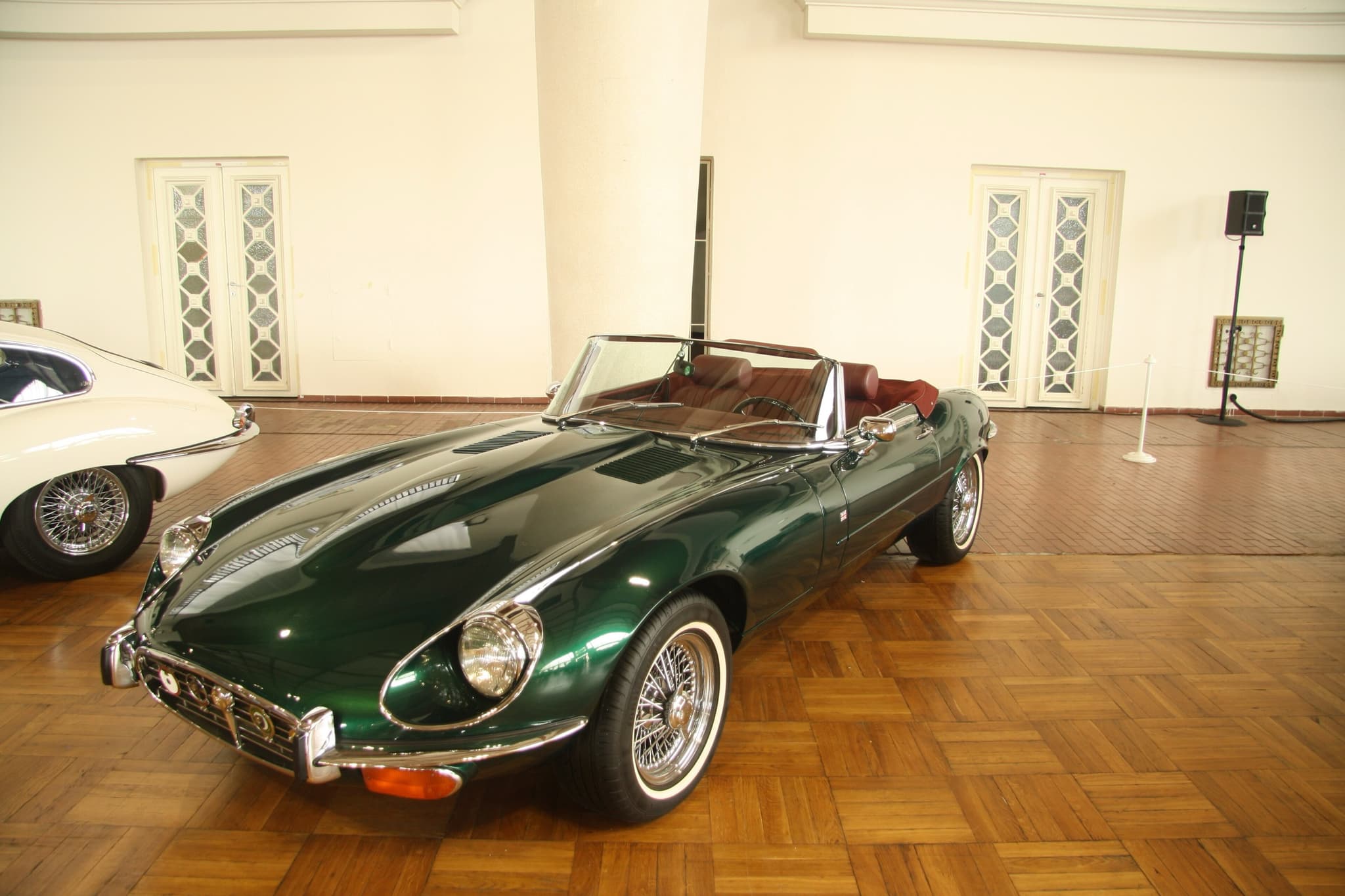
The last E-Type, the black roadster registered HDU 555N, was built on 12 June 1974, and Jaguar kept it. How many came before it is a question with several right answers. The maker's own figures, a register's count and a sum of the factory's car numbers all come to about 72,500, and none of them agrees with another to the car.
They differ because they count different things: cars delivered to markets, cars recorded by series and body, numbers issued on the line. This page sets out each figure with what it counts, then breaks the run down by series, body, steering side, market and year, working from the Jaguar Heritage Trust's list of the first and last car number in every run.source 1source 2source 3source 4
The totals, and what each counts
The figure most often printed is Jaguar's. When the E-Type was withdrawn, Jaguar gave Motor Sport its production split by market, and the magazine opened with it:
In those fourteen years of production, 72,584 E-types have been produced, no less than 85% of which have been exported.
Jaguar's four market figures add up to that total exactly. The share is another matter: the same figures put 60,264 cars abroad, which is 83%, by our arithmetic. The "fourteen years" ran to 1975, when the last cars were registered; building had stopped in June 1974.
The other totals in print:
| Figure | What it counts | Source |
|---|---|---|
| 72,527 | Car numbers issued, first to last, in all 20 runs | Our sum of the Jaguar Heritage Trust's list |
| 72,522 | Jaguar's own four series figures, added up | Our sum of the figures in Motor Sport, 1975 |
| 72,512 | Cars built "From 1961 to 1974", with no breakdown | The Jaguar Heritage Trust's exhibition page, 2021 |
Two more stand, with their sources, in the production chart on the chassis numbers page: the XKEdata register's count of cars built, the only total broken down by series, body and steering side, which comes to 69 cars fewer than Jaguar's; and a figure Motor Sport gave in April 1989, without a breakdown, in a paragraph that also dates the last car to the autumn of 1974, months too late.
The whole spread is 77 cars, about one in a thousand. This site writes "about 72,500".
By series, body and steering side
Jaguar numbered the E-Type in separate runs, one for each series, body and steering side, so the span of each run is a count of the numbers it used. The XKEdata register gives a count of cars built for each run; it does not say where its counts come from, but every one agrees with the Trust's span to within one car, and in 12 runs it is exactly one fewer, which looks like a difference in counting the ends, not in cars.
| Series | Body | Drive | Numbers issued (JDHT) | Built (XKEdata) |
|---|---|---|---|---|
| 3.8 | Roadster | Right | 943 | 942 |
| 3.8 | Roadster | Left | 6,886 | 6,886 |
| 3.8 | Coupé | Right | 1,799 | 1,798 |
| 3.8 | Coupé | Left | 5,872 | 5,872 |
| Series 1 4.2 | Roadster | Right | 1,183 | 1,183 |
| Series 1 4.2 | Roadster | Left | 8,367 | 8,367 |
| Series 1 4.2 | Coupé | Right | 1,958 | 1,958 |
| Series 1 4.2 | Coupé | Left | 5,814 | 5,814 |
| Series 1 4.2 | 2+2 | Right | 1,379 | 1,378 |
| Series 1 4.2 | 2+2 | Left | 4,221 | 4,221 |
| Series 2 | Roadster | Right | 776 | 775 |
| Series 2 | Roadster | Left | 7,853 | 7,853 |
| Series 2 | Coupé | Right | 1,071 | 1,070 |
| Series 2 | Coupé | Left | 3,786 | 3,785 |
| Series 2 | 2+2 | Right | 1,041 | 1,040 |
| Series 2 | 2+2 | Left | 4,287 | 4,286 |
| Series 3 | Roadster | Right | 1,872 | 1,871 |
| Series 3 | Roadster | Left | 6,120 | 6,119 |
| Series 3 | 2+2 | Right | 2,116 | 2,115 |
| Series 3 | 2+2 | Left | 5,183 | 5,182 |
The Series 1 4.2 rows include the late cars now called "Series 1½". Paul Skilleter's book table, which Motor Sport quoted in 1989, gives the 3.8's runs within one car of the register's. One run carries a caution: Anders Clausager's table, as the Jaguar Clubs of North America print it, counts 936 right-hand-drive 3.8 roadsters, with a note that seven numbers in that run were not built and were used later for the Lightweight's continuation series. The same run holds the numbers of the original Lightweights. The car numbers page gives every run's first and last number.
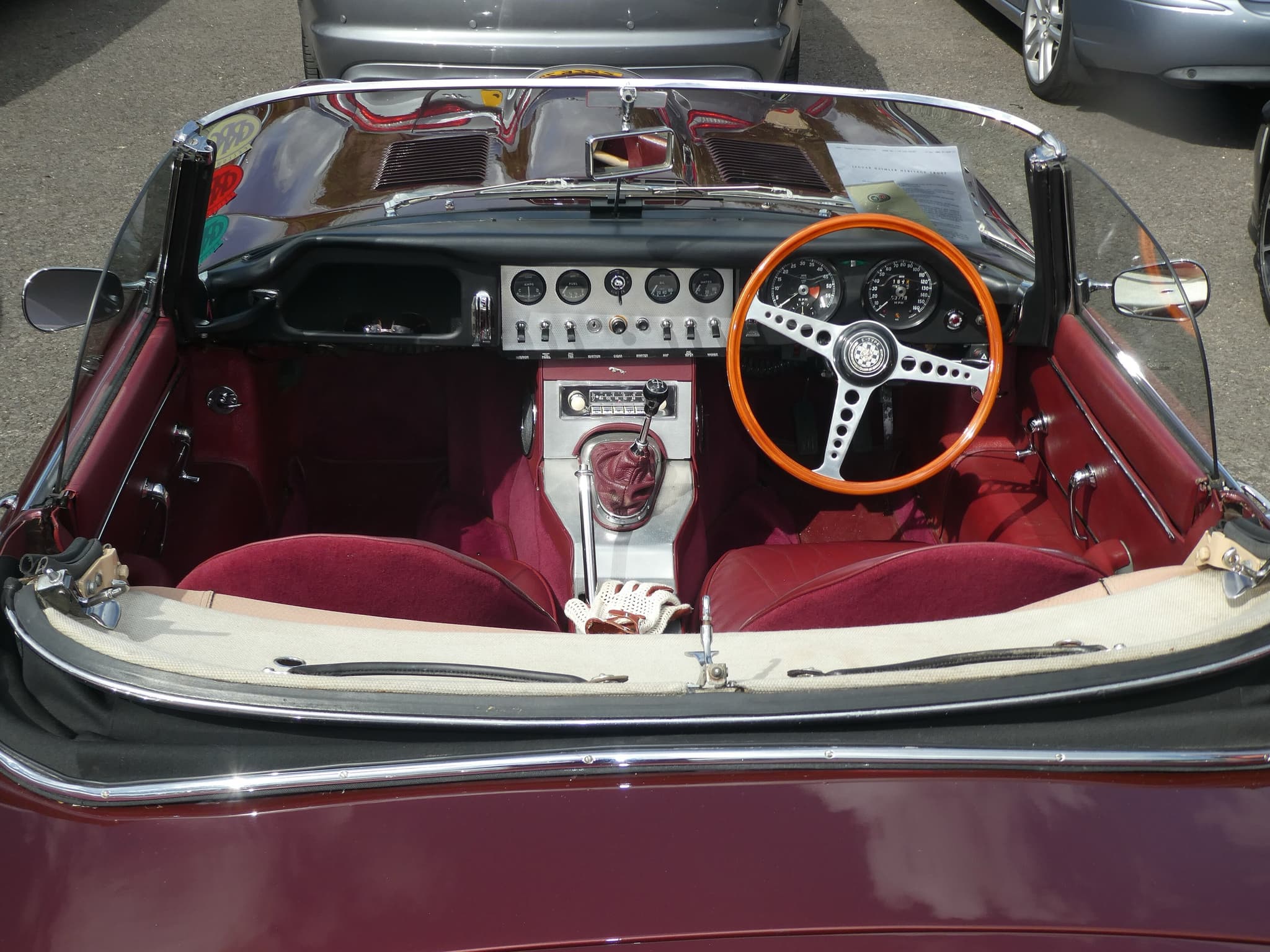
By the register's count, the open two-seater was the commonest body, with 33,996 built in all four series, against 20,297 coupés, which ended with the Series 2, and 18,222 of the 2+2. Left-hand-drive cars came to 58,385, four in five of the whole, and right-hand-drive cars to 14,130.source 1source 3source 7source 6source 8
By series
| Series | Built | Note |
|---|---|---|
| 3.8, 1961–64 | About 15,500 | Jaguar's figure counts cars "sold" |
| Series 1 4.2, 1964–68 | About 22,900 | Jaguar's includes the "Series 1½" cars |
| Series 2, 1968–70 | About 18,800 | Jaguar dates it "1968 and 1971" |
| Series 3 V12, 1970–74 | About 15,300 | Roadster and 2+2 only |
Each series's page sets Jaguar's own figure beside the register's. The two kinds of source agree to within a few dozen cars for every series, and neither is exact. Jaguar's 1975 list uses three verbs, "sold" for the 3.8 and "built" or "constructed" for the rest, and its Series 2 dates run to 1971, an American model year: the last Series 2 cars were numbered in October 1970, and some late American ones carry a 2R prefix inside the ordinary runs, so they are not counted twice.
The "Series 1½" is the hardest to count, because it was never a factory series. The register counts it from the open-headlamp change of 1967, which Jaguar's bulletins date by car number; counted instead from the American cars' Zenith-Stromberg carburettors, which began at the numbers in the Trust's "September 1967" row, it comes to a few hundred fewer cars. The Series 2 page explains the name.source 2source 3source 1source 9
By market
| Market | Cars | Share |
|---|---|---|
| United States | 49,032 | 67.6% |
| Canada | 2,439 | 3.4% |
| Other export markets | 8,793 | 12.1% |
| Britain | 12,320 | 17.0% |
These are Jaguar's figures as Motor Sport printed them in 1975, "only 12,320 being retained for home consumption", and the shares are our arithmetic. About two in three E-Types went to the United States, nearly 71 in 100 to North America. Jaguar's figures say where the cars went over the whole run; in a single year the share could be higher, and Denis Jenkinson reported in April 1971 that 78% of the new V12s were going to America.
The register's steering-side counts make a cross-check. Suppose every American, Canadian and British car was built with its market's steering. Then about 6,900 left-hand-drive cars and about 1,800 right-hand-drive cars remain for the other export markets, 8,724 in all against Jaguar's 8,793: a difference of 69 cars, exactly the gap between the two sources' totals, by our arithmetic. The two counts reconcile to the car.
The around the world page says what the export cars were, and Jaguar XKE tells the American story.source 2source 3source 10
Production by year
The Jaguar Heritage Trust gives the first car number of each year in every run, so the numbers issued in each calendar year can be worked out, run by run. The result below is our arithmetic, and it counts numbers, not finished cars. The Trust itself calls its change points approximate, a guide only.
| Year | Numbers issued | What was being built |
|---|---|---|
| 1961 | 2,328 | 3.8 roadsters and coupés from March |
| 1962 | 6,264 | The 3.8's best year |
| 1963 | 4,206 | 3.8 |
| 1964 | 3,810 | 3.8 to August (2,702), 4.2 from August (1,108) |
| 1965 | About 5,310 | 4.2; the first 2+2 cars from September |
| 1966 | 6,957 | 4.2 |
| 1967 | 4,969 | 4.2; open headlamps from the middle of the year |
| 1968 | 7,416 | Series 1 to July (4,575), Series 2 from August (2,841) |
| 1969 | 10,164 | Series 2: the peak year |
| 1970 | 6,400 | Series 2 to October (5,809); the first Series 3s (591) |
| 1971 | 3,414 | Series 3 |
| 1972 | 4,330 | Series 3 |
| 1973 | 5,087 | Series 3; the last 2+2 cars in July and August |
| 1974 | 1,869 | Series 3 roadsters, to June |
The rows add up to the 72,527 numbers issued. The 1965 and 1966 rows rest on the year table of Alan Karpovitch, in the Jaguar Clubs of North America's judges' guide, which also marks seven numbers in 1963 and two in 1965 as allocated but never built.
In 1969, the first full year of the Series 2, Jaguar numbered more E-Types than in any other year, and left-hand-drive roadsters were the largest single part of it. From the summer of 1973, when the last 2+2 cars were built, the roadster carried the car alone.source 1source 9source 11
Small runs and milestones
- Outside bonnet (hood) latches
- 500the first cars of both bodies, 1961
- Flat floors
- 2,616to early 1962
- Commemorative roadsters
- 50the last V12 roadsters, 1974
Jaguar's own service bulletins, as the Jaguar Clubs of North America reproduce them, give the first two. The outside bonnet latches were fitted to the first 91 right-hand-drive and 385 left-hand-drive roadsters and the first four and 20 coupés, and moved inside in October 1961; every one of those cars also had the flat floor, which ended with the footwells of early 1962. The 1961 E-Type tells their story. Of the last 50 roadsters, 49 were black and one green.
Some counts are not published at all. No source read gives the number of automatics built, though each carries the letters BW after its car number. The six-cylinder Series 3 was announced in 1971 but "only one example was ever built specifically as such", Motor Sport wrote in 1975, "though at least three more were converted from V12s in the Jaguar Experimental Department". The last 2+2 cars were numbered in July 1973 for left-hand drive and August for right; the last roadsters, and the last E-Type, in June 1974.
On 15 October 2026 the XKEdata register held entries for more than a third of the cars it counts as built. That is a register's count of cars someone has recorded, not a census of survivors, but it shows how many of these cars are still known by their numbers.source 8source 2source 4source 12source 1source 3
Sources
Sources are given as plain text; their addresses are on the sources page.
- Primarymade at the time, by the maker or by people who were there
- Referenceserious later work: clubs, specialists, magazines, books
- Jaguar Daimler Heritage Trust, Research Guide No. 001F: Chassis Number Runs and Change Points by model – Jaguar E-type, Issue 3, January 2023, pp. 1–2, the car-number runs and the caveat; pp. 1–2, first and last car numbers of each run; pp. 1–2, the 20 runs; pp. 1–2, the spans; the September 1967 row; the 2R cars; pp. 1–2, the first car number of each year in each run; the caveat; p. 2, the last 2+2 cars and roadsters; the BW suffix. Primary
- Motor Sport, "Jaguar E-type: the end of production and end of an era – but not of a legend", May 1975, p. 29, p. 29, Jaguar's figures; p. 29, the totals by market and by series, and "Discrepancies in the totals above"; p. 29, the series figures; p. 29, "Of the total, 49,032 went to the USA …"; p. 29, the Series 3 six and the last 50 roadsters. Primary
- XKEdata (xke.collectordata.com), "Statistics", the statistics table, "Built" columns; the statistics table, Totals row; the statistics table, by series, body and drive side; the statistics table, series rows; Totals row, left- and right-hand drive; the recorded cars, 15 October 2026. Reference
- Jaguar Daimler Heritage Trust, "1974 Jaguar E-type Series 3 V12 OTS HDU 555N: The Last E-type Built", the last car, built on 12 June 1974; the last car and the Commemorative roadsters. Primary
- Jaguar Daimler Heritage Trust, "E-Type Evolution Exhibition", "From 1961 to 1974". Reference
- William Kimberley, "The Jaguar E-Type 3.8, 4.2 & V12", Motor Sport, Apr 1989, p. 81, p. 81, "examples of all series"; p. 81, Skilleter's figures for the 3.8. Reference
- Paul Skilleter, Jaguar Sports Cars, Haynes (first published by G. T. Foulis, 1975), 1988 reprint, 1975, the production table, as quoted in *Motor Sport*, April 1989. Reference
- Jaguar Clubs of North America, Series 1 E-Type Judge's Guide (draft), part 1: Intro–Exterior, Draft, version of 21 Jul 2026, p. ii, the production table after Clausager; pp. 5 and 9, Service Department Bulletins P.46 and P.51. Reference
- Jaguar Clubs of North America, Series 1 E-Type Judge's Guide (draft): Appendices, Draft, version of 21 Jul 2026, pp. 167 ff., Appendix B, Karpovitch's 1968 Series 1½ total; Appendix D, the change points; Appendix B, Karpovitch's year table and the numbers not built. Reference
- Denis Jenkinson, "Driving the V12 Jaguar", Motor Sport, Apr 1971, p. 64, p. 64, "78% of the V12 cars". Primary
- François Prins, "Evolution of the E-Type", Jaguar Daimler Heritage Trust, "E-Type Production": the cars that had left the factory by the end of 1961. Reference
- Bill Boddy, "On the road with the V12 E-type Jaguar", Motor Sport, Jan 1972, p. 36, p. 36, the changes of the first year: the bonnet catches moved inside. Primary