Jaguar E-Type Prototypes
Before the E-Type there were E1A, a small aluminium test car of 1957; the development cars of 1958–61; and E2A, the racing prototype of 1960, which survives.
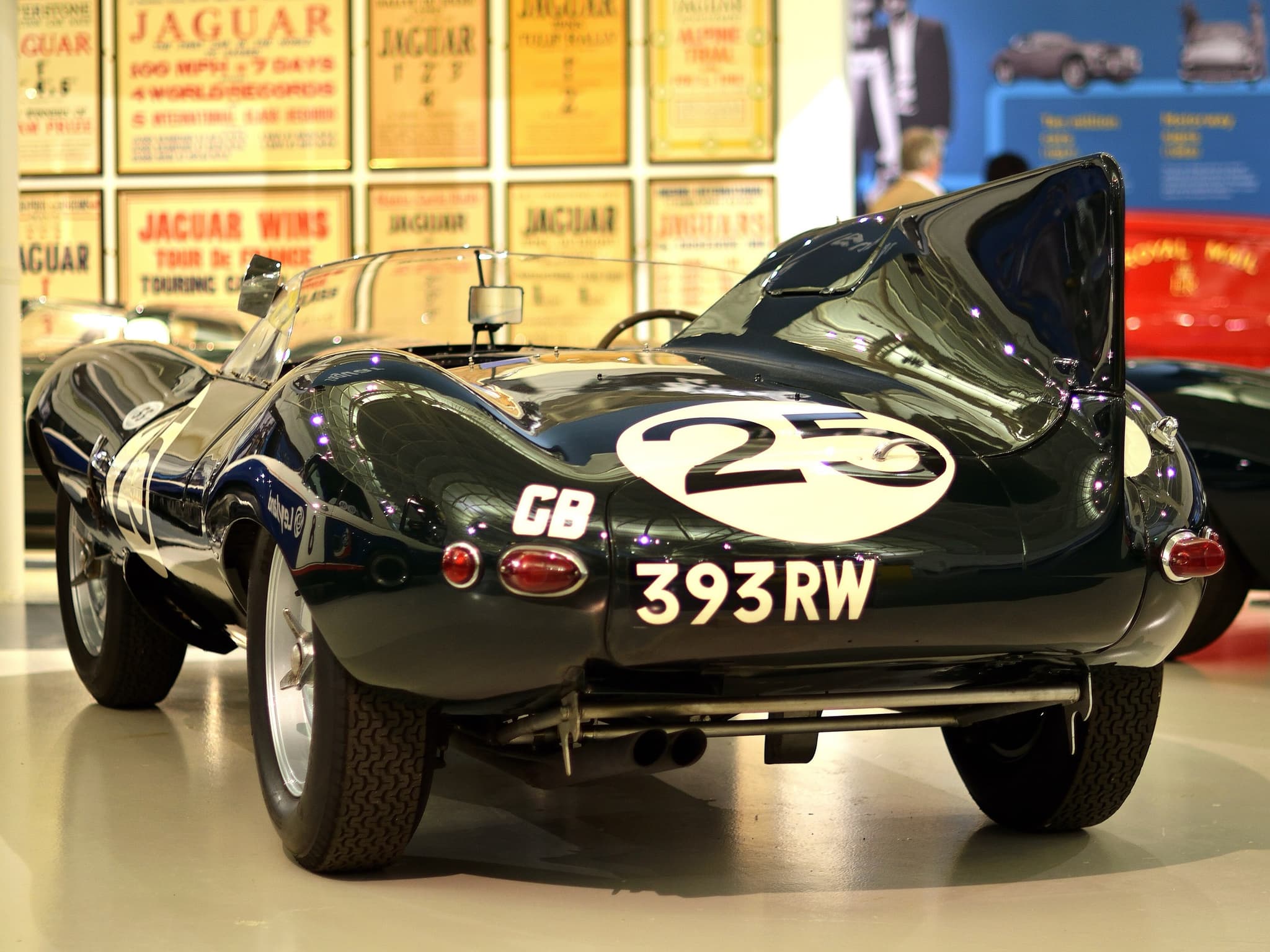
About the pictureA Jaguar D-type, the E-Type's racing ancestor, not one of the prototypes
On 15 May 1957 a small aluminium car was running at Jaguar's Browns Lane works in Coventry. Two days later William Heynes drove it 40 km (25 miles) on trade plates, and that evening Sir William Lyons took it out himself. Nine days after it first ran, Norman Dewis had it at MIRA, still unpainted. In the works it was called E1A.
The E-Type came out of three kinds of experimental car: E1A in 1957–58; the development cars of 1958–61, which led to production; and E2A, a racing car of 1960. Of the two experimental cars only E2A survives; of the development cars, the coupé 885002 does. Their engineers and stylists are on the people page, and the story they led to on the history page.source 1source 2source 3
E1A, 1957–58
The idea began in January 1956, as a replacement for the D-type. Heynes gave the work to Tom Jones, with Malcolm Sayer drawing the body. A first all-aluminium car, with a small XK engine and an early independent rear suspension, ran but was never finished and was broken up, and the Trust knows of no photograph of it. That rests on one account: Norman Dewis recalled it to the Jaguar Heritage Trust.
E1A followed. Bob Blake built its body early in 1957 on chassis XK 101, to Sayer's drawings of the previous December: a small two-seater with a D-type-style central tub, a bolted-on front frame, a six-cylinder XK engine and Bob Knight's independent rear suspension.
- 1957
First run
Running at Browns Lane on 15 May; Heynes and Lyons drive it on the 17th.
- 1957
MIRA
Dewis tests it on 24 May, unpainted. It is then painted Pastel Green and registered VKV 752, and in June he averages about 177 km/h (110 mph) on the banking.
- 1958
The Motor
In May its editor, Christopher Jennings, borrows it, by then with a larger engine; Mike Hawthorn's report follows in July.
- 1958
Last test
The final test note, on 3 December, reads "Tests abandoned because of bad weather."
- 1958
Broken up
The car is broken up at the end of 1958 or early in 1959.
Its chief lesson was the rear suspension. Bolted straight to the body, it passed noise and vibration through the whole car, so Heynes and Knight put it in a rubber-mounted cage of its own, as the production E-Type has it. E1A's registration did not disappear with it: VKV 752 passed to E2A by April 1960, and E2A wears it today.source 1source 2source 4
Was E1A the E-Type prototype?
There was no designation given to this model and it was generally referred to in-house as ' E1A ' (E for Experimental Type 1 A for Aluminium or Alloy) ; the name stuck and was shortened to 'E-type' by the workers and thus it has been spuriously credited as the 'Prototype E-Type'.
It was an experimental test car, the E-Type's forerunner, not its prototype. The Trust gives "E" two readings: the letter after D, and "Experimental".source 1source 2
The development cars, 1958–61
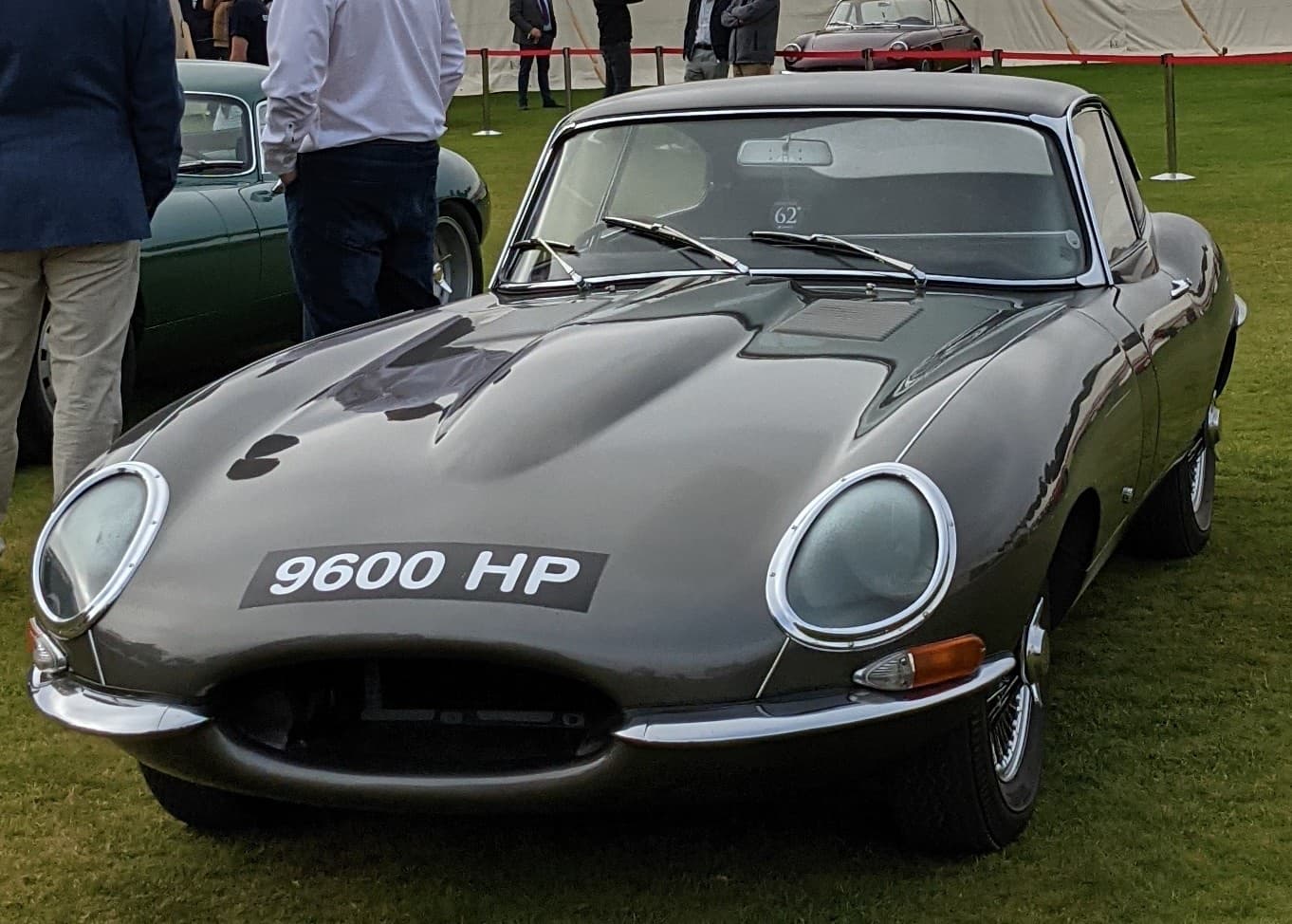
The cars that led to production followed E1A. A plywood-and-metal mock-up was turned into a running car within a week and tested from 20 March 1958; Dewis said it "shook and rattled". The first car with a production chassis number, 850001, painted Cotswold Blue, was on test at MIRA by June 1959, a third prototype joined in October 1959, and a red pre-production roadster, 850002, ran at MIRA in June 1960. By July 1960 two coupés and two roadsters were on test, and the coupé prototype 885002, the Trust's "FHC Prototype No 7", was registered 9600 HP on 10 February 1961 and became the Geneva press car.
The others did not last. One coupé was destroyed on MIRA's pavé, and the prototype roadsters were scrapped by early 1961. 885002 survives. The cars that launched the E-Type in March 1961, 9600 HP, the display coupé 885005 and the roadster 77 RW, are on the 1961 page.source 2source 5
E2A, 1960
E2A was a racing car, built by the Experimental Department from 1 January 1960 and ready for the road on 27 February: a D-type-like body with a longer nose, independent rear suspension and a fuel-injected aluminium-block XK engine. It was 3rd at the Le Mans test day in April, unpainted and carrying VKV 752. Jaguar then lent it, never sold it, to Briggs Cunningham, who raced it at Le Mans in June, where it retired after 89 laps, and in America from August to October, where it won at Bridgehampton.
Back at Jaguar it was used for trials of Dunlop's Maxaret anti-lock brakes, and according to the Trust it lapped MIRA in 1966, painted green, as a decoy for the secret XJ13. Jaguar sold it in the late 1960s. The Trust showed it in its 60th-anniversary exhibition in 2021.source 3source 6source 7source 8source 9
Before and after
E1A's line ran back through the D-type of 1954–56 and the XK-SS of 1957, whose planned run was cut short by the Browns Lane fire in February 1957. Its successor was the production E-Type, shown at Geneva in March 1961.
E2A's rivals at Le Mans in 1960 were the works Ferrari Testa Rossas and the Maserati "Birdcages". In practice Walt Hansgen lapped E2A in 4 minutes 8.4 seconds; Phil Hill's Ferrari did it in 3 minutes 58.5 seconds. The racing car lost to them.source 1source 2source 3
Sources
Sources are given as plain text; their addresses are on the sources page.
- Referenceserious later work: clubs, specialists, magazines, books
- Databaseresults and listings, entry by entry
- François Prins, "The Story of the E1A: The Experimental Car That Preceded The E-Type", Jaguar Daimler Heritage Trust. Reference
- François Prins, "Evolution of the E-Type", Jaguar Daimler Heritage Trust, First Thoughts; The Next Prototypes; the Geneva cars. Reference
- François Prins and Tony Merrygold, "The Story of the E2A: E for Exciting Experiment", Jaguar Daimler Heritage Trust, Le Mans practice. Reference
- Simon Taylor, "Lunch with… Norman Dewis", Motor Sport, Apr 2013, p. 86. Reference
- Jaguar Clubs of North America, Series 1 E-Type Judge's Guide (draft), part 1: Intro–Exterior, Draft, version of 21 Jul 2026, Pre-production E-Types. Reference
- racingsportscars.com, "Jaguar E 2A – All Results". Database
- racingsportscars.com, Le Mans 24 Hours 1960, results, No. 6. Database
- Motor Sport, News item on E2A, the 1960 Le Mans prototype, Aug 2008, p. 116, p. 116. Reference
- Jaguar Daimler Heritage Trust, "E-Type Evolution Exhibition". Reference