Malcolm Sayer and the Jaguar E-Type
The aerodynamicist who drew the E-Type's body, as he had drawn the C-type's and the D-type's, by calculation rather than sketches, at Jaguar from 1950 until his death in 1970.
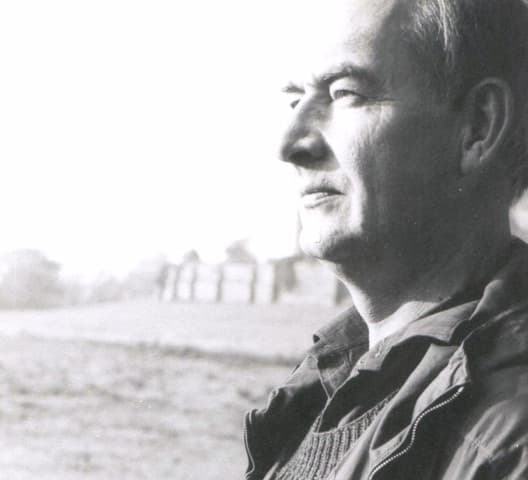
Norman Dewis remembered the walls of Malcolm Sayer's office at Jaguar: big sheets, three feet by eight, covered in coloured curves. "No one else could see it," he told Jaguar World in 2015, "but he knew it was there." What Sayer saw in his tables of numbers became the shapes of the C-type, the D-type and the E-Type.
His dates and two of his roles are in the panels on this page. Below are his road to Jaguar, how he worked, and the question his name answers: who designed the E-Type.source 1source 2
From aircraft to Jaguar
Sources for Malcolm Sayer
François Prins, "The Story of the E1A: The Experimental Car That Preceded The E-Type", Jaguar Daimler Heritage Trustsource 3; Christopher Mount, Refining the Sports Car: Jaguar's E-Type (exhibition brochure), The Museum of Modern Art, New York, Exhibition 282, 1996source 2; Jaguar World (Kelsey Media), "Sentimental journey" (contents: "Malcolm Sayer tribute"), Nov 2015, pp. 42–49source 1; François Prins, "Evolution of the E-Type", Jaguar Daimler Heritage Trustsource 4; Jaguar Daimler Heritage Trust, "1963 Jaguar E-type Series 1 Coupé YKE 374A"source 5; Damien Smith, "Cut and pace", Motor Sport, Mar 2005, p. 86source 6; Matthew Franey, "Cd Players", Motor Sport, Oct 1998, p. 74source 7; Alan Griffin, "Malcolm Sayer – Aerodynamicist and Designer of Jaguar cars", Leamington History Group, Mar 2014source 8; The Museum of Modern Art (GitHub: MuseumofModernArt/collection), MoMA collection research dataset: Artists.csvsource 9; Keith Howard, "X-ray spec: Jaguar XJ13", Motor Sport, Nov 2003, p. 69source 10; Clive Richardson, "The Jaguar XJ-S" ("A New Breed of Cat"), Motor Sport, Oct 1975, p. 26source 11
Sayer studied aeronautical and automotive engineering at Loughborough College and in 1938 went to the Bristol Aeroplane Company at Filton, where he worked through the war. In the late 1940s he went to Baghdad to teach engineering. In 1950 he joined Jaguar, after an interview with its chief engineer, William Heynes, whose recollection Jaguar World gives: "I quite took to him and said, 'Yes, we'll give you a job'".
His first Jaguar shapes were racing ones. He drew the C-type's body for its tubular frame, and the bubble canopy and undertray that helped Dewis to his record at Jabbeke in a modified XK120 in 1953 were his idea. Then came the D-type, the Le Mans winner, and from it, through the experimental cars E1A and E2A, the E-Type (the prototypes page has them). Another aerodynamicist gave him his place in 1984:
The first serious aerodynamicist was Malcolm Sayer, of Jaguar, another ex-aircraft man.
How he worked
MoMA's curator put the difference in one sentence.
Unlike most car designers, Sayer did not draw first, but instead used paper only to record long lists of numbers.
The engineers gave him four fixed dimensions, height, length, width and ground clearance, and he calculated the body's curves as ellipses, passing the co-ordinates to the men who shaped the panels. Tom Jones, of Jaguar's styling department, told MoMA that Sayer "kept his mathematical formula for design a secret and in fact died before anyone else learned it". Sayer himself claimed to have learned it from a German professor while teaching in Iraq; Jaguar World noted in 2015 that the story cannot be confirmed. Bob Knight, the suspension engineer, put the principle more simply to MoMA: "Proportions are the first necessity. If the proportions are wrong, you might as well go home."
He disliked being called a stylist; his family's site gives his retort, "I'm not a hairdresser!" He tested what he calculated. Models went into wind tunnels, the D-type into the big tunnel at the Royal Aircraft Establishment, Farnborough, and at MIRA he taped wool tufts to the bodywork and watched them from a second car.source 2source 1source 10source 14
Who designed the E-Type?
The shape was Sayer's. Jaguar said so at the 50th anniversary in 2011, and MoMA in 1996. But three other hands are on the car, and the honest answer names them.
The engineering was done by the team under William Heynes. Motor Sport credited Heynes's design team when it introduced the car in April 1961, and Bob Knight designed its independent rear suspension.
The last word on its looks was Sir William Lyons's. MoMA wrote that Lyons "maintained for himself the title of Chief Stylist, which assured him final authority on all designs", and Motor Sport in 2007 called the outline "Malcolm Sayer-penned, Sir William Lyons-refined".
The coupé came by another route. The fixed-head coupé's roof and tailgate began as Bob Blake's mock-up, which Lyons approved and refined; Sayer then drew the production shape. That account is the Jaguar Heritage Trust's, which quotes Blake that Sayer "later drew the shape … and corrected all my errors".
MoMA's own record of its E-Type credits three men: Lyons, Sayer and Heynes.
After the E-Type
Sayer did not like everything that followed. MoMA judged that the later cars, the 2+2 and the Series 2 and 3, deviated "increasingly from Sayer's original design", and his daughter remembered his reaction to the bulge a bigger engine needed in the bonnet (hood): "It's not supposed to be there!"
He went on working on low-drag shapes: the factory's Low Drag Coupé of 1962, and the mid-engined XJ13, his last racing shape. He made the first studies for the car that became the XJ-S. He died in Leamington Spa on 22 April 1970, before the Series 3 E-Type was announced, and Motor Sport called the XJ-S, in 1975, his "last styling monument".
I still class Malcolm Sayer as one of the best aerodynamicists we've ever had in this country.
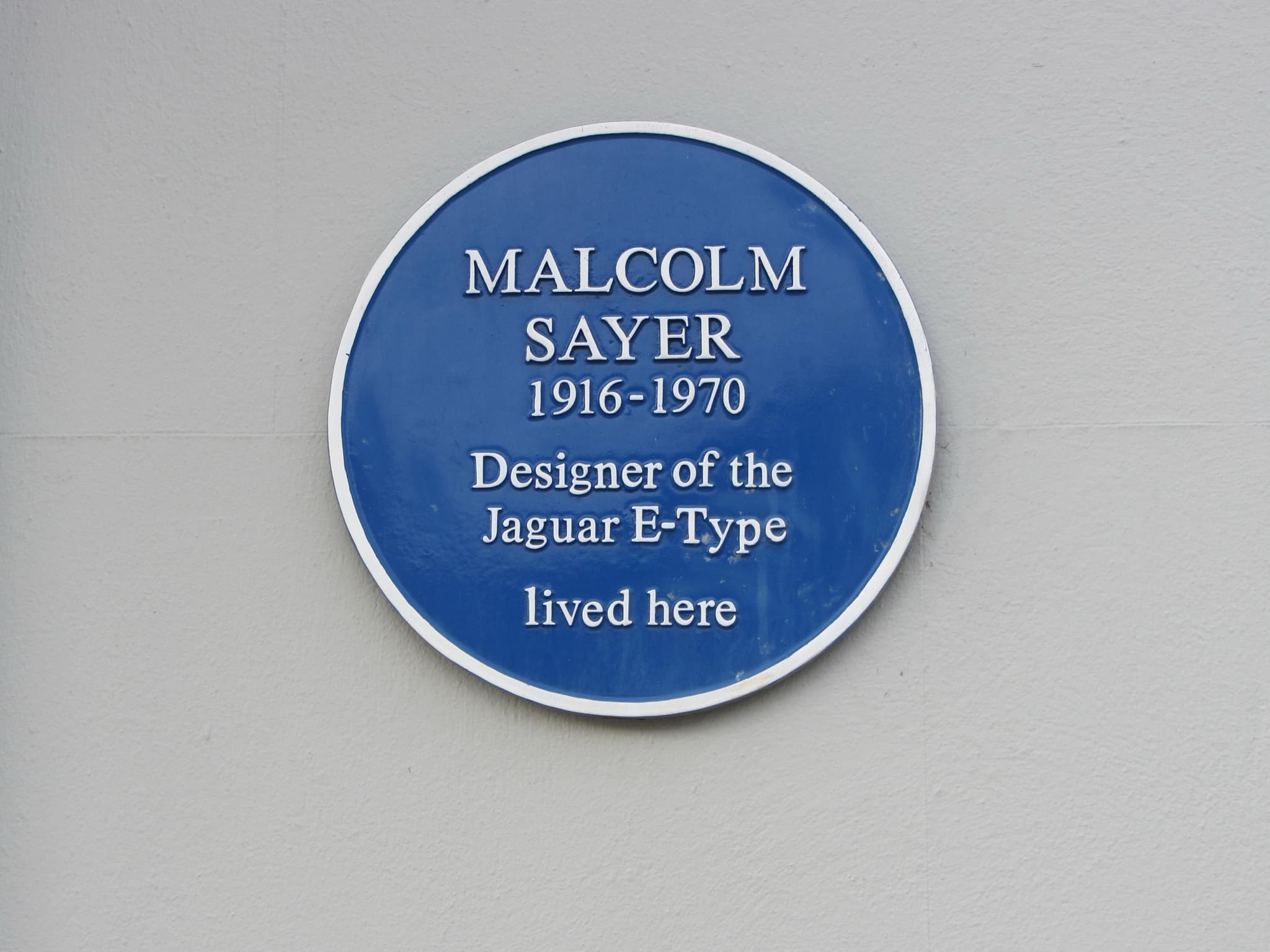
A blue plaque marks his home in Leamington Spa, and a plaque marks his birthplace in Cromer (2008).source 1source 2source 6source 10source 16source 11source 8
Roles
- 1956
Aerodynamicist
December 1956. Drew the body of E1A, the experimental car of 1957, from December 1956, in the style of his D-type, according to the Jaguar Daimler Heritage Trust
François Prins, "The Story of the E1A: The Experimental Car That Preceded The E-Type", Jaguar Daimler Heritage Trustsource 3
- 1962
Sources
Sources are given as plain text; their addresses are on the sources page.
- Primarymade at the time, by the maker or by people who were there
- Referenceserious later work: clubs, specialists, magazines, books
- Jaguar World (Kelsey Media), "Sentimental journey" (contents: "Malcolm Sayer tribute"), Nov 2015, pp. 42–49, Dewis on the sheets of curves; pp. 42–49. Reference
- Christopher Mount, Refining the Sports Car: Jaguar's E-Type (exhibition brochure), The Museum of Modern Art, New York, Exhibition 282, 1996, exhibition essay; Tom Jones and Bob Knight, January 1996. Reference
- François Prins, "The Story of the E1A: The Experimental Car That Preceded The E-Type", Jaguar Daimler Heritage Trust, 1956–57. Reference
- François Prins, "Evolution of the E-Type", Jaguar Daimler Heritage Trust, the fixed-head coupé; the coupé: Bob Blake's account. Reference
- Jaguar Daimler Heritage Trust, "1963 Jaguar E-type Series 1 Coupé YKE 374A", introduction. Primary
- Damien Smith, "Cut and pace", Motor Sport, Mar 2005, p. 86, the low-drag project. Reference
- Matthew Franey, "Cd Players", Motor Sport, Oct 1998, p. 74, the low-drag project. Reference
- Alan Griffin, "Malcolm Sayer – Aerodynamicist and Designer of Jaguar cars", Leamington History Group, Mar 2014, biography. Reference
- The Museum of Modern Art (GitHub: MuseumofModernArt/collection), MoMA collection research dataset: Artists.csv, Sayer row. Reference
- Keith Howard, "X-ray spec: Jaguar XJ13", Motor Sport, Nov 2003, p. 69, p. 69. Reference
- Clive Richardson, "The Jaguar XJ-S" ("A New Breed of Cat"), Motor Sport, Oct 1975, p. 26, p. 26. Primary
- Simon Taylor, "Lunch with… Norman Dewis", Motor Sport, Apr 2013, p. 86, Jabbeke. Reference
- Jaguar Land Rover (Jaguar media newsroom), "'Hello, My Name Is Sayer. I Am the Steering Wheel of the Future'" (press release), 4 Sep 2017. Primary
- Malcolm Sayer Foundation (the Sayer family; malcolmsayer.com), Malcolm Sayer: home page and biography ("Malcolm Sayer"), the biography page. Reference
- Mike Lawrence, "The Cars of Frank Costin", Motor Sport, Sep 1984, p. 35. Reference
- Jaguar Daimler Heritage Trust, "Swallow Sidecar Company Centenary 100 Facts Exhibition", 2022, fact 34; fact 53. Primary
- Jaguar Land Rover (Jaguar media newsroom), "Jaguar Celebrates 50 Years of Iconic E-type" (press release), 24 Jan 2011. Primary
- Bill Boddy, "The New 3.8-Litre Jaguar E-Type G.T.", Motor Sport, Apr 1961, p. 35, p. 35. Primary
- Richard Heseltine, "Jaguar E-type", Motor Sport, Mar 2007, p. 80. Reference