Jaguar E-Type Low Drag Coupe
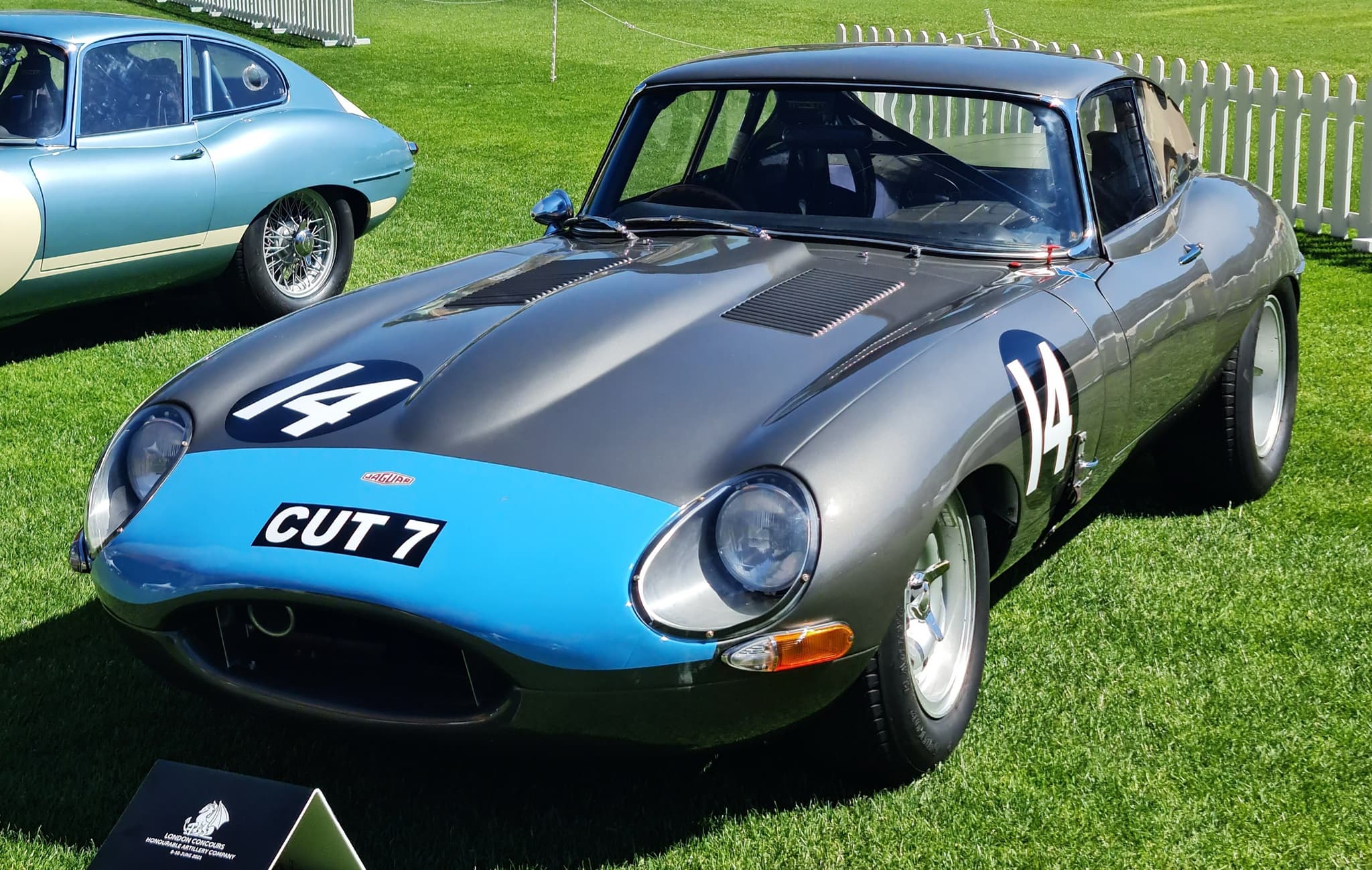
Malcolm Sayer's racing E-Type of 1962, built by the factory with a lower roof, a new tail and a lighter steel body, then sold to Dick Protheroe, who raced it as CUT 7 in 1963 and 1964. Other cars called "low drag" are Lightweights rebodied in 1964, recreations, or Eagle's.
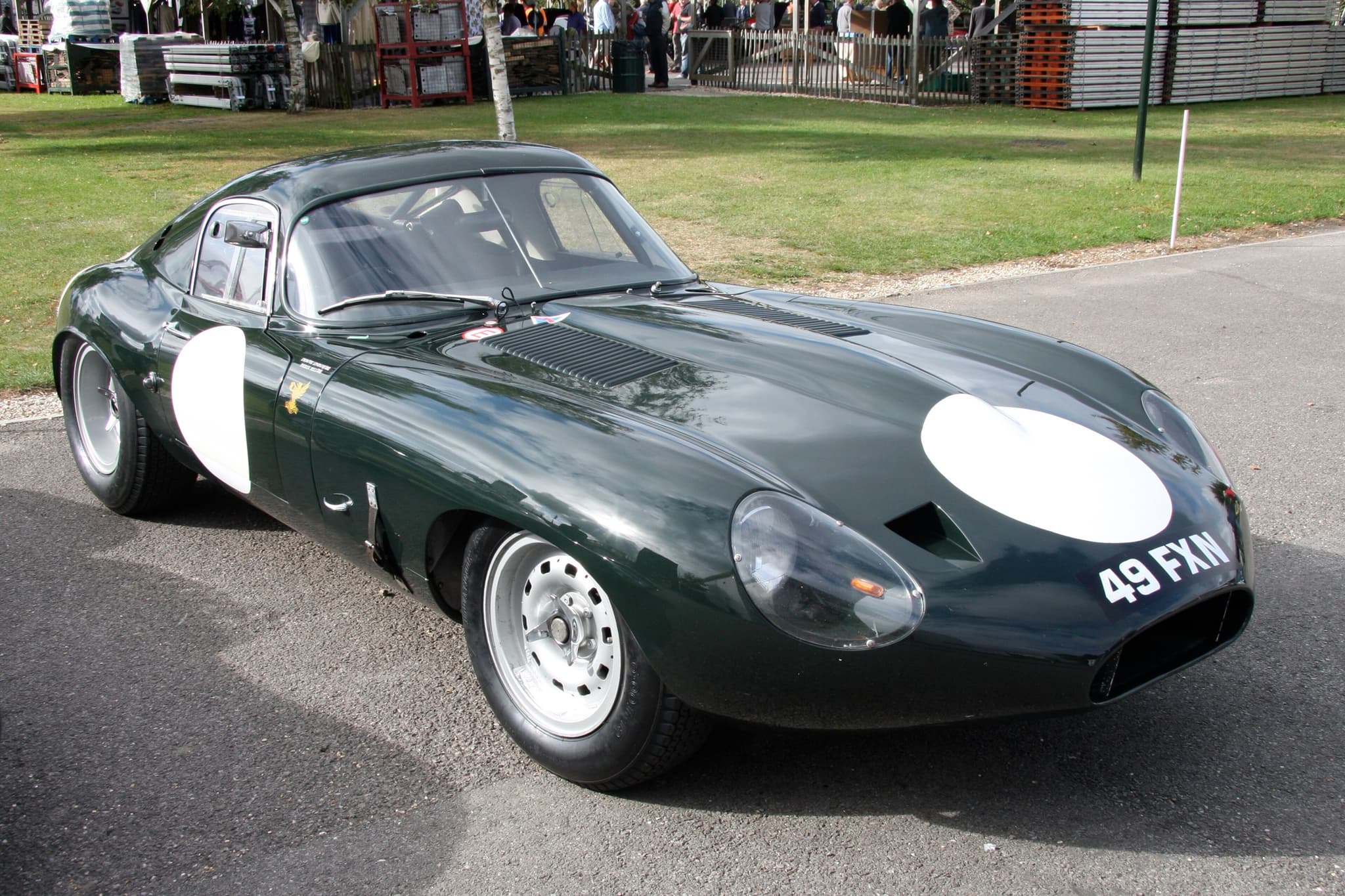
About the picture49 FXN (S850663), a factory Lightweight rebodied with a low-drag roof and tail in 1964; not the Low Drag Coupé (EC1001).
At Reims on 30 June 1963, in the GT race at the French Grand Prix meeting, Dick Protheroe held off Lucien Bianchi's Ferrari to finish second overall and win the GT class in an E-Type unlike any other. It had a lower roof, a new tail and a body of thinner steel. It was Malcolm Sayer's low-drag coupé, and Jaguar had built it the year before.source 1source 2source 3
What it was
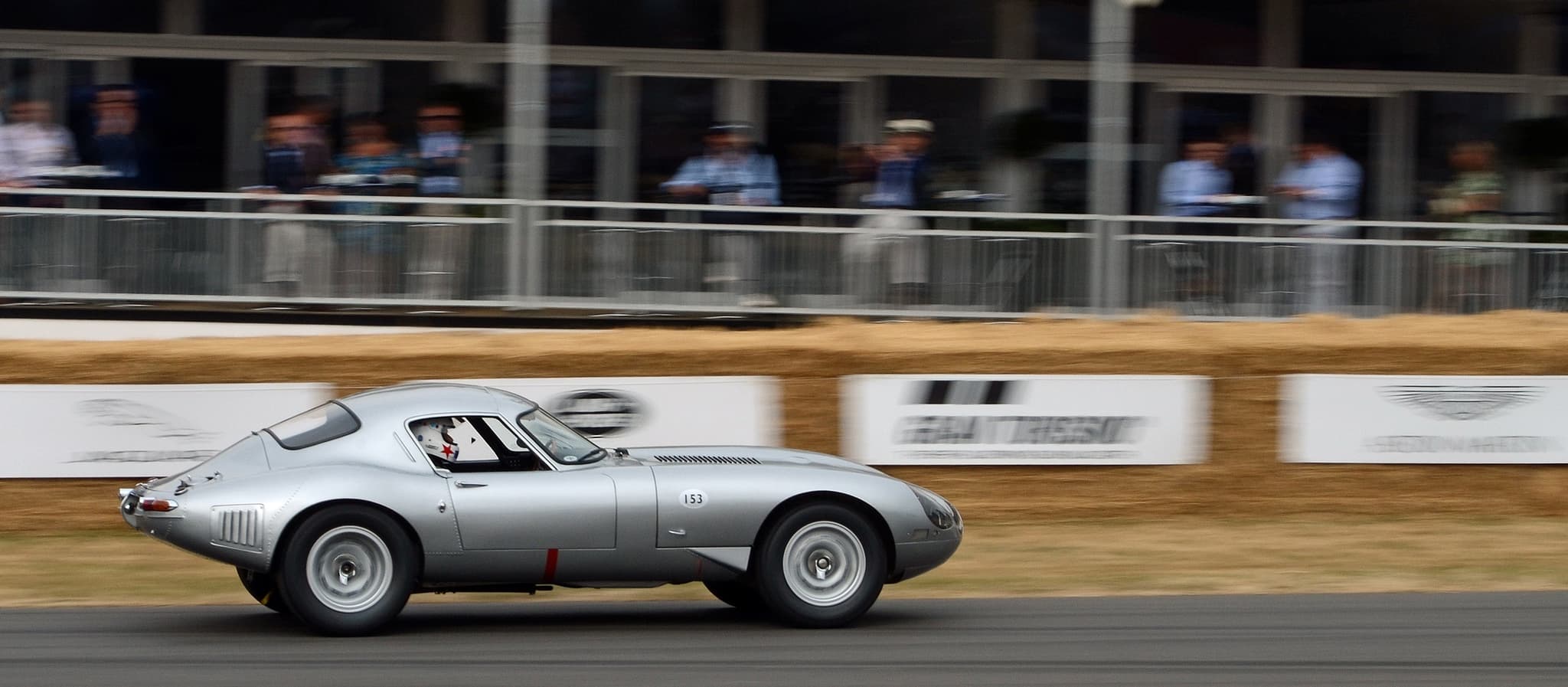
Sayer began looking at ways to cut the E-Type's weight and drag late in 1961, Motor Sport wrote in 1998, for a team that Jaguar might support in 1962. The result was built by the factory in 1962, but the Lightweight overtook it.
Six were planned, but as the 'Lightweight' project gathered pace, only one was built.
By Motor Sport's accounts, the work went on slowly after hours. The roof was about 51 mm (2 in.) lower than a standard coupé's, and the roof and tail were redrawn. The monocoque and body were of lighter-gauge steel, unlike the aluminium Lightweights that followed, with aluminium doors and bonnet (hood) and Perspex windows, and the suspension mountings were changed. The engine was a 3.8 with an aluminium block, a dry sump, the wide-angle head and fuel injection, and Motor Sport records a D-type gearbox (transmission). Jaguar kept the car at Browns Lane for a time as a test-bed, to compare with its other racing E-Types and with Ferrari's GTO. Motor Sport reported in 1998 that Jaguar's wind-tunnel work had found it about 10 per cent more efficient through the air than the GTO, and nearly 20 per cent better than a standard E-Type; it named no test, and no source read gives a drag figure.
Its chassis number is EC1001, on the Coventry Racers register and in the racingsportscars results; the number 850006 sometimes given for it belongs to John Coombs's Lightweight. The car came between the racing E-Types of 1961 and the Lightweight of 1963, which kept the open body under a hardtop and went to aluminium.
CUT 7: Dick Protheroe's three cars
Three different E-Types carried Protheroe's registration CUT 7, and the low-drag car was the last. The first was a right-hand-drive coupé, 860004, which he raced through 1962, with five overall wins and 6th place in the Tourist Trophy, and sold early in 1963. The second, a lighter car built up from parts, crashed heavily on its debut at Snetterton in March 1963 and was rebuilt and sold. The third was the low-drag car, which Protheroe bought from Jaguar in 1963; Motor Sport has written both that he persuaded Sir William Lyons to sell it and that he prised it out of a corner of the experimental department.
Its first race in the published histories is Reims, 30 June 1963, where Protheroe was second overall and won the GT class. He had raced "his special Jaguar E-type coupé", as Motor Sport called it, at Goodwood on 15 April and at Silverstone on 11 May; whether that was this car is not recorded. At the Tourist Trophy in August 1963 it was 6th; Motor Sport's report knew it as Protheroe's fastback. In 1964 Protheroe shared it with John Coundley, and they were 8th and first in the GT class over three litres in the Reims 12 Hours, and 7th and again first in that class in the Paris 1000 km at Montlhéry.
In 1965 the car was sold to Robbie Gordon. David Wansborough drove it into the lake at Oulton Park in practice for that year's Tourist Trophy, and it still raced, finishing 11th. In 2005 Motor Sport reported it in a private collection in Britain that also held the CUT 7 number, and racing at the Goodwood Revival; the register records a restoration in 2014.
Sayer's car is the only Low Drag Coupé; the cars sold today under the name are recreations, such as those built by Lynx and RS Panels, or Eagle's Low Drag GT, which is not a Jaguar: replicas and Eagle cover them.source 1source 2source 7source 8source 3source 9source 5source 10source 4
Specification
Production
Sources for Production, Low Drag Coupé
- Built
- One good source.V2 with motor-sport-2005-03-cut-and-pace and motor-sport-1998-10-cd-players. collectordata.com (the XKEdata family of registers), Coventry Racers: Jaguar C-Type, D-Type, XKSS and Lightweight E-Type registersource 4
- Designers
- One good source.Damien Smith, "Cut and pace", Motor Sport, Mar 2005, p. 86source 1
| Built | Low Drag Coupe, FHC, RHD, 1962 |
|---|---|
| Designers | the Low Drag project "led by ... aerodynamicist Malcolm Sayer" |
Engine
Sources for Engine, Low Drag Coupé
- Capacity
- One good source.Damien Smith, "Cut and pace", Motor Sport, Mar 2005, p. 86source 1
- Block
- One good source.Aluminium block (motor-sport-1998-10-cd-players). Damien Smith, "Cut and pace", Motor Sport, Mar 2005, p. 86source 1
- Cylinders
- One good source.The import's value; the same text: "give the 3.8-litre XK its full head". Damien Smith, "Cut and pace", Motor Sport, Mar 2005, p. 86source 1
- Lubrication
- One good source.Damien Smith, "Cut and pace", Motor Sport, Mar 2005, p. 86source 1
| Capacity | "an alloy dry-sump fuel-injected 3.8-litre engine" (L) |
|---|---|
| Block | "an alloy dry-sump fuel-injected 3.8-litre engine" |
| Cylinders | "That wondrous six fires and gurgles" |
| Lubrication | "an alloy dry-sump fuel-injected 3.8-litre engine" |
Body and chassis
Sources for Body and chassis, Low Drag Coupé
- Body
- One good source.Damien Smith, "Cut and pace", Motor Sport, Mar 2005, p. 86source 1
- Body material
- One good source.Damien Smith, "Cut and pace", Motor Sport, Mar 2005, p. 86source 1
- Panels
- One good source.Damien Smith, "Cut and pace", Motor Sport, Mar 2005, p. 86source 1
- Chassis
- One good source.V2 with motor-sport-2005-03-cut-and-pace (ERRATA-competition §5). Matthew Franey, "Cd Players", Motor Sport, Oct 1998, p. 74source 2
| Body | fixed-head coupé with the roof lowered by 2 in |
|---|---|
| Body material | lighter-gauge steel body, aluminium doors and bonnet |
| Panels | lighter-gauge steel body, aluminium doors and bonnet |
| Chassis | lighter-gauge steel monocoque |
Production
Production: how far the sources agree
- 1, "Six were planned, but ... only one was built" (EC1001, 1962)
- One good source.
- 1, built 1962
- One good source.
Sources
Sources are given as plain text; their addresses are on the sources page.
- Primarymade at the time, by the maker or by people who were there
- Referenceserious later work: clubs, specialists, magazines, books
- Databaseresults and listings, entry by entry
- Damien Smith, "Cut and pace", Motor Sport, Mar 2005, p. 86, p. 86, Reims, 1963; p. 86: six planned, one built; the specification; p. 86: the three cars registered CUT 7, the purchase, the results, 1965 and today; text; para 7. Reference
- Matthew Franey, "Cd Players", Motor Sport, Oct 1998, p. 74, p. 74, Reims, 1963; p. 74: Sayer's aim, the after-hours work, the steel monocoque, the wind-tunnel claim, the test-bed; p. 74: Protheroe and Lyons; Reims, 1963; the 1998 drive; text. Reference
- racingsportscars.com, GP Reims 1963, results, results, 30 June 1963. Database
- collectordata.com (the XKEdata family of registers), Coventry Racers: Jaguar C-Type, D-Type, XKSS and Lightweight E-Type register, car page EC1001; car page EC1001: the registrations and the restoration. Reference
- racingsportscars.com, "Jaguar E-Type – All Results", the chassis column, EC1001; Protheroe's results, 1963–65. Database
- Motor Sport, "Famous E-type to star at show", Aug 2011, p. 20, the Lindner car's low-drag body. Reference
- Motor Sport, "Easter Goodwood International 100 Race", May 1963, p. 56, Protheroe's "special Jaguar E-type coupé". Primary
- Motor Sport, "Tourist Trophy" ("Ferrari's fourth successive victory"), Oct 1963, p. 22, the race report. Primary
- Denis Jenkinson, "The 12 Hours of Reims" ("A Race to the Finish"), Motor Sport, Aug 1964, p. 53, the race report. Primary
- racingsportscars.com, Tourist Trophy 1965 (Oulton Park), results, results, the 1965 Tourist Trophy. Database