Jaguar E-Type Review
What the press said, from the first drives of March 1961 to the farewell of 1975: the British weeklies and Motor Sport, Motor Trend and Car and Driver in America, the faults every early test found, and how the 4.2, the 2+2 and the V12 were received.
About the pictureA Series 1 coupé at a modern track day, not a car the period magazines tested.
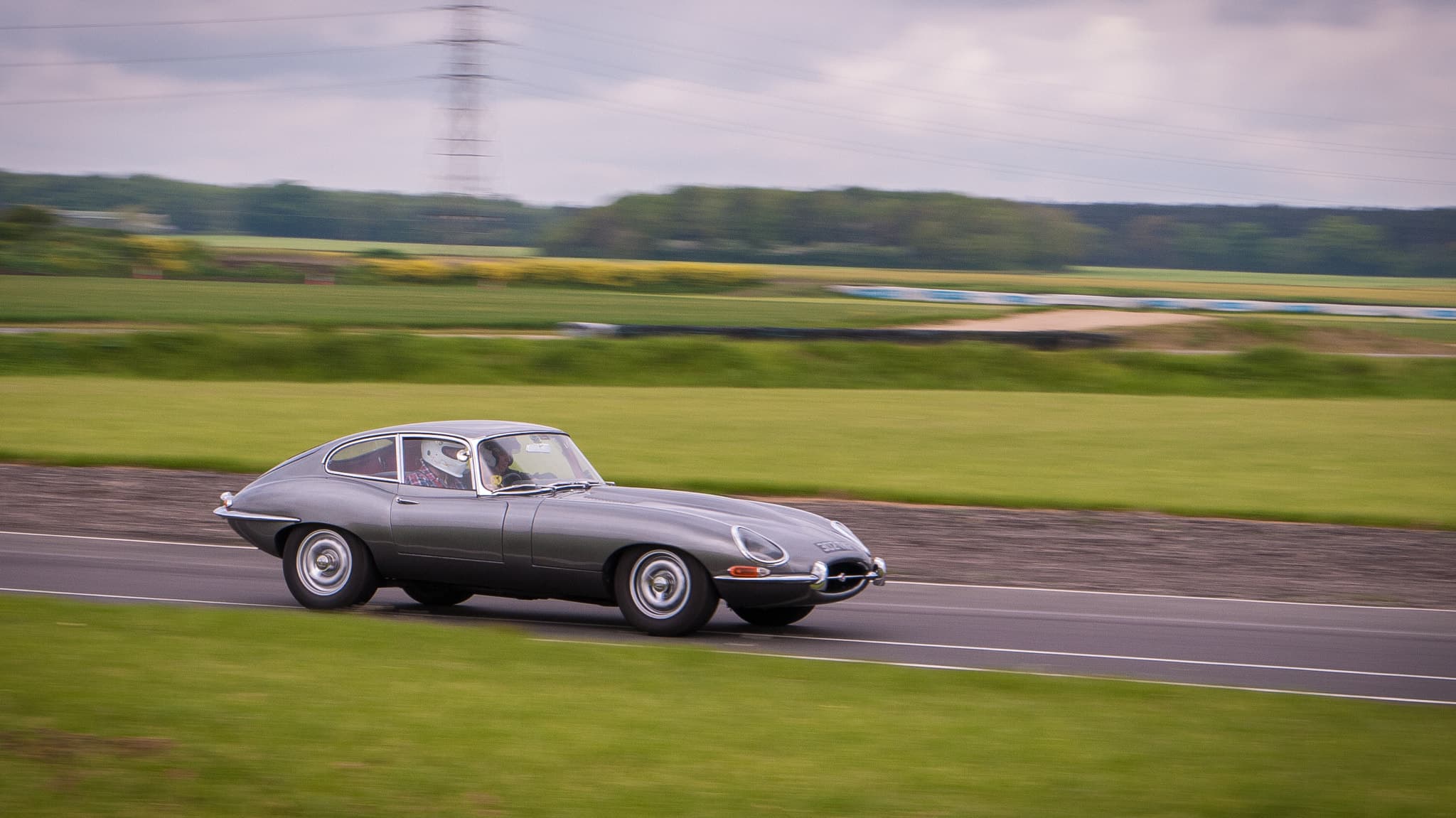
Bill Boddy of Motor Sport drove a left-hand-drive E-Type coupé near Coventry and up the M1 just over a week before the car was announced in March 1961, and came back with a sentence that began "Sir William Lyons has bred another winner!" For the next 14 years the press kept returning to the car, and the reviews tell its story from the other side: what it was like to drive when it was new, what annoyed the people who drove it hardest, and how Jaguar answered them. "The Press eulogised about it, customers queued for it", Motor Sport remembered when production ended.source 1source 2
1961: the first drives in Britain
Boddy's report appeared in Motor Sport's April issue. The brakes stopped the car from high speed "to a crawl without deviation", and he forgave the gearbox (transmission) for now: "The synchromesh can be beaten if the gearlever is handled too rapidly but otherwise this is a precise, excellent gearbox." He wanted a bigger fuel tank. But what struck him was the price, "only about a third of the price of a G.T. Maserati or Ferrari of something like equivalent performance", and he ended on it:
The E-type is a staggering motor car on all counts; safety, acceleration, speed, equipment, appearance— all are there, for a basic price of only £1,480. Staggering!
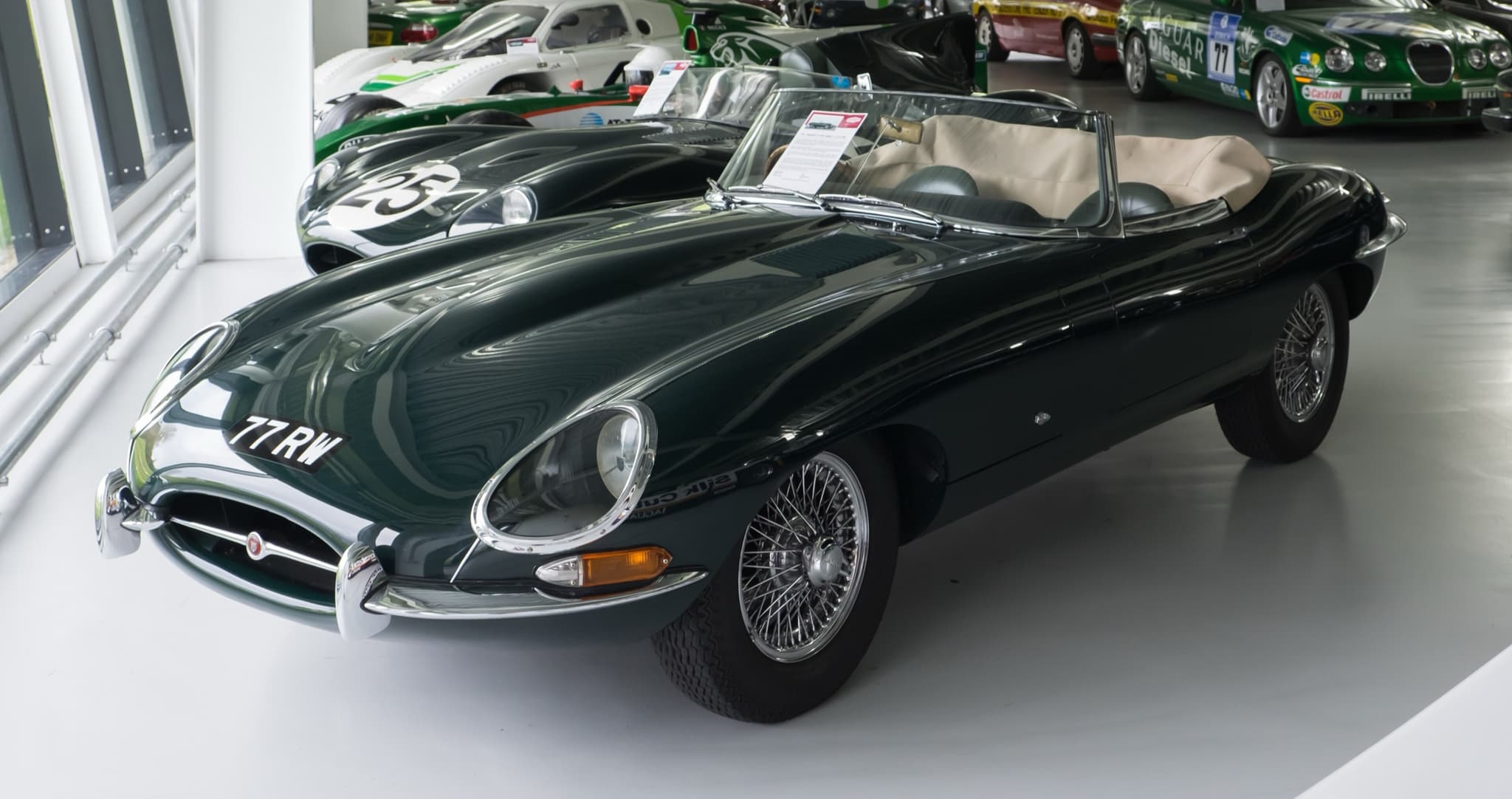
The two weekly magazines tested works press cars that March: The Autocar the coupé 9600 HP, The Motor the roadster 77 RW. Their full tests were not among the sources read. Motor Sport quoted The Autocar's verdict in 1975, "a break-through in design of high-performance vehicles for sale to the public", and the top speeds both weeklies recorded made the car's name; how far the press cars were prepared is told on the specifications page.source 1source 2
1961: the American reception
America's first report came from Gordon Wilkins, Motor Trend's European editor, who drove a coupé in Britain for the issue of July 1961. "It is unquestionably the fastest car to be made in quantity and offered to the public as a package," he wrote; "Road holding is superb — the best on any Jaguar to date." His reservations were the cramped cabin and the gearbox, which "is not the best feature of the car", and his last line was: "The XK-E, in my opinion, is the best thing Jaguar has ever done".
Car and Driver took a roadster from Jaguar in New York, a demonstrator, to Detroit and back for its December issue:
After a week and 2200 miles in the XK-E Jaguar, we are bound to recognize it as a thoroughly GOOD car. And at the price of $5620 it is really in a class of its own.
It listed the faults too: seats whose bead drilled into the driver's back, cramped pedals, rain that leaked in over the windscreen (windshield) and at the doors, a boot (trunk) with no drain holes, poor ventilation with the hood (soft top) up, and an engine that used a great deal of oil. Its forecast was generous all the same: "We expect as the E-Type evolves it will become one of the world's truly great cars from any standpoint." The same issue set the E-Type against the Corvette of the 1962 model year, which the rivals page describes.
1962: the long test to Monaco
In 1962 Boddy took a roadster 2,800 miles, from Coventry to Monaco and back, for Motor Sport's issue of July. He praised its performance, its brakes, its ride and its roadholding, and the hood, "made in Jaguar's own trim-shop, each one individually tailored". He had complaints too: petrol (gas) fumes in the boot, a cracked sump, a fuel range too short for long journeys, and the boot lid, which "would open of its own volition" on rough roads at speed, "a fault not confined to this particular E-type". The luggage space settled a question of definition: "That this 2-seater is not a true Gran Turismo car was evident when we had to pack our evening suits into one case."
1964 and 1965: the 4.2
The 4.2 answered the early tests' main complaint. Motor Sport's test of January 1965 called its all-synchromesh gearbox "the greatest single improvement over the 3.8", whose own box gave off "a good deal of whine". The test car had faults of its own, among them its brake servo, its idling and fumes, but the verdict was the warmest yet: "In its latest form it is very near perfection." Cecil Clutton, who had preferred the XK150 to an early 3.8, wrote to the magazine that April that the 4.2 was "an entirely transformed car, and in my view a great advance on the 150", and that its new gearbox was "a real joy to use".source 6source 7
1966 and 1967: the 2+2
Motor Sport explained in April 1966 that the 2+2 had been built partly to earn more dollars, and that a strike had kept it from the London motor show, so it was "first shown at Geneva last month". The magazine found that "unless you have just parted with a 2-seater E-type coupe, you would not know the difference when driving it", and Jenkinson's conclusion placed it carefully: "To my mind the E-type Jaguar is a very nice, refined, touring car for Touring in the Grand manner, and that does not mean Gran Turismo." He found the finish skimped in places, but a Ferrari, he pointed out, cost as much as three E-Types. He found corrosion under the bonnet of a car with 5,000 miles on it, and the box between the seats so shortened that it "now barely takes maps".
Boddy's test of the manual 2+2 in January 1967 came to the same place by a different road:
In what category does this Jaguar fall? It has too small a fuel range, too heavy an oil consumption (judging by the car submitted for test) and not quite the required standard of high-speed handleability to rank as a GT car. … But it is a jolly nice touring car and good value for £2,284 5s. 8d.
1968 to 1970: the Series 2
No period road test of the Series 2 was among the sources read. The best witness is an owner's. Denis Jenkinson ran a 1970 roadster, slower than his old 4.2 coupé, and did not mind: "In 25,000 miles with the 1970 roadster I have not missed the lack of top speed on more than two or three occasions."source 10
1971 and 1972: the V12
Jenkinson drove the V12 for Motor Sport in April 1971 and was of two minds. He admired the engine, and the factory that built it, but the car was not what he had hoped for: he was "nonplussed because I had been expecting an 'F'-type Jaguar, not a third series 'E'-type", and he disliked the new 2+2 body and "a decorative bird-cage grille stuck up its nose". Still, "Jaguars have made an impressive step forward in refinement". In America, Road & Track later recalled, the New York International Show of April 1971 "introduced … the Jaguar E-Type V-12" to the public.
Boddy tested a manual V12 2+2 for January 1972. He found the driving position cramped, the clutch heavy, the gear change stiff and notchy, the minor controls "out-dated", and the car itself unforgettable: "It remains an unforgettable motoring experience", "twelve-cylinder Jaguar motoring being travel of a most effortless kind".source 10source 11source 12
1975: the farewell
When the E-Type went, Motor Sport gave it a long obituary. The early 1960s, with their speed, reasonable freedom and value for money and the standing of the British motor industry, were over, C. R. wrote, "and nothing seems to signify this more than the demise of the E-type." He closed on what the car had come to stand for; the last E-Type page quotes him.
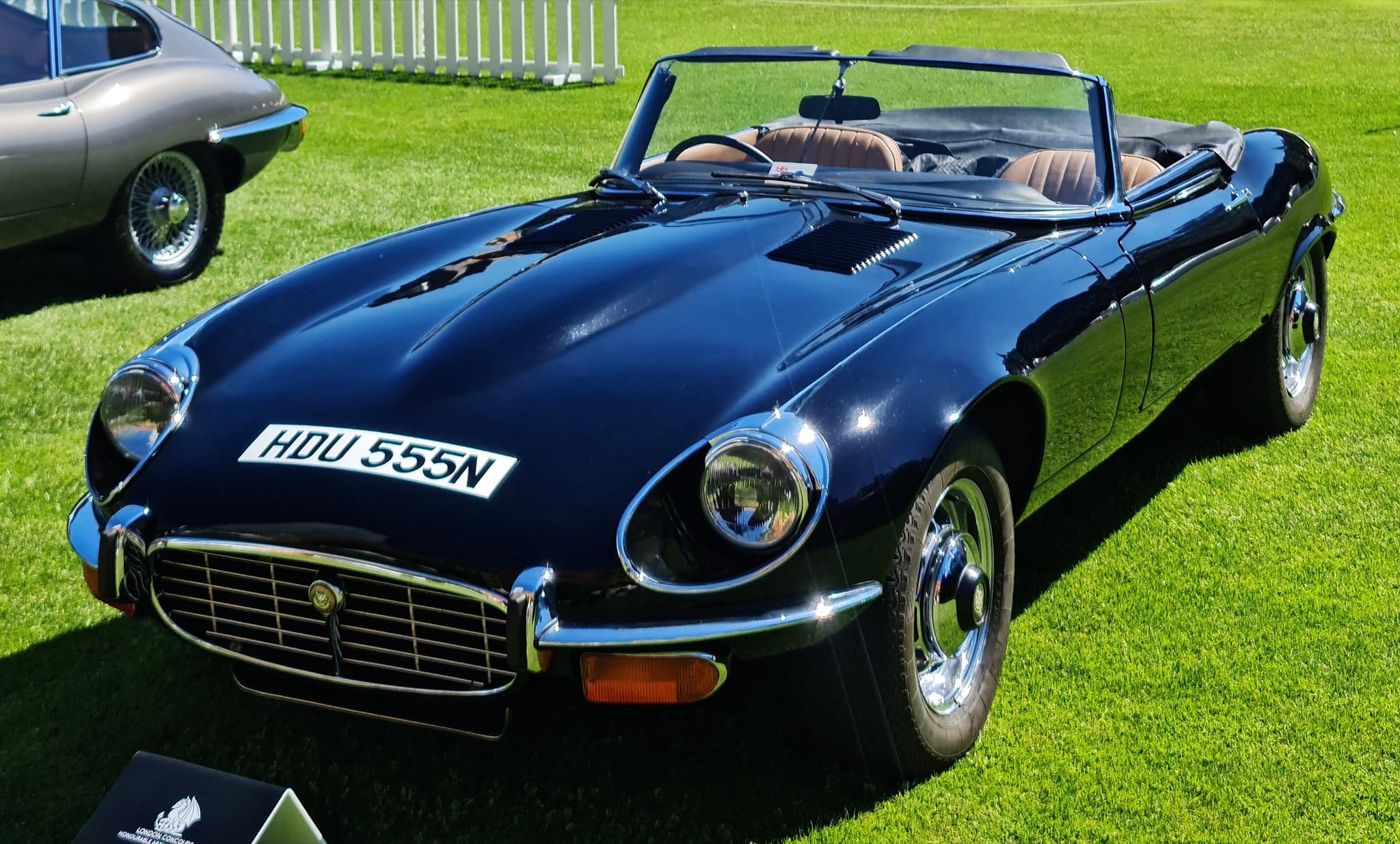
HDU 555N, the last car, which he described, was built on 12 June 1974 and is in the Jaguar Heritage Trust's collection. Films of E-Types on the road are on the home page and the roadster and V12 pages.source 2
Sources
Sources are given as plain text; their addresses are on the sources page.
- Primarymade at the time, by the maker or by people who were there
- Bill Boddy, "The New 3.8-Litre Jaguar E-Type G.T.", Motor Sport, Apr 1961, p. 35, p. 35, Boddy's first drive; p. 35, the drive near Coventry and on the M1; the brakes, the gearbox and the price. Primary
- Motor Sport, "Jaguar E-type: the end of production and end of an era – but not of a legend", May 1975, p. 29, p. 29, "The Press eulogised about it"; p. 29, The Autocar's test as C. R. quoted it; p. 29, the farewell. Primary
- Gordon Wilkins, "Driver's Report: A First Test of the Jaguar XK-E", Motor Trend, Jul 1961 (vol. 13 no. 7), pp. 70–71, pp. 70–71, Gordon Wilkins's first test. Primary
- Car and Driver, "Road Research Report: Jaguar XK-E" and "Dual Test: Jaguar XK-E vs. 1962 Corvette", Dec 1961 (vol. 7), pp. 30–32 and 82–88, the Road Research Report and the dual test with the Corvette. Primary
- Bill Boddy, "By E-Type To Monaco", Motor Sport, Jul 1962, p. 59, the 2,800-mile trip: the hood, the boot lid, the luggage and the fuel. Primary
- Motor Sport, "The 4.2-Litre Jaguar E-type" ("A lengthy road test of the 150 m.p.h. E-Type"), Jan 1965, p. 23, p. 23, the gearbox, the faults of the test car and the verdict. Primary
- Cecil Clutton, "Clutton and the E-Type" (letter), Motor Sport, Apr 1965, p. 62, p. 62, Cecil Clutton's letter. Primary
- Bill Boddy and Denis Jenkinson, "The Jaguar E-type 2+2", Motor Sport, Apr 1966, p. 18, p. 18, the reasons for the 2+2, Geneva, the drive and the verdict. Primary
- Bill Boddy, "Jaguar E-type 2+2 with manual gearbox", Motor Sport, Jan 1967, p. 22, p. 22, the manual 2+2 and its category. Primary
- Denis Jenkinson, "Driving the V12 Jaguar", Motor Sport, Apr 1971, p. 64, p. 64, the author's 1970 roadster; p. 64, the first drive, the grille and the factory. Primary
- Bill Boddy, "On the road with the V12 E-type Jaguar", Motor Sport, Jan 1972, p. 36, p. 36, the 2+2 manual: the faults and the verdict. Primary
- Road & Track, Road & Track, October 1973 (road-test summary table), Oct 1973, the New York International Show report. Primary