Jaguar E-Type V12
The Series 3, built from December 1970 to June 1974 as a roadster and a 2+2 on one longer wheelbase, with Jaguar's new V12 engine: every one a V12 in practice, sold in America as the Jaguar V12. Also written Series III or S3; the last 50 were the Commemorative roadsters.
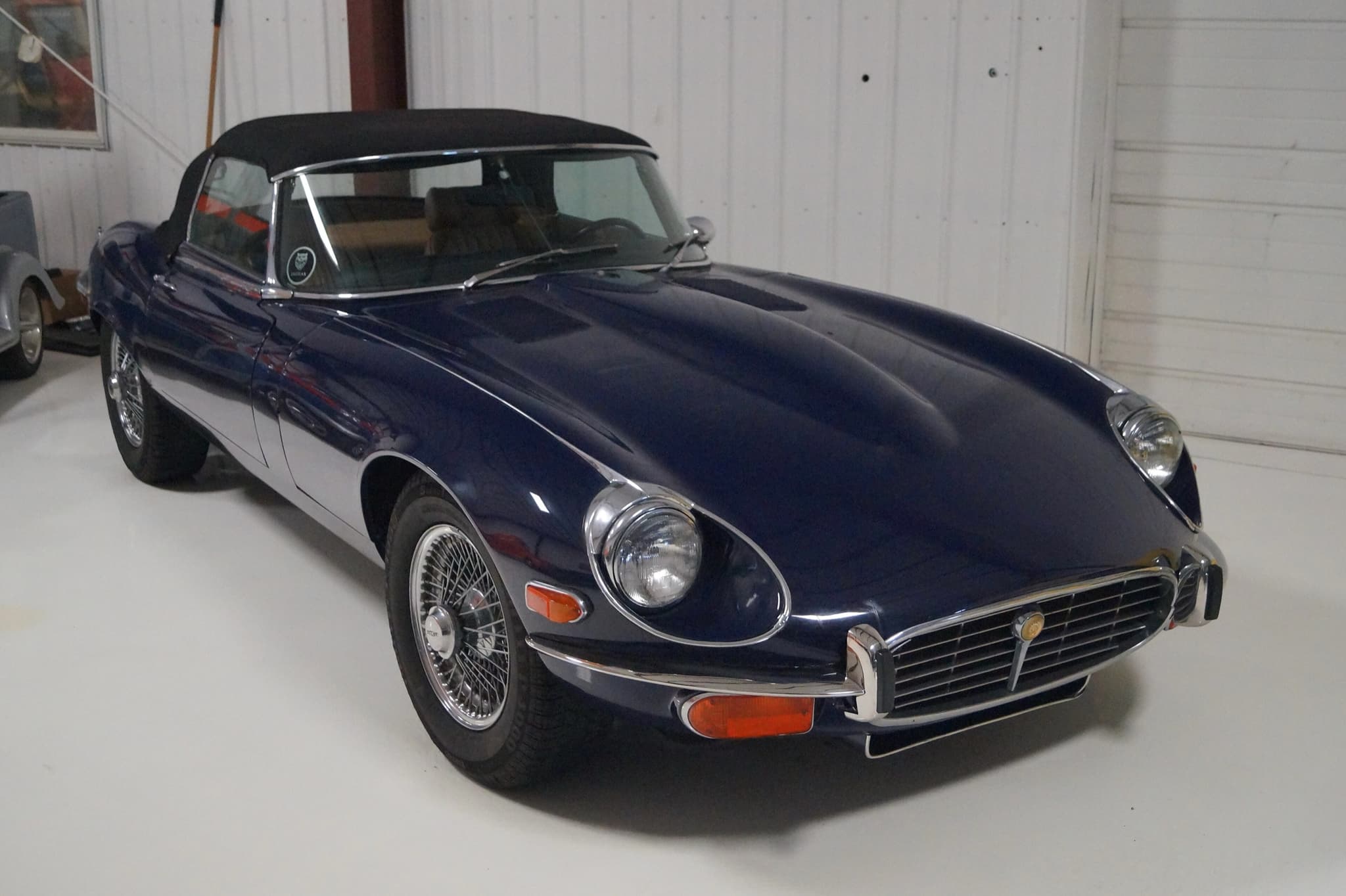
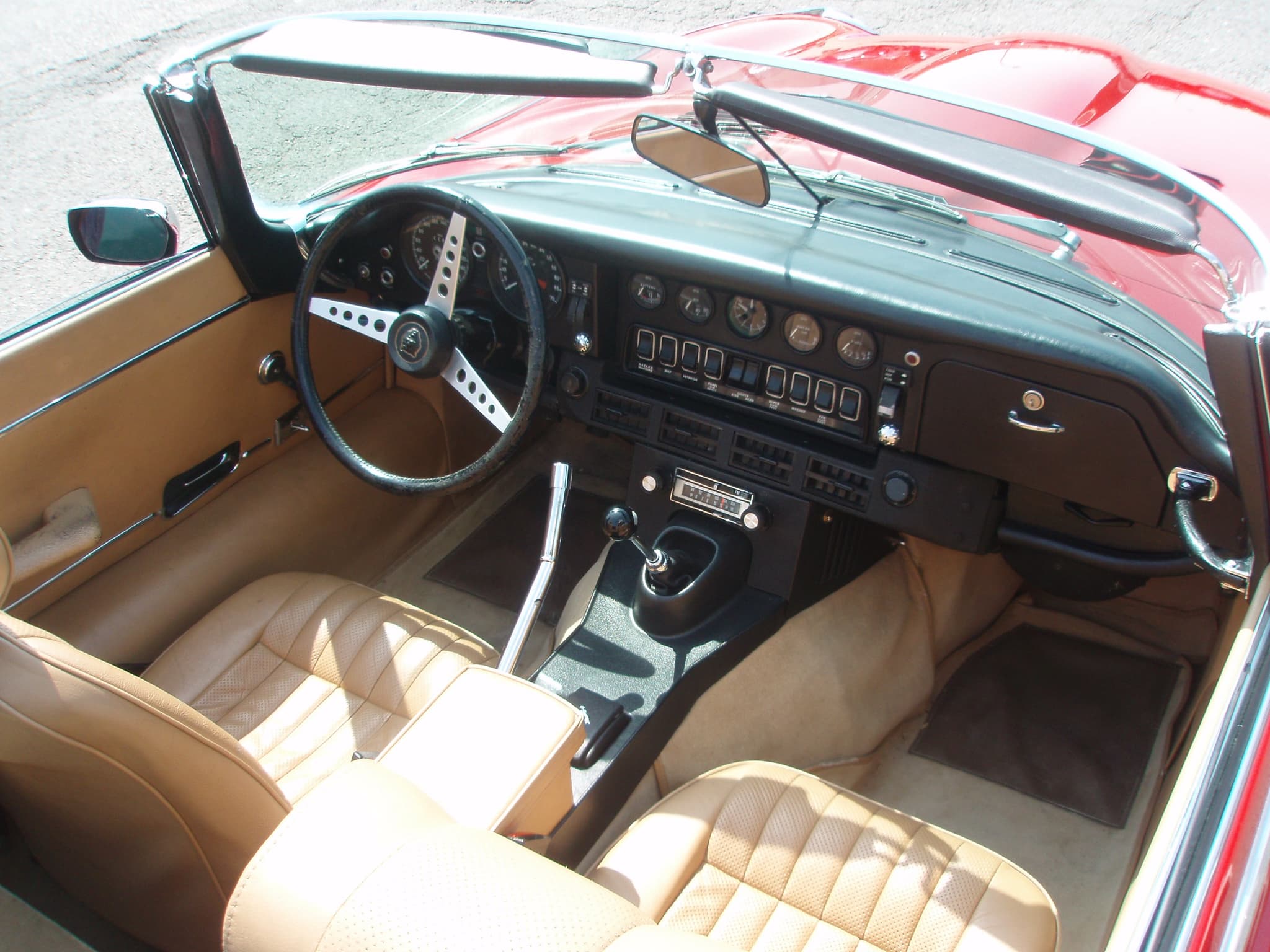
A Series 3 V12 roadster with its hood (soft top) up, an American car its photographer dates to the 1974 model year, in a garage in Minnesota in April 2016.Greg Gjerdingen from Willmar, USA, CC BY 2.0
In practice every E-Type built after 1970 was a V12. The Series 3 used one longer wheelbase for both its bodies, the roadster and the 2+2, and the original short car was dropped. Jaguar did list a six-cylinder Series 3 beside it, but almost none was built. By the Jaguar Heritage Trust's car numbers the first Series 3 cars were built in December 1970, and the last, the last E-Type of all, on 12 June 1974.source 1source 2source 3
Names and the American car
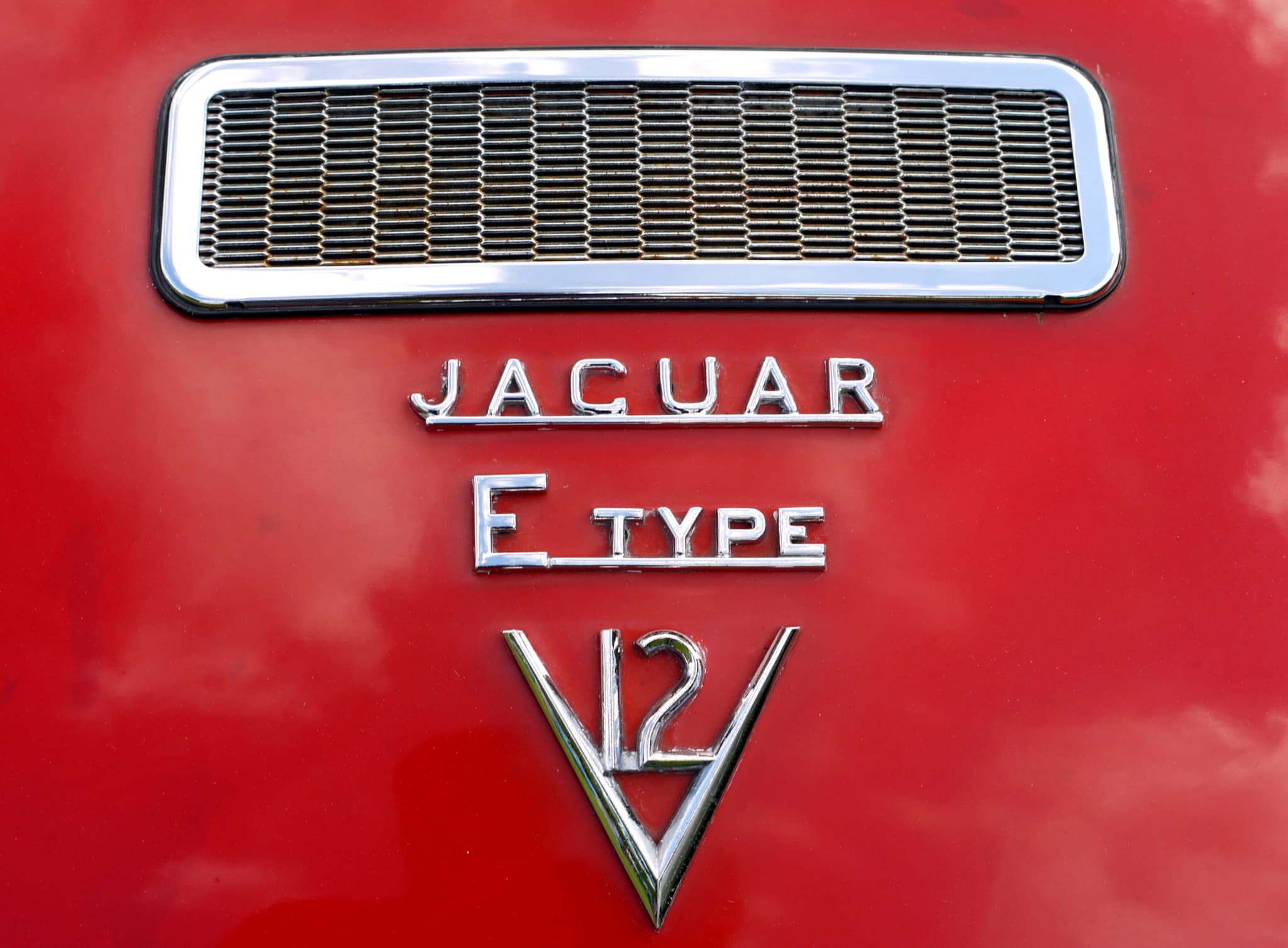
Jaguar and Motor Sport called it the Series III or Series 3; this site calls it the V12, after its engine. In America it lost the old name altogether. AROnline, the British car-industry history site, records that Jaguar's first American advertising for it called it simply the Jaguar V12, and dropped XKE.
It was announced on 29 March 1971, by the Jaguar Heritage Trust's record, with its American press launch at Palm Springs the same month; Denis Jenkinson of Motor Sport drove it six weeks before the announcement and watched transporters full of V12 coupés already leaving for the dealers. America was its market. Jenkinson reported that 78% of the V12 cars were going there, and the cars changed to suit it: American cars carry a U prefix with a letter for the model year (C for 1972, D for 1973, E for 1974), large rubber overriders (bumper guards) arrived at the front for the 1973 model year and at both ends for the 1974 model year, and for the 1974 model year only the roadster was sold there. Motor Sport noted that the tyre pressures America's federal rules required held the car's top speed down there.source 2source 4source 5source 6source 1
The engine
The V12 had a long history before it reached the E-Type. Motor Sport traced it to a four-camshaft racing engine that William Heynes and Claude Baily designed in the early 1960s, too bulky for the E-Type and too costly to make in numbers; Walter Hassan and Harry Mundy were then asked for a V12 that was easier to build. The Heritage Trust tells it differently, saying the production engine had first been meant for the XJ13, Jaguar's Le Mans car of 1966. Both accounts agree that the production engine was developed from Jaguar's racing V12 of the 1960s; Jaguar E-Type Engine follows the story.
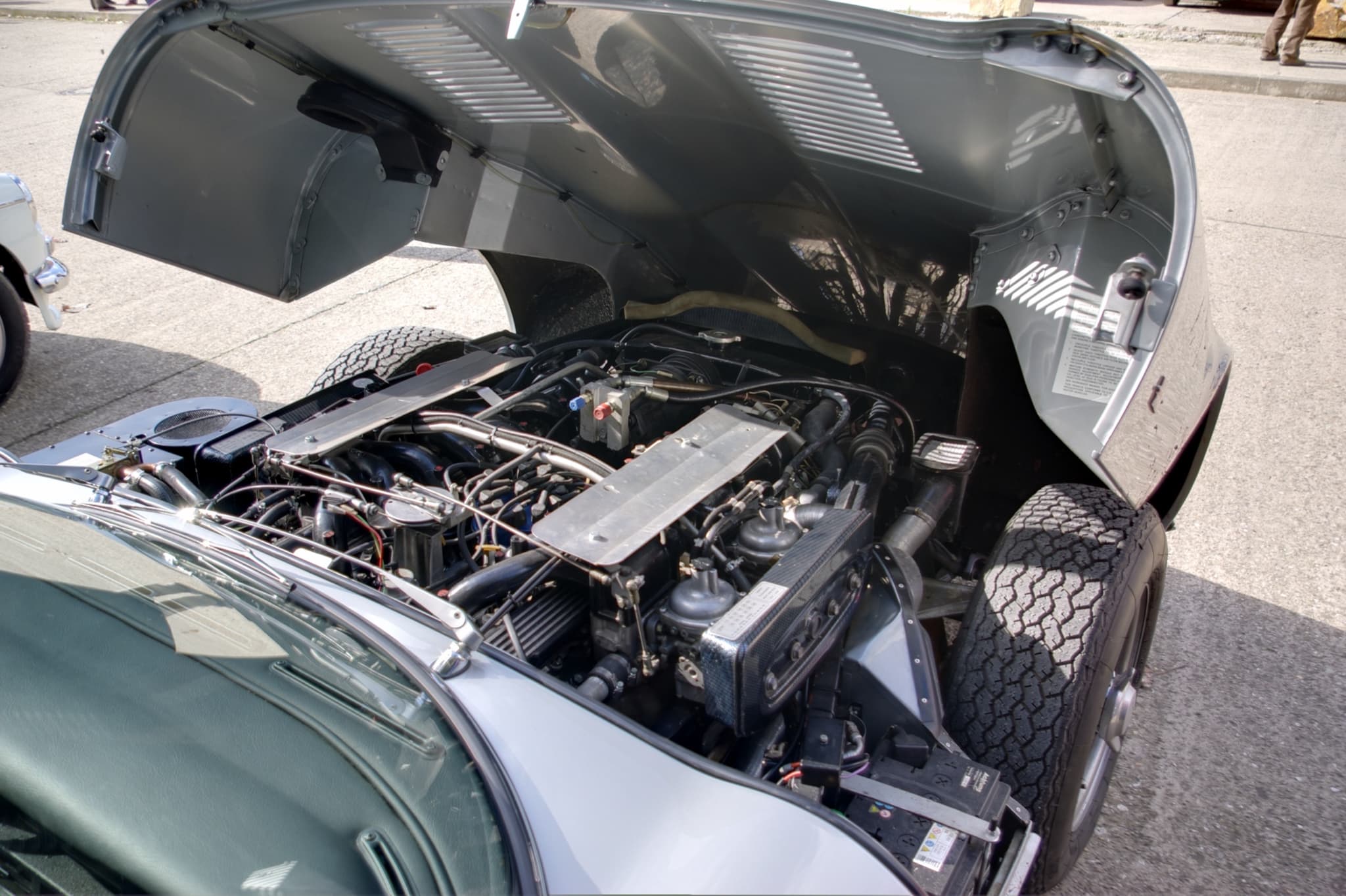
As built, it was a 60-degree V12 with a single overhead camshaft on each bank, aluminium cylinder blocks and heads, transistorised ignition and four Zenith-Stromberg carburettors outside the vee. Jaguar made it at Radford in a new machine shop, and the E-Type was the first car to carry it. Its refinement was what struck the first testers. Jenkinson spent an afternoon in two V12 cars and kept saying the same thing:
Throughout the whole afternoon I spent driving the two 12-cylinder 'E'-types, I found myself continually commenting that I would never know there was a V12 engine under the bonnet
What changed from the Series 2
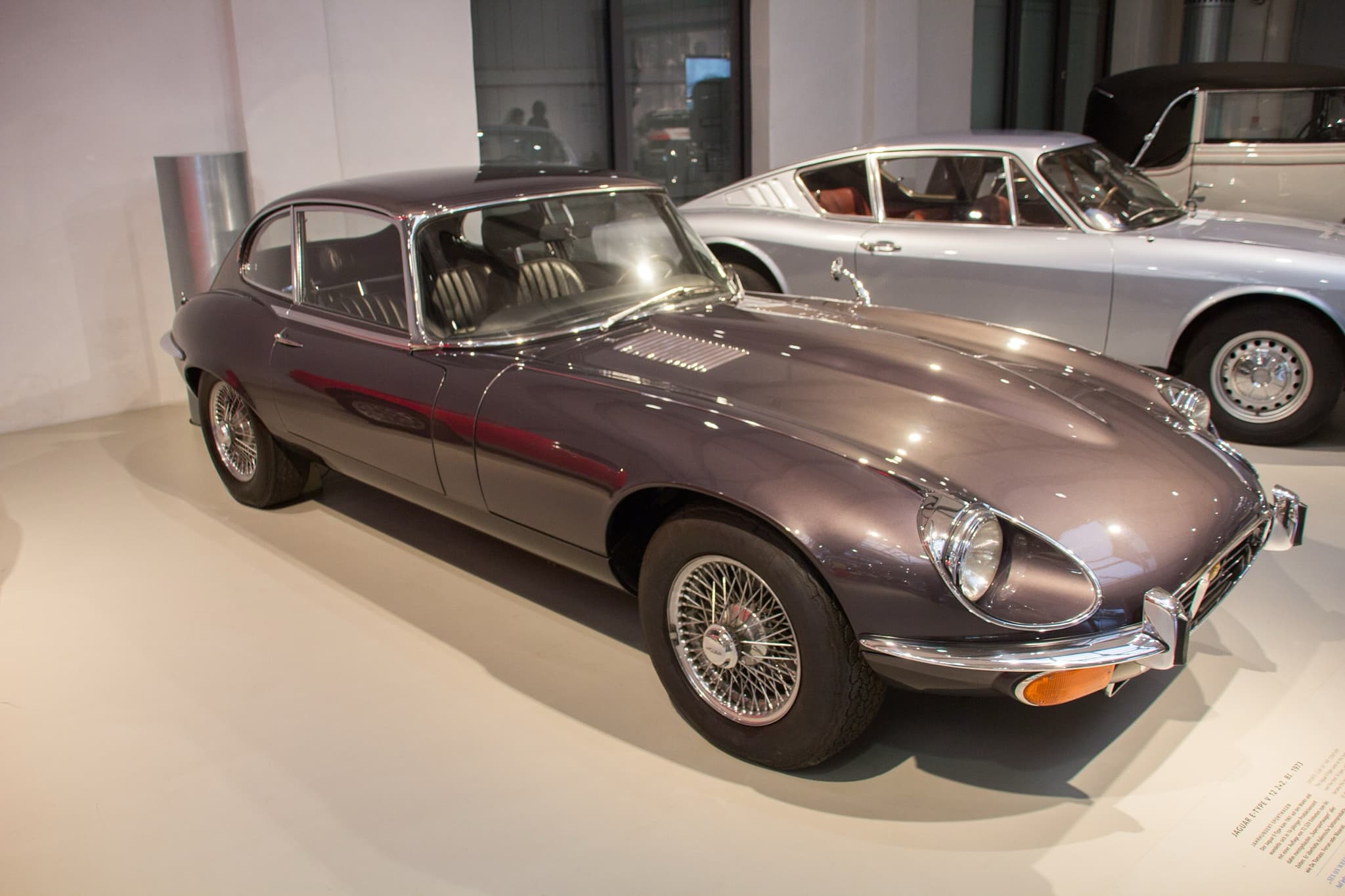
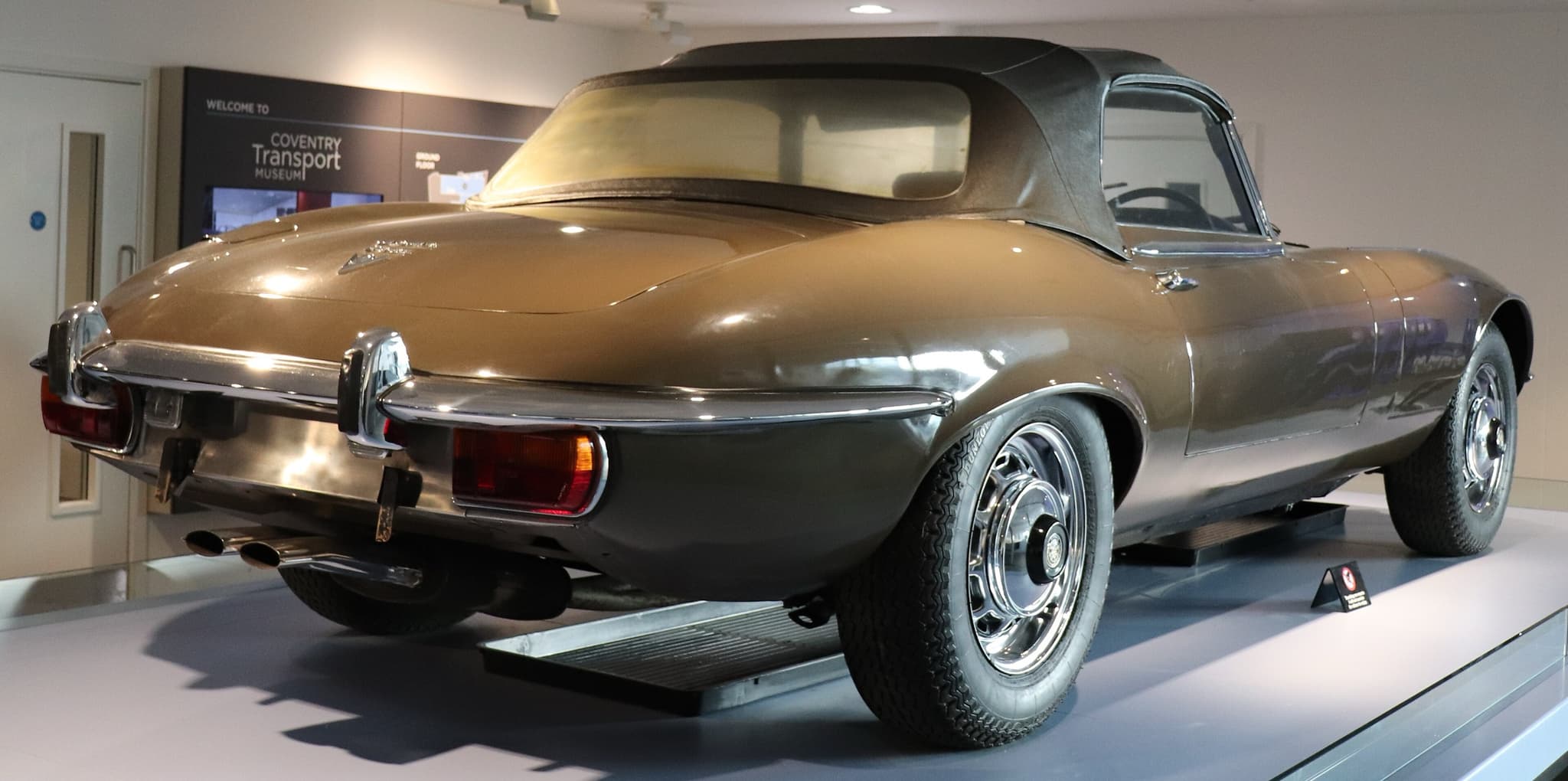
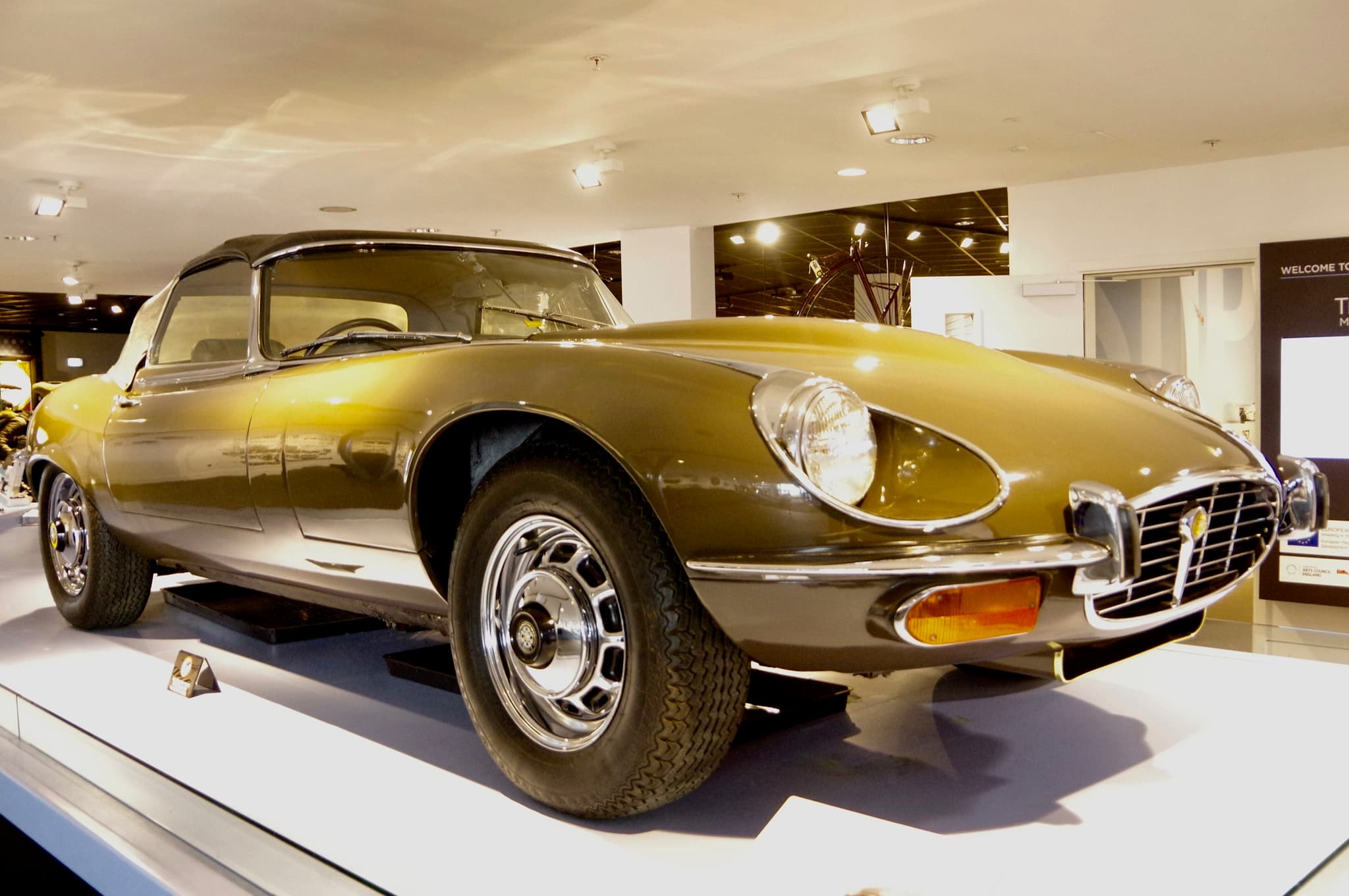
The longer wheelbase was the 2+2's, and in the Series 3 the roadster took it too, with the 2+2's longer doors and a luggage shelf behind the seats. Jaguar redesigned the square-tube front frame to carry the V12 and gave it anti-dive geometry from the XJ6 saloon (sedan). The tracks were wider, under flared arches, on low-profile Dunlop tyres; the fuel tank was larger; power steering was standard, and the front discs were ventilated. Pressed-steel wheels were standard and the wire wheels an extra. At the back were four tailpipes and a V12 badge, at the front a cross-hatched grille that Jenkinson disliked. Bill Boddy, testing a manual 2+2 for Motor Sport in January 1972, found it 22% heavier than the car of 1961, and saw the change for what it was:
The V12 E-type is not a new car, rather a fine new power unit using the former details and running gear.
He still liked the car a great deal. There was no two-seat coupé in the Series 3: the 2+2 was the only closed body.source 2source 4source 9
The end and the Commemorative cars
The 2+2 went first: the last were built in July 1973 with left-hand drive and in August with right-hand drive. The roadster went on alone into 1974. Most Series 3 cars, the Heritage Trust says, had the automatic gearbox, a Borg-Warner three-speed by Jaguar's American brochure, and the Trust's guide to car numbers marks them with BW; how many were built is not published.
Production ended in June 1974 with a special run of 50 roadsters. Of these, 49 were painted black; the next-to-last, built for a private collector, was green (British Racing Green, by the Heritage Trust's record), and all 50 carried a plaque with a facsimile of Sir William Lyons's signature. Motor Sport added that Jaguar charged no extra for them, and that the very last car was noticeably slower than earlier V12 cars, the later engines having lost some power to tighter emission rules. That car, a right-hand-drive roadster built on 12 June 1974, is the last E-Type, kept by Jaguar from the day it was built and now in the Heritage Trust's collection.
The production readings below give the XKEdata register's count of Series 3 cars and Jaguar's own figure. Its successor was the XJ-S of 1975, which Jaguar insisted was not a replacement; the history tells the end of the line.source 1source 3source 9source 8source 10source 11
Specification: Series 3 V12 2+2
Production
Sources for Production, Series 3 V12 2+2
- Price new
- One good source.The earliest 2+2 price in a source read (the live £3,369 for 1971 has no source); ERRATA-generations §5, §6. Bill Boddy, "On the road with the V12 E-type Jaguar", Motor Sport, Jan 1972, p. 36source 4
- Built
- One good source.Jaguar Daimler Heritage Trust, Research Guide No. 001F: Chassis Number Runs and Change Points by model – Jaguar E-type, Issue 3, January 2023source 1
- Designers
- One good source.Motor-sport-1971-04-new-jaguar-v12: "Messrs. Hassan and Mundy ... have evolved for Jaguar ... V12 engine". Jaguar Daimler Heritage Trust, "1974 Jaguar E-type Series 3 V12 OTS HDU 555N: The Last E-type Built"source 3
- Built at
- One good source.Engines built at Radford, cars assembled at Browns Lane, Allesley (Coventry: "Coventry factory", motor-sport-1972-01-v12-e-type-on-the-road). Bill Boddy, "The new Jaguar V12", Motor Sport, Apr 1971, p. 61source 7
| Price new | "£3,387" |
|---|---|
| Built | 2+2 runs from 1S 50001 and 1S 70001 (1970, month unknown) to 1S 52116 (August 1973) and 1S 75183 (July 1973) |
| Designers | the V12 "had been designed and developed by Walter Hassan and Harry Mundy" |
| Built at | "a great many more complete at the Radford factory"; "transported to the Jaguar assembly plant at Browns Lane, Allesley" |
Engine
Sources for Engine, Series 3 V12 2+2
- Engine maker
- One good source.Bill Boddy, "The new Jaguar V12", Motor Sport, Apr 1971, p. 61source 7
- Capacity
- One good source.Bill Boddy, "The new Jaguar V12", Motor Sport, Apr 1971, p. 61source 7
- Engine position
- One good source.Denis Jenkinson, "Driving the V12 Jaguar", Motor Sport, Apr 1971, p. 64source 2
- Block
- One good source."light-alloy" in motor-sport-1972-01-v12-e-type-on-the-road. Bill Boddy, "The new Jaguar V12", Motor Sport, Apr 1971, p. 61source 7
- Cylinder head
- One good source.Bill Boddy, "The new Jaguar V12", Motor Sport, Apr 1971, p. 61source 7
- Valve gear
- One good source.One camshaft per bank. Bill Boddy, "The new Jaguar V12", Motor Sport, Apr 1971, p. 61source 7
- Bore × stroke
- One good source.The imperial 3.54 x 2.76 in matches the US brochure's 3.543 x 2.756 in. Bill Boddy, "The new Jaguar V12", Motor Sport, Apr 1971, p. 61source 7
- Compression ratio
- One good source.Bill Boddy, "The new Jaguar V12", Motor Sport, Apr 1971, p. 61source 7
- Fuel system
- One good source.Bill Boddy, "The new Jaguar V12", Motor Sport, Apr 1971, p. 61source 7
- Carburettors
- One good source.US brochure; motor-sport-1971-04-new-jaguar-v12 prints "four Zenith 175CDSE carburetters"; ERRATA-generations C11: every V12 had four. British Leyland Motors Inc., Leonia, New Jersey, "The Ultimate Cat": Jaguar V-12 E-type (sales brochure), USA, 1971source 9
- Cooling
- One good source.Bill Boddy, "The new Jaguar V12", Motor Sport, Apr 1971, p. 61source 7
- Cylinder layout
- One good source.Bill Boddy, "On the road with the V12 E-type Jaguar", Motor Sport, Jan 1972, p. 36source 4
- Cylinders
- One good source.Bill Boddy, "On the road with the V12 E-type Jaguar", Motor Sport, Jan 1972, p. 36source 4
- Fuel
- One good source.Bill Boddy, "On the road with the V12 E-type Jaguar", Motor Sport, Jan 1972, p. 36source 4
- Ignition
- One good source.Bill Boddy, "On the road with the V12 E-type Jaguar", Motor Sport, Jan 1972, p. 36source 4
- Lubrication
- One good source.British Leyland Motors Inc., Leonia, New Jersey, "The Ultimate Cat": Jaguar V-12 E-type (sales brochure), USA, 1971source 9
| Engine maker | "Messrs. Hassan and Mundy, directed originally by Heynes and Baily, have evolved for Jaguar a significantly compact, 300-b.h.p. V12 engine" |
|---|---|
| Capacity | "the new 90 x 70-mm. (5,343-c.c.) engine" (cc) |
| Engine position | the square-tube front frame "completely re-designed" to take the V12 |
| Block | "The cylinder block is an alloy casting, with wet c.i. liners." |
| Cylinder head | "The heads are sand-cast alloy" |
| Valve gear | "a single o.h. camshaft actuating in-line vertical valves" |
| Bore × stroke | "the new 90 x 70-mm. (5,343-c.c.) engine" |
| Compression ratio | "on a 9-to-1 c.r." |
| Fuel system | "Carburation is by four Zenith 175CDSE carburetters, two on the outside of each block" |
| Carburettors | four Zenith-Stromberg 175 CD2SE |
| Cooling | "cooling water from the radiator"; "The centrifugal impeller-type water pump feeds both banks of cylinders" |
| Cylinder layout | "the new light-alloy 60° V12 single-cam-per-block power unit" |
| Cylinders | "the new light-alloy 60° V12 single-cam-per-block power unit" |
| Fuel | "The V12 runs happily on four-star fuel" |
| Ignition | "its Lucas Opus transistorised ignition" |
| Lubrication | sump 11.5 US quarts |
Performance
Sources for Performance, Series 3 V12 2+2
- Power
- One good source.DIN, as announced in 1971 (ERRATA-generations C6: never 266 as the launch figure; 314 gross at 6,200 rpm is the other rating). Bill Boddy, "On the road with the V12 E-type Jaguar", Motor Sport, Jan 1972, p. 36source 4
- Torque
- Several figures in print.Bill Boddy, "The new Jaguar V12", Motor Sport, Apr 1971, p. 61source 7; British Leyland Motors Inc., Leonia, New Jersey, "The Ultimate Cat": Jaguar V-12 E-type (sales brochure), USA, 1971source 9
- Top speed
- Several figures in print.Bill Boddy, "On the road with the V12 E-type Jaguar", Motor Sport, Jan 1972, p. 36source 4
- Standing start
- One good source.Manual 2+2 test car. Bill Boddy, "On the road with the V12 E-type Jaguar", Motor Sport, Jan 1972, p. 36source 4
- Red line
- One good source.The rev counter's red sector starts at 6,500 rpm. Bill Boddy, "On the road with the V12 E-type Jaguar", Motor Sport, Jan 1972, p. 36source 4
| Power | "314 b.h.p.—272 (DIN) at 5,850 r.p.m." |
|---|---|
| Torque | "Maximum torque of 349 lb./ft. (304 DIN) is achieved at 3,600 (3,800) r.p.m." (lb ft) Torque, Series 3 V12 2+2 Several figures in print.
|
| Top speed | "143 m.p.h. in top" Top speed, Series 3 V12 2+2 Several figures in print.
|
| Standing start | the standing quarter-mile takes "14 1/2 sec." |
| Red line | "The engine runs up to 6,500 r.p.m." |
Running gear
Sources for Running gear, Series 3 V12 2+2
- Steering
- One good source.Standard on every Series 3 (jdht-rg001f-e-type-chassis-runs: no P prefix "as these had power steering as standard"). Bill Boddy, "On the road with the V12 E-type Jaguar", Motor Sport, Jan 1972, p. 36source 4
- Layout
- One good source.British Leyland Motors Inc., Leonia, New Jersey, "The Ultimate Cat": Jaguar V-12 E-type (sales brochure), USA, 1971source 9
- Front brakes
- One good source.Girling discs with a Lockheed servo on the 1972 test car (motor-sport-1972-01-v12-e-type-on-the-road). British Leyland Motors Inc., Leonia, New Jersey, "The Ultimate Cat": Jaguar V-12 E-type (sales brochure), USA, 1971source 9
- Rear brakes
- One good source.British Leyland Motors Inc., Leonia, New Jersey, "The Ultimate Cat": Jaguar V-12 E-type (sales brochure), USA, 1971source 9
- Rear suspension
- One good source.US brochure, March 1971. British Leyland Motors Inc., Leonia, New Jersey, "The Ultimate Cat": Jaguar V-12 E-type (sales brochure), USA, 1971source 9
- Tyres
- One good source.Bill Boddy, "On the road with the V12 E-type Jaguar", Motor Sport, Jan 1972, p. 36source 4
- Wheels
- One good source.As read in specifications.md (S3546); 15 in from the tyres; motor-sport-1972-01-v12-e-type-on-the-road: "disc wheels became standard equipment". British Leyland Motors Inc., Leonia, New Jersey, "The Ultimate Cat": Jaguar V-12 E-type (sales brochure), USA, 1971source 9
- Final drive
- One good source.British Leyland Motors Inc., Leonia, New Jersey, "The Ultimate Cat": Jaguar V-12 E-type (sales brochure), USA, 1971source 9
| Steering | "the rack-and-pinion power-steering" |
|---|---|
| Layout | "Rear: Wishbones with drive shaft forming upper link" |
| Front brakes | 11.18-in. ventilated front discs |
| Rear brakes | 10.38-in. solid inboard rear discs |
| Rear suspension | "Rear: Wishbones with drive shaft forming upper link, radius arms, monotube hydraulic shock absorbers inside coil springs" |
| Tyres | "The tyres are Dunlop E70Vr 15 Sport" |
| Wheels | Wheels: ventilated pressed steel, Dunlop E70VR15 SP Sport |
| Final drive | limited-slip differential; axle 3.54 manual, 3.31 automatic (US) |
Body and chassis
| Body | "a 2 + 2 coupé and a roadster (available with hard-top)" |
|---|---|
| Seats | "a 2 + 2 coupé" |
Dimensions and weight
Sources for Dimensions and weight, Series 3 V12 2+2
- Width
- One good source.US brochure, March 1971. British Leyland Motors Inc., Leonia, New Jersey, "The Ultimate Cat": Jaguar V-12 E-type (sales brochure), USA, 1971source 9
- Height
- One good source.US brochure, March 1971; printed figures. British Leyland Motors Inc., Leonia, New Jersey, "The Ultimate Cat": Jaguar V-12 E-type (sales brochure), USA, 1971source 9
- Wheelbase
- One good source.Both bodies (motor-sport-1972-01-v12-e-type-on-the-road: "both open and hard-top versions thus being nine inches longer than the old E-type"). British Leyland Motors Inc., Leonia, New Jersey, "The Ultimate Cat": Jaguar V-12 E-type (sales brochure), USA, 1971source 9
- Fuel tank
- One good source.Imperial gallons; the sheet keeps its live 82 L. Bill Boddy, "On the road with the V12 E-type Jaguar", Motor Sport, Jan 1972, p. 36source 4
| Width | width 66.06 in (1,678 mm) |
|---|---|
| Height | height 2+2 51.13 in (1,299 mm) |
| Wheelbase | wheelbase 105 in (2,667 mm) |
| Fuel tank | "The petrol tank holds 18 gallons" |
Specification: Roadster
Production
Sources for Production, Roadster
- Price new
- One good source.ERRATA-generations §5, §6 (V2 with Skilleter, passage only). Jaguar Daimler Heritage Trust, "1974 Jaguar E-type Series 3 V12 OTS HDU 555N: The Last E-type Built"source 3
- Built
- One good source.Jaguar Daimler Heritage Trust, Research Guide No. 001F: Chassis Number Runs and Change Points by model – Jaguar E-type, Issue 3, January 2023source 1
| Price new | £3,123 "without extras" |
|---|---|
| Built | roadsters 1S 20001 (December 1970), 1S 1001 (February 1971) to June 1974 |
Engine
| Capacity | "the new 90 x 70-mm. (5,343-c.c.) engine" (cc) |
|---|---|
| Cylinders | "the new light-alloy 60° V12 single-cam-per-block power unit" |
Performance
Sources for Performance, Roadster
- Power
- One good source.DIN, as announced in 1971; the import value (272 / 203 / 276) gains its rpm and quoted unit. Bill Boddy, "On the road with the V12 E-type Jaguar", Motor Sport, Jan 1972, p. 36source 4
| Power | "314 b.h.p.—272 (DIN) at 5,850 r.p.m." |
|---|
Body and chassis
Sources for Body and chassis, Roadster
- Body
- One good source.The import value, kept. Bill Boddy, "On the road with the V12 E-type Jaguar", Motor Sport, Jan 1972, p. 36source 4
| Body | "a roadster (available with hard-top)" |
|---|
Specification: Series 3 V12
Performance
| Power | 314 bhp Power, Series 3 V12 Several figures in print.
|
|---|
Specification: Series 3 V12 Roadster
Production
Sources for Production, Series 3 V12 Roadster
- Built
- One good source.Jaguar Daimler Heritage Trust, Research Guide No. 001F: Chassis Number Runs and Change Points by model – Jaguar E-type, Issue 3, January 2023source 1
- Designers
- One good source.Motor-sport-1971-04-new-jaguar-v12: "Messrs. Hassan and Mundy ... have evolved for Jaguar ... V12 engine". Jaguar Daimler Heritage Trust, "1974 Jaguar E-type Series 3 V12 OTS HDU 555N: The Last E-type Built"source 3
- Built at
- One good source.Engines built at Radford, cars assembled at Browns Lane, Allesley (Coventry: "Coventry factory", motor-sport-1972-01-v12-e-type-on-the-road). Bill Boddy, "The new Jaguar V12", Motor Sport, Apr 1971, p. 61source 7
| Built | 1S 20001 (December 1970) and 1S 1001 (February 1971) to 1S 26120 and 1S 2872 (June 1974) |
|---|---|
| Designers | the V12 "had been designed and developed by Walter Hassan and Harry Mundy" |
| Built at | "a great many more complete at the Radford factory"; "transported to the Jaguar assembly plant at Browns Lane, Allesley" |
Engine
Sources for Engine, Series 3 V12 Roadster
- Engine maker
- One good source.Bill Boddy, "The new Jaguar V12", Motor Sport, Apr 1971, p. 61source 7
- Capacity
- One good source.326 cu in by the schema's conversion, as its siblings. Bill Boddy, "The new Jaguar V12", Motor Sport, Apr 1971, p. 61source 7
- Engine position
- One good source.Denis Jenkinson, "Driving the V12 Jaguar", Motor Sport, Apr 1971, p. 64source 2
- Block
- One good source."light-alloy" in motor-sport-1972-01-v12-e-type-on-the-road. Bill Boddy, "The new Jaguar V12", Motor Sport, Apr 1971, p. 61source 7
- Cylinder head
- One good source.Bill Boddy, "The new Jaguar V12", Motor Sport, Apr 1971, p. 61source 7
- Valve gear
- One good source.One camshaft per bank. Bill Boddy, "The new Jaguar V12", Motor Sport, Apr 1971, p. 61source 7
- Bore × stroke
- One good source.The imperial 3.54 x 2.76 in matches the US brochure's 3.543 x 2.756 in. Bill Boddy, "The new Jaguar V12", Motor Sport, Apr 1971, p. 61source 7
- Compression ratio
- One good source.Bill Boddy, "The new Jaguar V12", Motor Sport, Apr 1971, p. 61source 7
- Fuel system
- One good source.Bill Boddy, "The new Jaguar V12", Motor Sport, Apr 1971, p. 61source 7
- Carburettors
- One good source.US brochure; motor-sport-1971-04-new-jaguar-v12 prints "four Zenith 175CDSE carburetters"; ERRATA-generations C11: every V12 had four. British Leyland Motors Inc., Leonia, New Jersey, "The Ultimate Cat": Jaguar V-12 E-type (sales brochure), USA, 1971source 9
- Cooling
- One good source.Bill Boddy, "The new Jaguar V12", Motor Sport, Apr 1971, p. 61source 7
- Cylinder layout
- One good source.Bill Boddy, "On the road with the V12 E-type Jaguar", Motor Sport, Jan 1972, p. 36source 4
- Cylinders
- One good source.Bill Boddy, "On the road with the V12 E-type Jaguar", Motor Sport, Jan 1972, p. 36source 4
- Fuel
- One good source.Bill Boddy, "The new Jaguar V12", Motor Sport, Apr 1971, p. 61source 7
- Ignition
- One good source.Bill Boddy, "On the road with the V12 E-type Jaguar", Motor Sport, Jan 1972, p. 36source 4
- Lubrication
- One good source.British Leyland Motors Inc., Leonia, New Jersey, "The Ultimate Cat": Jaguar V-12 E-type (sales brochure), USA, 1971source 9
| Engine maker | "Messrs. Hassan and Mundy, directed originally by Heynes and Baily, have evolved for Jaguar a significantly compact, 300-b.h.p. V12 engine" |
|---|---|
| Capacity | "the new 90 x 70-mm. (5,343-c.c.) engine" (cc) |
| Engine position | the square-tube front frame "completely re-designed" to take the V12 |
| Block | "The cylinder block is an alloy casting, with wet c.i. liners." |
| Cylinder head | "The heads are sand-cast alloy" |
| Valve gear | "a single o.h. camshaft actuating in-line vertical valves" |
| Bore × stroke | "the new 90 x 70-mm. (5,343-c.c.) engine" |
| Compression ratio | "on a 9-to-1 c.r." |
| Fuel system | "Carburation is by four Zenith 175CDSE carburetters, two on the outside of each block" |
| Carburettors | four Zenith-Stromberg 175 CD2SE |
| Cooling | "cooling water from the radiator"; "The centrifugal impeller-type water pump feeds both banks of cylinders" |
| Cylinder layout | "the new light-alloy 60° V12 single-cam-per-block power unit" |
| Cylinders | "the new light-alloy 60° V12 single-cam-per-block power unit" |
| Fuel | "enabling 97-octane petrol to be used" |
| Ignition | "its Lucas Opus transistorised ignition" |
| Lubrication | sump 11.5 US quarts |
Performance
Sources for Performance, Series 3 V12 Roadster
- Power
- One good source.DIN, as announced in 1971 (ERRATA-generations C6: never 266 as the launch figure; 314 gross at 6,200 rpm is the other rating). Bill Boddy, "On the road with the V12 E-type Jaguar", Motor Sport, Jan 1972, p. 36source 4
- Torque
- One good source.Bill Boddy, "The new Jaguar V12", Motor Sport, Apr 1971, p. 61source 7
- Top speed
- One good source.Manual two-seater, the Trust's figure. Jaguar Daimler Heritage Trust, "1974 Jaguar E-type Series 3 V12 OTS HDU 555N: The Last E-type Built"source 3
- 0–60 mph
- One good source.Manual two-seater, the Trust's figure. Jaguar Daimler Heritage Trust, "1974 Jaguar E-type Series 3 V12 OTS HDU 555N: The Last E-type Built"source 3
- Standing start
- One good source.The maker's US claim, March 1971. British Leyland Motors Inc., Leonia, New Jersey, "The Ultimate Cat": Jaguar V-12 E-type (sales brochure), USA, 1971source 9
- Red line
- One good source.The rev counter's red sector starts at 6,500 rpm. Bill Boddy, "On the road with the V12 E-type Jaguar", Motor Sport, Jan 1972, p. 36source 4
| Power | "314 b.h.p.—272 (DIN) at 5,850 r.p.m." |
|---|---|
| Torque | "Maximum torque of 349 lb./ft. (304 DIN) is achieved at 3,600 (3,800) r.p.m." (lb ft) |
| Top speed | 146 mph |
| 0–60 mph | 0-60 mph 6.4 s |
| Standing start | standing quarter-mile 14.8 sec. |
| Red line | "The engine runs up to 6,500 r.p.m." |
Running gear
Sources for Running gear, Series 3 V12 Roadster
- Steering
- One good source.US brochure, March 1971; standard on every Series 3 (jdht-rg001f-e-type-chassis-runs: no P prefix "as these had power steering as standard"). British Leyland Motors Inc., Leonia, New Jersey, "The Ultimate Cat": Jaguar V-12 E-type (sales brochure), USA, 1971source 9
- Layout
- One good source.British Leyland Motors Inc., Leonia, New Jersey, "The Ultimate Cat": Jaguar V-12 E-type (sales brochure), USA, 1971source 9
- Front brakes
- One good source.Girling discs with a Lockheed servo on the 1972 test car (motor-sport-1972-01-v12-e-type-on-the-road). British Leyland Motors Inc., Leonia, New Jersey, "The Ultimate Cat": Jaguar V-12 E-type (sales brochure), USA, 1971source 9
- Rear brakes
- One good source.British Leyland Motors Inc., Leonia, New Jersey, "The Ultimate Cat": Jaguar V-12 E-type (sales brochure), USA, 1971source 9
- Rear suspension
- One good source.US brochure, March 1971. British Leyland Motors Inc., Leonia, New Jersey, "The Ultimate Cat": Jaguar V-12 E-type (sales brochure), USA, 1971source 9
- Tyres
- One good source.US brochure, March 1971. British Leyland Motors Inc., Leonia, New Jersey, "The Ultimate Cat": Jaguar V-12 E-type (sales brochure), USA, 1971source 9
- Wheels
- One good source.As read in specifications.md (S3546); 15 in from the tyres; motor-sport-1972-01-v12-e-type-on-the-road: "disc wheels became standard equipment". British Leyland Motors Inc., Leonia, New Jersey, "The Ultimate Cat": Jaguar V-12 E-type (sales brochure), USA, 1971source 9
- Final drive
- One good source.British Leyland Motors Inc., Leonia, New Jersey, "The Ultimate Cat": Jaguar V-12 E-type (sales brochure), USA, 1971source 9
| Steering | "Rack-and-pinion, power assisted." |
|---|---|
| Layout | "Rear: Wishbones with drive shaft forming upper link" |
| Front brakes | 11.18-in. ventilated front discs |
| Rear brakes | 10.38-in. solid inboard rear discs |
| Rear suspension | "Rear: Wishbones with drive shaft forming upper link, radius arms, monotube hydraulic shock absorbers inside coil springs" |
| Tyres | "Dunlop E70VR 15 SP sport radial-ply tires" |
| Wheels | Wheels: ventilated pressed steel, Dunlop E70VR15 SP Sport |
| Final drive | limited-slip differential; axle 3.54 manual, 3.31 automatic (US) |
Body and chassis
Sources for Body and chassis, Series 3 V12 Roadster
| Body | "a roadster (available with hard-top)" |
|---|---|
| Seats | Open Two-Seater (column heading) |
Dimensions and weight
Sources for Dimensions and weight, Series 3 V12 Roadster
- Width
- One good source.US brochure, March 1971. British Leyland Motors Inc., Leonia, New Jersey, "The Ultimate Cat": Jaguar V-12 E-type (sales brochure), USA, 1971source 9
- Height
- One good source.US brochure, March 1971. British Leyland Motors Inc., Leonia, New Jersey, "The Ultimate Cat": Jaguar V-12 E-type (sales brochure), USA, 1971source 9
- Wheelbase
- One good source.Both bodies (motor-sport-1972-01-v12-e-type-on-the-road: "both open and hard-top versions thus being nine inches longer than the old E-type"). British Leyland Motors Inc., Leonia, New Jersey, "The Ultimate Cat": Jaguar V-12 E-type (sales brochure), USA, 1971source 9
- Fuel tank
- Several figures in print.Denis Jenkinson, "Driving the V12 Jaguar", Motor Sport, Apr 1971, p. 64source 2; British Leyland Motors Inc., Leonia, New Jersey, "The Ultimate Cat": Jaguar V-12 E-type (sales brochure), USA, 1971source 9
| Width | width 66.06 in (1,678 mm) |
|---|---|
| Height | height convertible 48.13 in (1,223 mm) |
| Wheelbase | wheelbase 105 in (2,667 mm) |
| Fuel tank | "there is now an 18 gallon petrol tank" Fuel tank, Series 3 V12 Roadster Several figures in print.
|
Production
Production: how far the sources agree
- 7,297, Series 3 V12 2+2, the register's "Built" count, 2,115 RHD + 5,182 LHD; JDHT spans 7,299 (our sum of RG001F's number spans, last - first + 1)
- One good source.
- 7,990, Roadster, the register's "Built" count, 1,871 RHD + 6,119 LHD, including the 50 Commemorative cars; JDHT spans 7,992 (our sum of RG001F's number spans, last - first + 1)
- One good source.
- 15,287, Series 3 V12, the register's "Built" count, OTS 7,990, 2+2 7,297; Jaguar's 15,292 is a row
- One good source.
- 15,292, Series 3 V12, Jaguar's figure, to 1975
- One good source.
7,297Series 3 V12 2+2, the register's "Built" count, 2,115 RHD + 5,182 LHD; JDHT spans 7,299 (our sum of RG001F's number spans, last - first + 1)
XKEdata (xke.collectordata.com), "Statistics"source 10
7,990Roadster, the register's "Built" count, 1,871 RHD + 6,119 LHD, including the 50 Commemorative cars; JDHT spans 7,992 (our sum of RG001F's number spans, last - first + 1)
XKEdata (xke.collectordata.com), "Statistics"source 10
15,287Series 3 V12, the register's "Built" count, OTS 7,990, 2+2 7,297; Jaguar's 15,292 is a row
XKEdata (xke.collectordata.com), "Statistics"source 10
15,292Series 3 V12, Jaguar's figure, to 1975
Motor Sport, "Jaguar E-type: the end of production and end of an era – but not of a legend", May 1975, p. 29source 8
Sources
Sources are given as plain text; their addresses are on the sources page.
- Primarymade at the time, by the maker or by people who were there
- Referenceserious later work: clubs, specialists, magazines, books
- Jaguar Daimler Heritage Trust, Research Guide No. 001F: Chassis Number Runs and Change Points by model – Jaguar E-type, Issue 3, January 2023, Series 3 table: first and last numbers; notes: the UC, UD and UE prefixes; Series 3 table: the last 2+2 and roadster numbers; the BW suffix; p. 2, Series 3 table. Primary
- Denis Jenkinson, "Driving the V12 Jaguar", Motor Sport, Apr 1971, p. 64, p. 64, the long wheelbase; the six-cylinder car; p. 64, "Series III"; the cars before the announcement; the American share; p. 64, the refinement; the six-cylinder car and its price; p. 64: the wheelbase, doors, frame, steering, brakes, grille, wheels and ventilation; text. Primary
- Jaguar Daimler Heritage Trust, "1974 Jaguar E-type Series 3 V12 OTS HDU 555N: The Last E-type Built", the last car, 12 June 1974; the Series 3 paragraph: the engine and the XJ13; the power quoted; the special run; the plaque; the automatic; the last car; Series 3 paragraph. Primary
- Bill Boddy, "On the road with the V12 E-type Jaguar", Motor Sport, Jan 1972, p. 36, "Series-3"; "in March last year"; the American tyre pressures; the power figures; the price difference between the engines; the road test: floor pan, track, tyres, tank, weight, verdict; last paragraph; text. Primary
- Jaguar Daimler Heritage Trust, "1970 Jaguar E-type Series 3 V12 2+2 WHP 205J", "launched on 29 March 1971". Primary
- Chris Cowin, "History: Exporting British cars to the USA – Part Two", AROnline, 31 May 2025, updated 21 Oct 2025, 1971–74: the Jaguar V12, Palm Springs, the overriders and the 1974 model year. Reference
- Bill Boddy, "The new Jaguar V12", Motor Sport, Apr 1971, p. 61, p. 61, the engine's history, technical description and manufacture; manufacture section; closing paragraph; technical description; fuel section. Primary
- Motor Sport, "Jaguar E-type: the end of production and end of an era – but not of a legend", May 1975, p. 29, the DIN figure; the six-cylinder Series 3; the last 50; no price premium; the last car's speed; para 4. Primary
- British Leyland Motors Inc., Leonia, New Jersey, "The Ultimate Cat": Jaguar V-12 E-type (sales brochure), USA, 1971, specification; specification: the Borg-Warner three-speed; specification page; dimensions; performance; specification page, Steering; specification page, Road wheels; specification page, Fuel tank capacity. Primary
- XKEdata (xke.collectordata.com), "Statistics", statistics, Series 3; statistics, Series 3 2+2; statistics, Series 3 OTS. Reference
- Clive Richardson, "The Jaguar XJ-S" ("A New Breed of Cat"), Motor Sport, Oct 1975, p. 26, p. 26, the XJ-S. Primary