Jaguar E-Type History
From a racing car that was never finished, through the experimental car E1A of 1957, to the Geneva launch of 1961 and the last car of June 1974: how the E-Type was made, who shaped it, and what came before and after it.
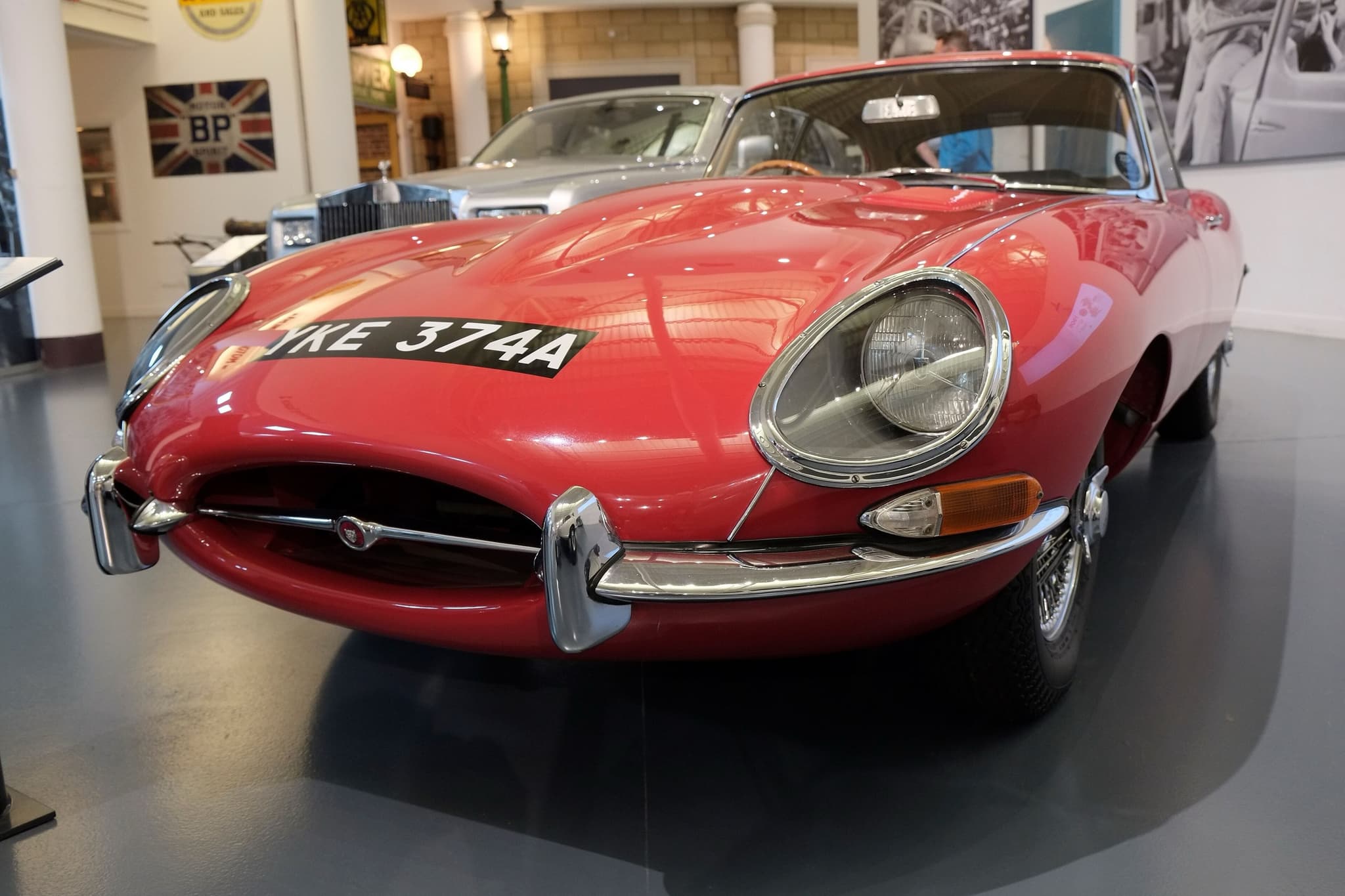
On 24 May 1957 Jaguar's test engineer Norman Dewis took a small aluminium car, still unpainted, to the test track of the Motor Industry Research Association. It was E1A, the experimental car from which the E-Type grew, and Bob Blake had built its body from drawings by Malcolm Sayer. It had first run nine days earlier, by the Jaguar Heritage Trust's account. The production car was still four years away.
Its roots were in racing. In early 1956, by the Trust's account, the chief engineer William Heynes had his chassis engineer Tom Jones build an "E" car to follow the D-type at Le Mans; Dewis recalled an unpainted aluminium car that ran but was never finished and was broken up. When a fire at Browns Lane early in 1957 ended the road-going XK-SS after 16 cars, the work went on in E1A. Bill Boddy put it plainly in Motor Sport when the car was launched: the E-Type had, "to some degree", carried on where the XK-SS left off. Like the D-type, it was built around a monocoque centre section with a tubular frame at the front for the engine and front suspension. Prototypes tells the story of E1A and the racing prototype E2A in full.source 1source 2source 3source 4
The story by date
- 1957
E1A
The experimental car runs at MIRA in May.
- 1960
E2A
The racing prototype runs at Le Mans for Briggs Cunningham.
- 1961
Geneva
Shown to the press on 15 March; in New York on 1 April.
- 1964
The 4.2
A larger engine and an all-synchromesh gearbox (transmission), announced in October.
- 1966
The 2+2
A longer body with two small rear seats, shown at Geneva in March.
- 1968
Series 2
Rebuilt around American rules, at the London Motor Show in October.
- 1971
V12
The Series 3, announced in March, every one a V12 in practice.
- 1974
The last car
A V12 roadster, built on 12 June.
Between the first prototype and the launch came four years of development. By the Trust's account, a mock-up made into a running car was tested in March 1958, the first car to carry an E-Type number, 850001, was on test in June 1959, and by July 1960 four prototypes, two coupés and two roadsters, were in testing. That summer Jaguar lent E2A, the racing prototype, to Briggs Cunningham for Le Mans; it never sold it to him.
Lyons himself, the Trust writes, thought the E-Type would be a low-volume model.
Amazingly, apart from Heynes, there was no expectation within Jaguar that the E-Type would be a success.
Jaguar presented the car to the press in Geneva on 15 March 1961, the motor show opened there the next day, and the American debut followed at the New York show on 1 April. The 1961 Jaguar E-Type tells that spring day by day. A fortnight later Graham Hill won the first race an E-Type started, at Oulton Park. Export markets came first, and British buyers had their cars from July; by the Heritage Trust's figure, 2,160 cars had been completed by the end of the year.
The car then changed almost every year. In October 1964 the Series 1 gained the larger 4.2 engine and Jaguar's new all-synchromesh gearbox. The 2+2 followed in March 1966. Open headlamps came in 1967, and American safety and emissions rules shaped the Series 2, shown at the London Motor Show in October 1968. No year was busier than 1969, going by the car numbers the Heritage Trust lists.
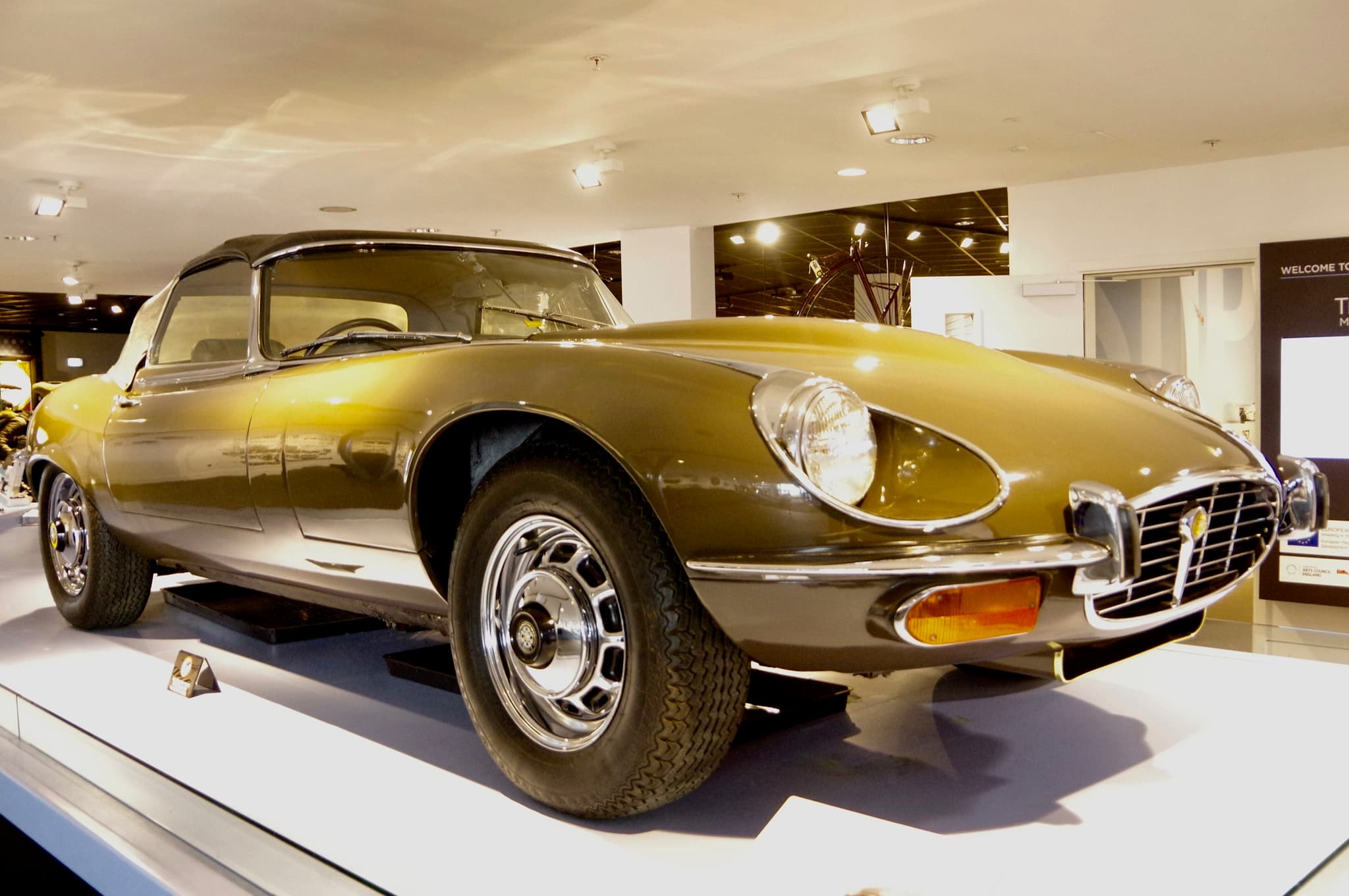
Sayer died in 1970. The Series 3, the Jaguar E-Type V12, was announced, by the Heritage Trust's record, on 29 March 1971, with its American press launch at Palm Springs that month. The 2+2 ended in the summer of 1973, and the roadster went on alone until 12 June 1974, when the last car was built. Jaguar kept it, registered it HDU 555N in February 1975, and passed it to the Jaguar Heritage Trust in 1983: it is the last E-Type. About four in five E-Types had gone abroad, by Jaguar's own figures.source 1source 5source 6source 7source 4source 8source 9source 10source 11source 12source 13source 14source 15source 16source 17
Who designed the E-Type?
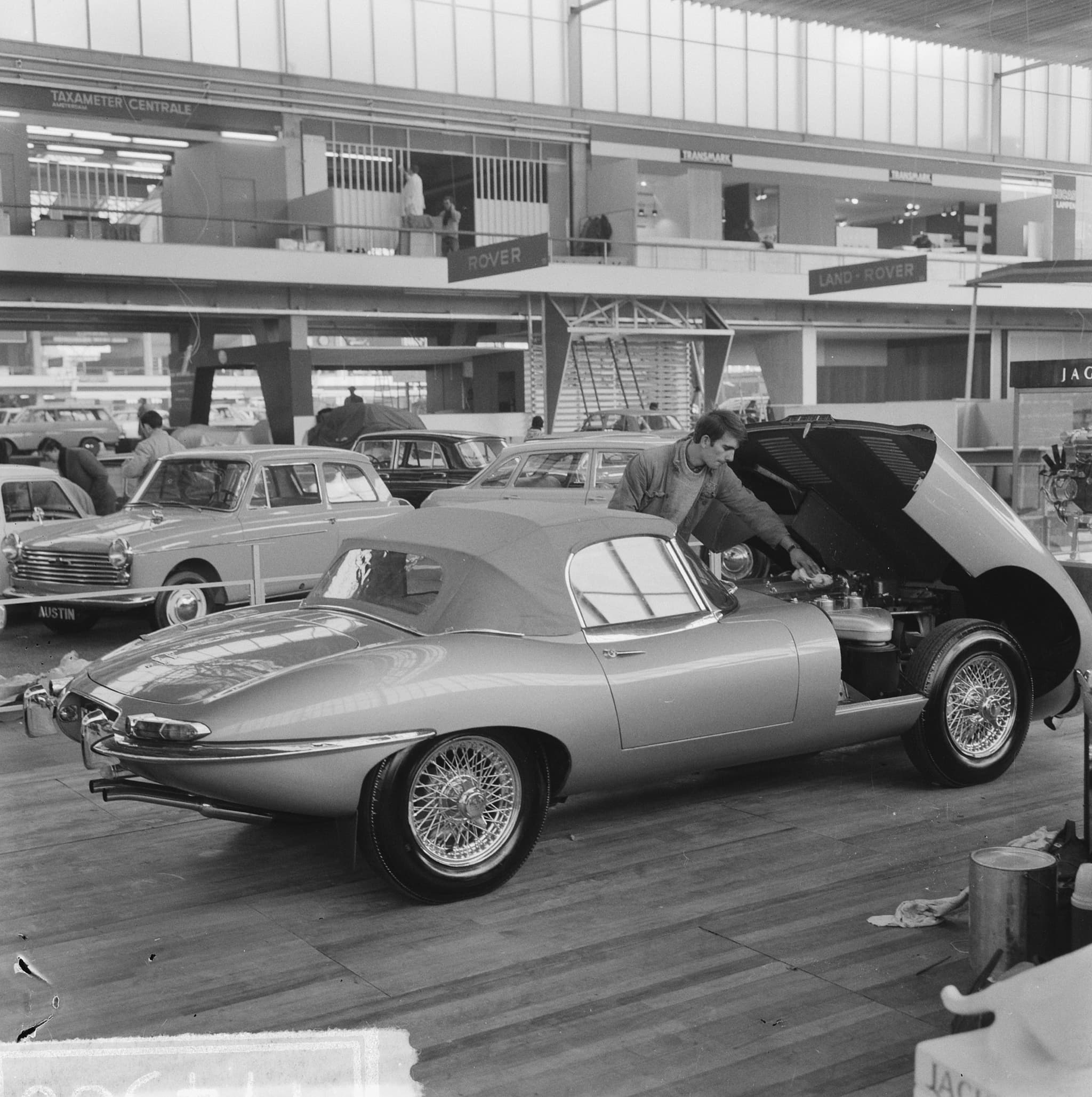
No one person. The shape is Malcolm Sayer's. Jaguar's aerodynamicist, he had drawn the C-type and the D-type, and he drew E1A's body by the end of 1956; Motor Sport, in its farewell to the E-Type in 1975, credited him with the shapes of all three. In 1961 the magazine had named no stylist at all, only "the Jaguar design team, under W. M. Heynes", and a one-tenth-scale model tested in wind tunnels.
William Heynes was the chief engineer. His department engineered the car, and the Heritage Trust credits him with keeping up the pressure to turn the idea into a production model. Tom Jones, his chassis engineer, gave Sayer the fixed points:
I gave Mr Sayer the wheelbase length, chassis details and engine height. That allowed him to work on how to design the body around the established mechanicals.
Bob Knight designed the independent rear suspension, carried in a cage of its own on rubber mountings. Sir William Lyons, Jaguar's founder, sanctioned the project and had the final say. He wanted a coupé as well as the open car. The fixed-head coupé's roof and tailgate began as Bob Blake's mock-up, which Lyons approved and refined; Sayer then drew the production shape. That account comes from the Heritage Trust alone; the coupé and Sayer's own page tell it in more detail.
The result was far lighter than the car it followed: by the Trust's figure, the E-Type weighed 225 kg (about 500 lb) less than the XK150.source 1source 18source 19source 4source 3source 20
Predecessor and successor
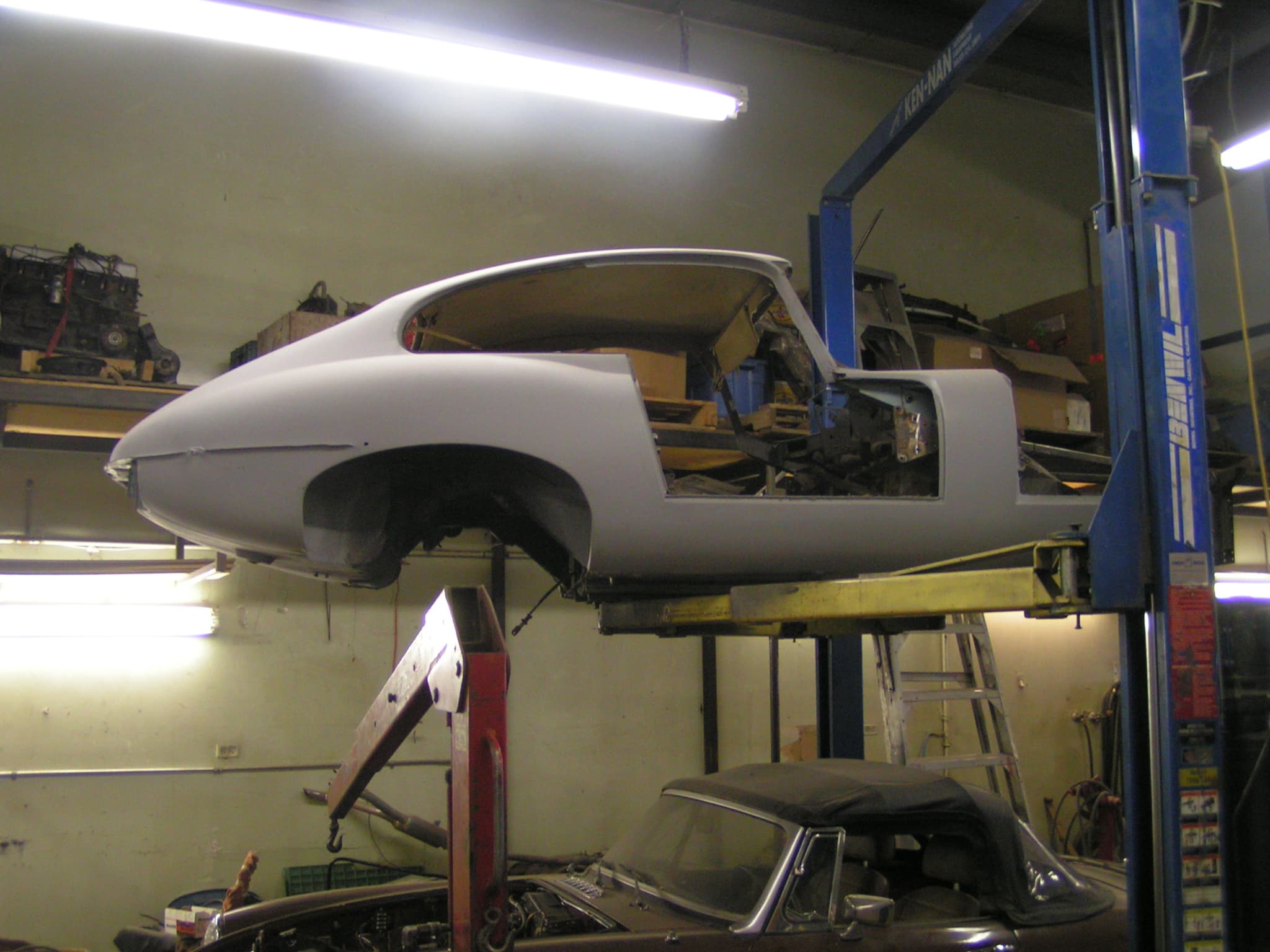
The E-Type's road-going predecessor was the XK150, the last of the line of sports cars that had begun with the XK120 in 1948. The two overlapped. The E-Type took the XK150S's three-carburettor 3.8 engine, but at the launch, Boddy wrote, it did "not replace any other Jaguar model", and, he wrote, the XK150 would "remain in production". Automotive News reported that September that XK-150 production had stopped early in the year. The Heritage Trust's Prins goes further: at first the E-Type was not meant to replace the XK range at all. By 1989 Motor Sport could call it the XK150's replacement, "although there was some overlapping to begin with".
Its successor was the XJ-S, launched at the Frankfurt show in September 1975 with a fuel-injected V12, and Jaguar insisted, Motor Sport reported, that it was "not a replacement for the E-type". In America, AROnline notes, it cost twice as much as the outgoing V12. A British Leyland man drew the line under the old car:
The 12-cylinder E-type roadster marks the last of the line of that type of car which started with the XK in 1948 and continued with the E-type in 1961.
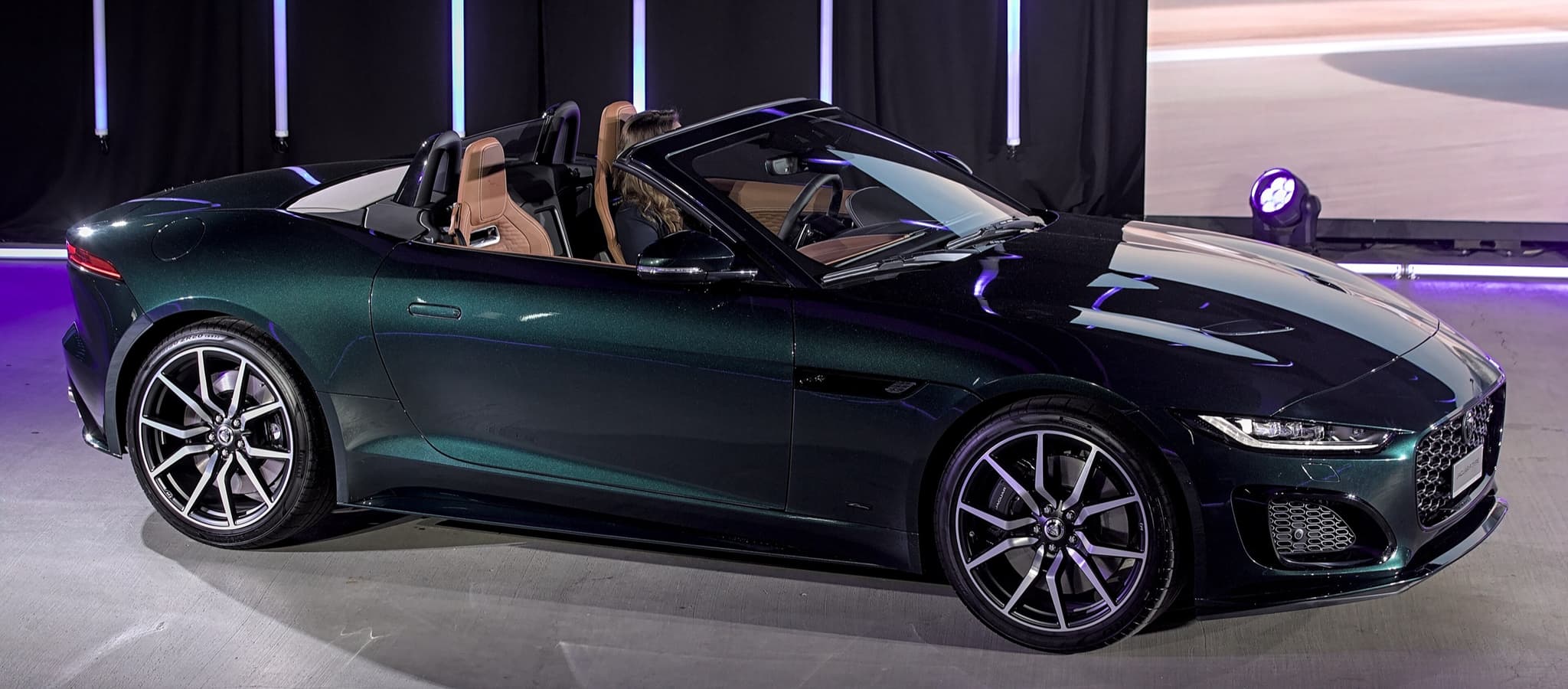
Denis Jenkinson had expected something else. Driving the V12 for Motor Sport in 1971, he admitted he had been "expecting an 'F'-type Jaguar, not a third series 'E'-type". The F-Type came much later: Jaguar presented it in Paris in September 2012 as its first two-seater sports car since the E-Type. When its production ended in 2024, Jaguar placed the final F-Type in its heritage collection, which also holds HDU 555N, to mark 50 years since the last E-Type was built.source 3source 21source 6source 1source 18source 17source 14source 22source 23source 24
Sources
Sources are given as plain text; their addresses are on the sources page.
- Primarymade at the time, by the maker or by people who were there
- Referenceserious later work: clubs, specialists, magazines, books
- François Prins, "Evolution of the E-Type", Jaguar Daimler Heritage Trust, "First Thoughts": the 1956 car, E1A and its first runs; "The Next Prototypes" and "E-Type Production"; "First Thoughts" and "The Next Prototypes": Sayer, Heynes, Jones, Knight, Blake and Lyons; "First Thoughts": not a replacement for the XK range. Reference
- François Prins, "The Story of the E1A: The Experimental Car That Preceded The E-Type", Jaguar Daimler Heritage Trust, E1A's build, its first run on 15 May 1957 and MIRA on 24 May. Reference
- Bill Boddy, "The New 3.8-Litre Jaguar E-Type G.T.", Motor Sport, Apr 1961, p. 35, p. 35, the project and the XKSS; p. 35, the design team under Heynes; the wind-tunnel model; p. 35, "does not replace any other Jaguar model"; the XK150S engine. Primary
- Motor Sport, "Jaguar E-type: the end of production and end of an era – but not of a legend", May 1975, p. 29, the XK-SS fire; the D-type layout; the Geneva show, 16 March 1961; Jaguar's figures by market; the tribute to Sayer; Heynes and his team. Primary
- François Prins and Tony Merrygold, "The Story of the E2A: E for Exciting Experiment", Jaguar Daimler Heritage Trust, E2A and Cunningham, 1960. Reference
- William Kimberley, "The Jaguar E-Type 3.8, 4.2 & V12", Motor Sport, Apr 1989, p. 81, p. 81, the July 1961 sales; p. 81, the XK150 overlap. Reference
- Jaguar Land Rover (Jaguar media newsroom), "Jaguar Celebrates 50 Years of Iconic E-type" (press release), 24 Jan 2011, facts for editors, 15 March 1961. Primary
- Jaguar Clubs of North America, Series 1 E-Type Judge's Guide (draft), part 1: Intro–Exterior, Draft, version of 21 Jul 2026, introduction: New York, 1 April 1961. Reference
- Motor Sport, "Oulton Park debut for E-Types", May 1961, p. 24, the race report. Primary
- Jaguar Daimler Heritage Trust, Research Guide No. 001F: Chassis Number Runs and Change Points by model – Jaguar E-type, Issue 3, January 2023, first and last car numbers by year. Primary
- Motor Sport, "New cars" (Earls Court), Nov 1964, p. 13, p. 13, the 4.2. Primary
- Bill Boddy and Denis Jenkinson, "The Jaguar E-type 2+2", Motor Sport, Apr 1966, p. 18, p. 18, the 2+2 at Geneva. Primary
- Bill Boddy, "On the road with the V12 E-type Jaguar", Motor Sport, Jan 1972, p. 36, Jaguar's changes by year; the Series 2 at the Motor Show; the Series 3 "in March last year". Primary
- Chris Cowin, "History: Exporting British cars to the USA – Part Two", AROnline, 31 May 2025, updated 21 Oct 2025, 1971: the Palm Springs launch; 1975: the XJ-S in America. Reference
- Jaguar Daimler Heritage Trust, "1970 Jaguar E-type Series 3 V12 2+2 WHP 205J", "launched on 29 March 1971". Primary
- Jaguar Daimler Heritage Trust, "1974 Jaguar E-type Series 3 V12 OTS HDU 555N: The Last E-type Built", the last car: built, registered, kept. Primary
- Clive Richardson, "The Jaguar XJ-S" ("A New Breed of Cat"), Motor Sport, Oct 1975, p. 26, Sayer's death in 1970; p. 26, the launch and Keith Hopkins's words. Primary
- Jaguar Daimler Heritage Trust, "E-Type Evolution Exhibition", Sayer's method; Blake and Lyons; the weight; "Structural Evolution": the weight against the XK150. Reference
- Jaguar Daimler Heritage Trust, "1963 Jaguar E-type Series 1 Coupé YKE 374A", Lyons and the coupé; Knight's rear suspension. Primary
- Jaguar Daimler Heritage Trust, "1961 Jaguar E-type 77 RW: The First E-type OTS", the style and the D-type. Primary
- Automotive News (Crain Communications), via Internet Archive, "Port-of-Entry Prices on Imported Cars", 11 Sep 1961, vol. 37 no. 3828, import price list, the XK-150's production. Primary
- Denis Jenkinson, "Driving the V12 Jaguar", Motor Sport, Apr 1971, p. 64, p. 64, "expecting an 'F'-type". Primary
- Jaguar Land Rover (Jaguar media newsroom), "Jaguar F-TYPE Revealed to a VIP Audience" (press release), 26 Sep 2012, the F-Type and the E-Type. Primary
- Jaguar Land Rover (Jaguar media newsroom), "Jaguar Marks Sports Car Anniversary with Final F-Type" (press release), 13 Jun 2024, the final F-Type and the last E-Type. Primary