Jaguar E-Type Series 1
The first E-Types, built from March 1961 to July 1968: the 3.8 until 1964 and the 4.2 after it, as roadster, coupé and, from 1966, 2+2. Also written Series I or S1, a name the cars were given only once the Series 2 arrived.
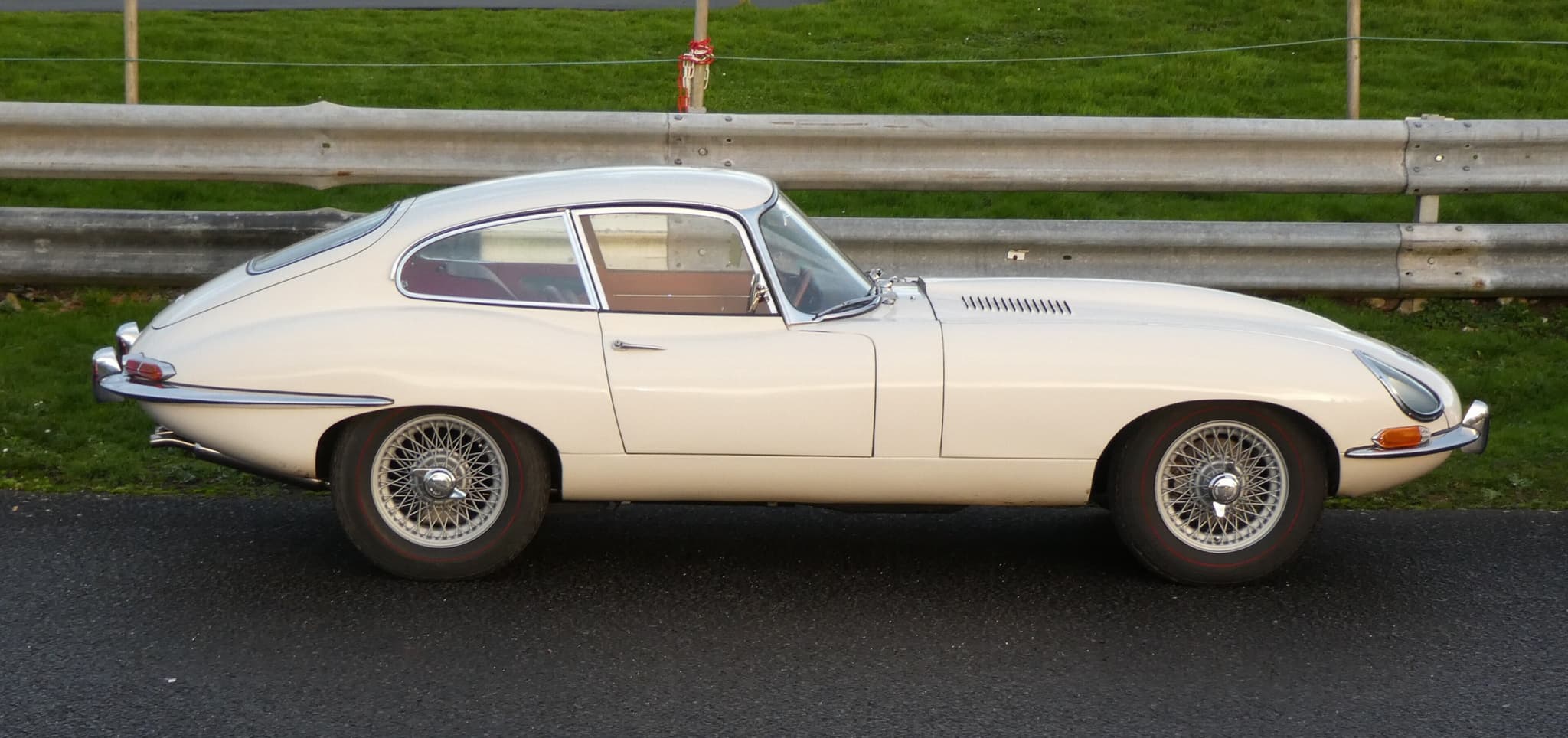
A Series 1 coupé that its photographer dates to 1962, a 3.8, at the Haynes International Motor Museum, Somerset, in January 2020.Andrew Bone from Weymouth, England, CC BY 2.0
"Series 1" is a name these cars were given afterwards. To Jaguar they were simply the E-Type, first the 3.8 and then the 4.2; once the Series 2 arrived in 1968, the earlier cars became the Series 1. By the Jaguar Heritage Trust's car numbers they were built from March 1961 to July 1968, as an open roadster and a fixed-head coupé, joined by the longer 2+2, built from late 1965 and announced in 1966. The two engines differ in size and the cars around them in many details, but they share one family of bodies.source 1source 2source 3source 4
1961–64: the 3.8
The first E-Type took the triple-carburettor 3.8 six of the Jaguar XK150S and put it into a structure from the racing D-type: a steel monocoque centre section with a square-tube frame bolted to its front, carrying the engine and front suspension. The independent rear suspension, with twin coil-spring units on each side, sat in a detachable subframe with the rear disc brakes inboard beside the differential, and the steering was rack and pinion. The launch and the earliest cars, with their outside bonnet latches and flat floors, are on 1961 Jaguar E-Type.
The gearbox (transmission) was Jaguar's old four-speed, which the Jaguar Heritage Trust calls "the aged Moss box", with synchromesh on second, third and top but none on first. It was the part the testers liked least. On a long run to Monaco in a 3.8 roadster in 1962, Motor Sport found it the least pleasant feature of the car:
The synchromesh is almost useless for rapid changes and causes jarring at the lever
Jaguar kept changing the 3.8, and in 1972 Motor Sport printed the factory's own list of the changes, year by year. In the second year of production the seats were moved back for more legroom, footwells were let into the floor and the brake pedal's angle was altered. In the third, Jaguar tried a 3.07 axle and then went back to the original 3.31, changed the rear suspension to protect its universal joints, fitted thicker rear discs, new brake pads and Dunlop SP41 radial tyres, and added stowage between the seats. From early 1963 the engine numbers carried an RA prefix in place of R.source 5source 6source 7source 8source 1source 9
1964–68: the 4.2
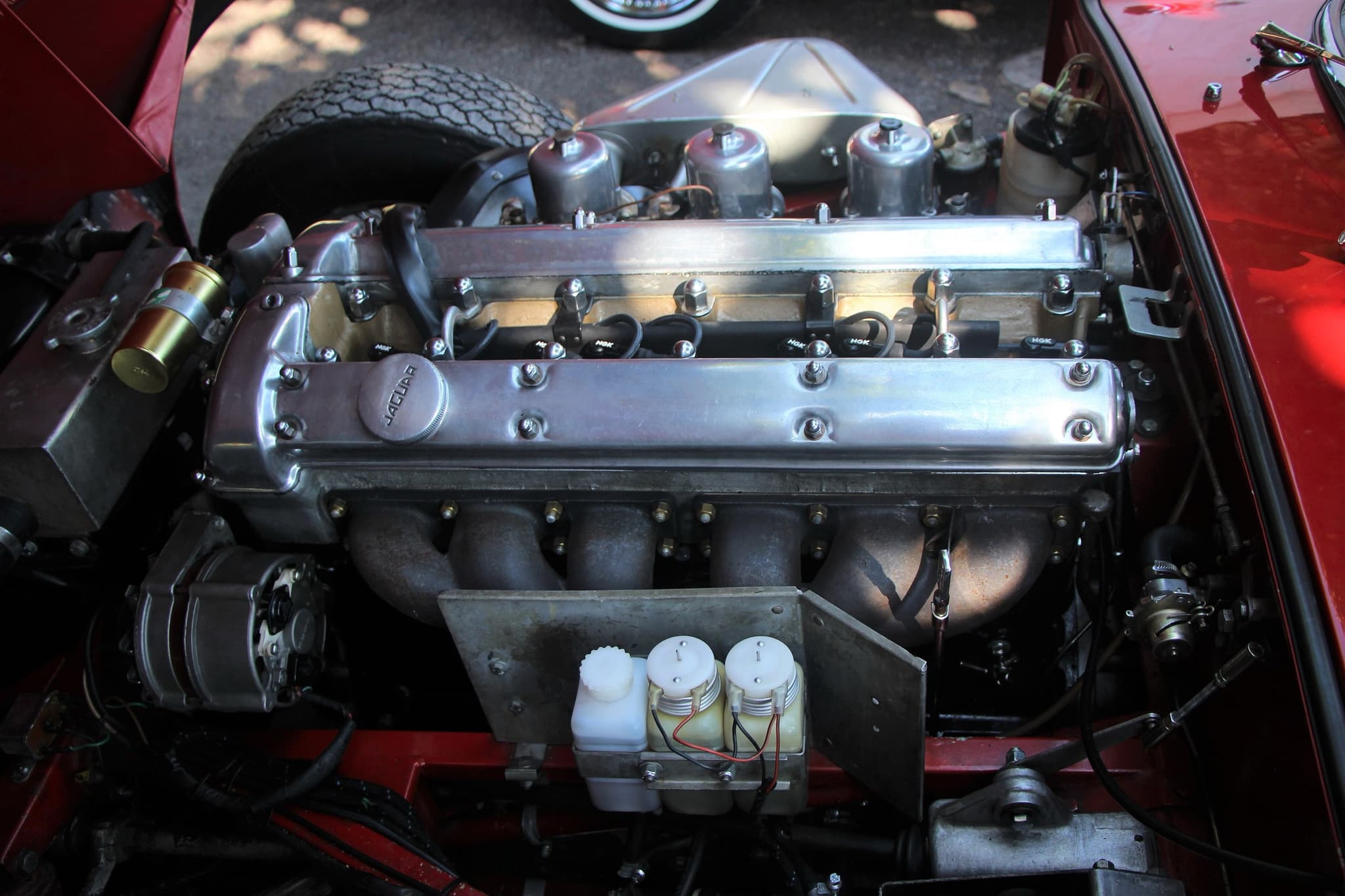
The 4.2 was announced at the London Motor Show in October 1964, and the Heritage Trust's numbers show the first cars built in August and September and no 3.8 built after August. The engine was bored out, with its cylinders moved to make room, a stiffer crankshaft, and Jaguar rated it at the same power as the 3.8, at slightly lower engine speed, with more torque; the specifications give both engines' figures. Around it came an alternator in place of the dynamo, a pre-engaged starter, a new brake servo, a diaphragm-spring clutch and new seats shaped to support the small of the back.
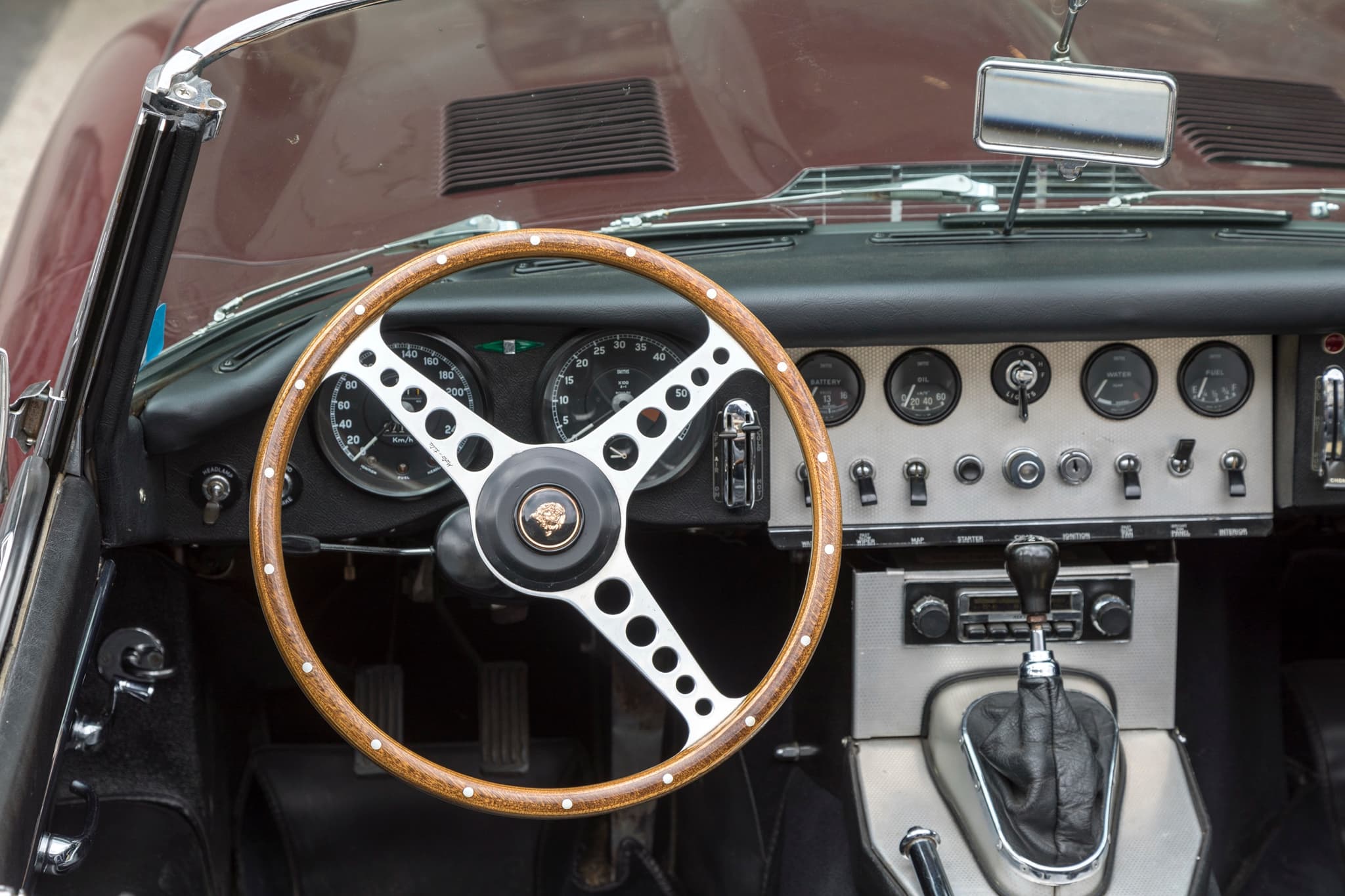
Above all, it had Jaguar's own new gearbox, with synchromesh on all four gears. Some accounts put that gearbox in the last 3.8s; every period source read ties it to the 4.2. Motor Sport's long road test of January 1965 set the two cars side by side and found the old box whined in the lower gears; of the new one it wrote:
The new box has unbeatable syncromesh and a quick if rather springy movement between gears.
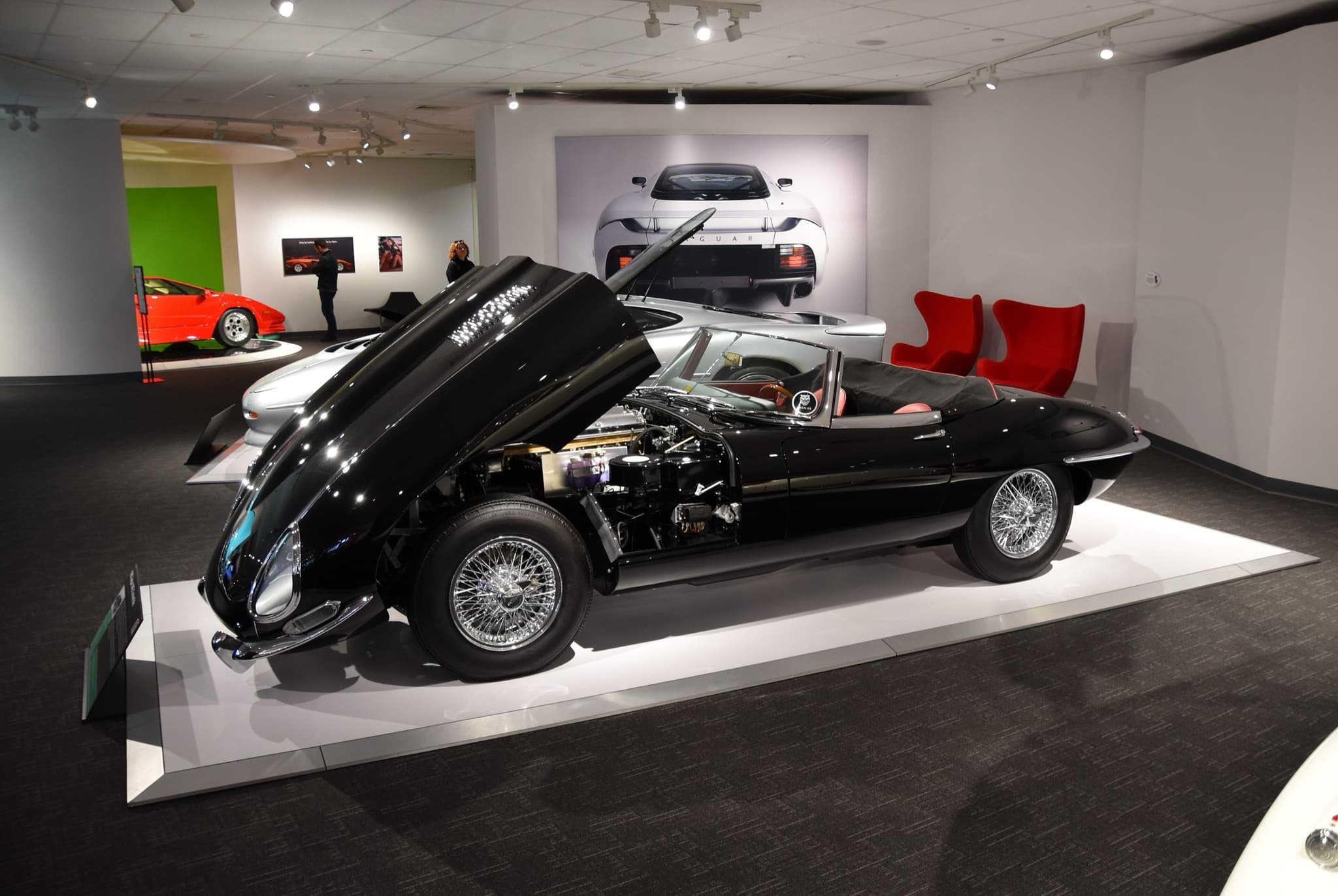
More changes followed by Jaguar's list: aluminised silencers, a better fuel pump and radiator, divided brake circuits, a lockable boot on the two-seater and covered boot hinges on the coupé. In March 1966 the 2+2 was added, and with it a wider-ratio gearbox for the 2+2 and the coupé, which went into every model the next year. Motor Sport counted the changes of 1967 as backward steps: the roadster's hood (soft top) was now made of plastic instead of canvas, and the glass covers over the headlamps were taken off. The open-headlamp cars of 1967 and 1968 are the ones enthusiasts call "Series 1½", and the Series 2 page explains them.
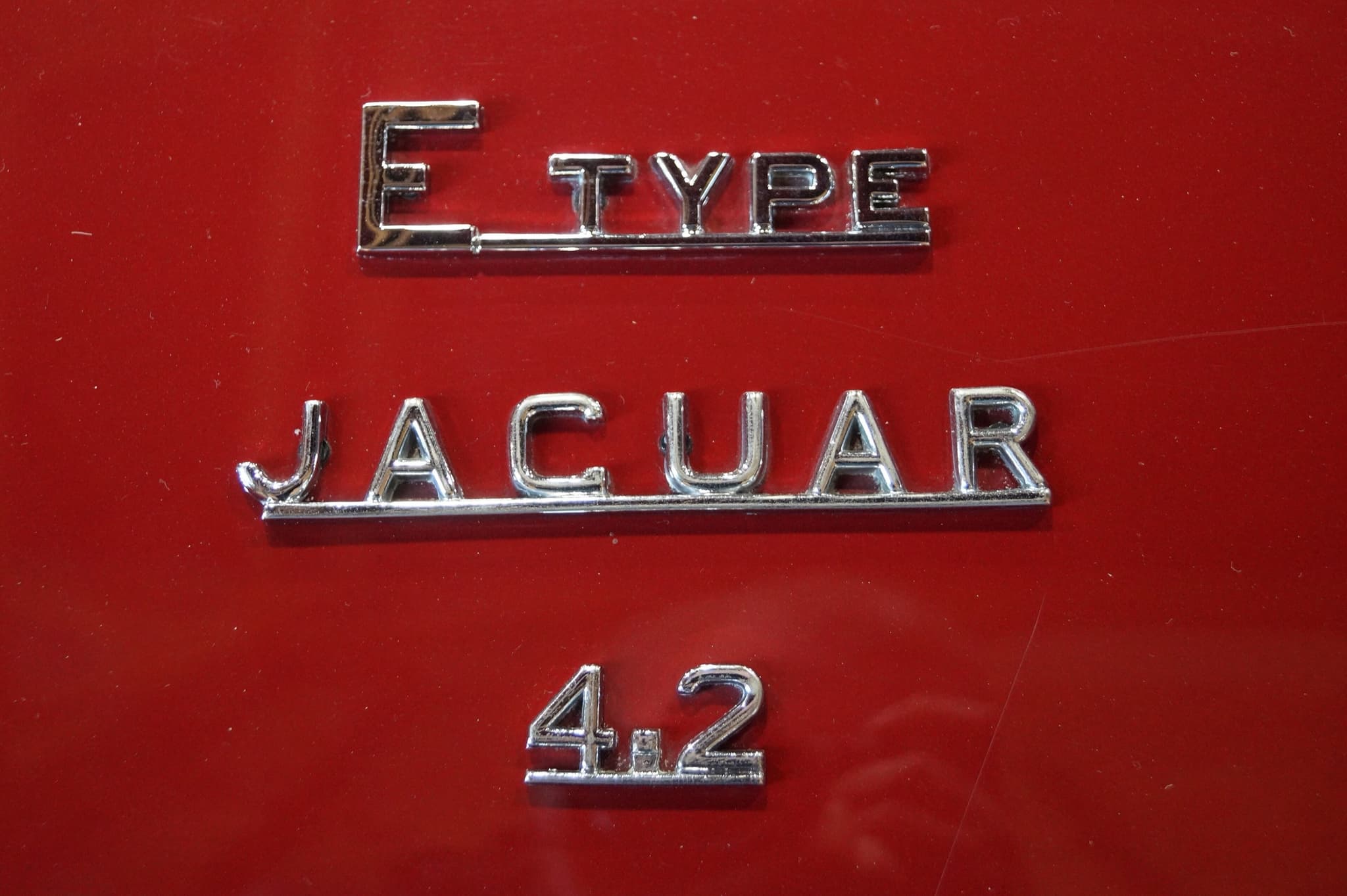
The 3.8's boot lid had carried a JAGUAR emblem alone; the 4.2's added the E-Type name and the engine size.source 3source 10source 1source 8source 2
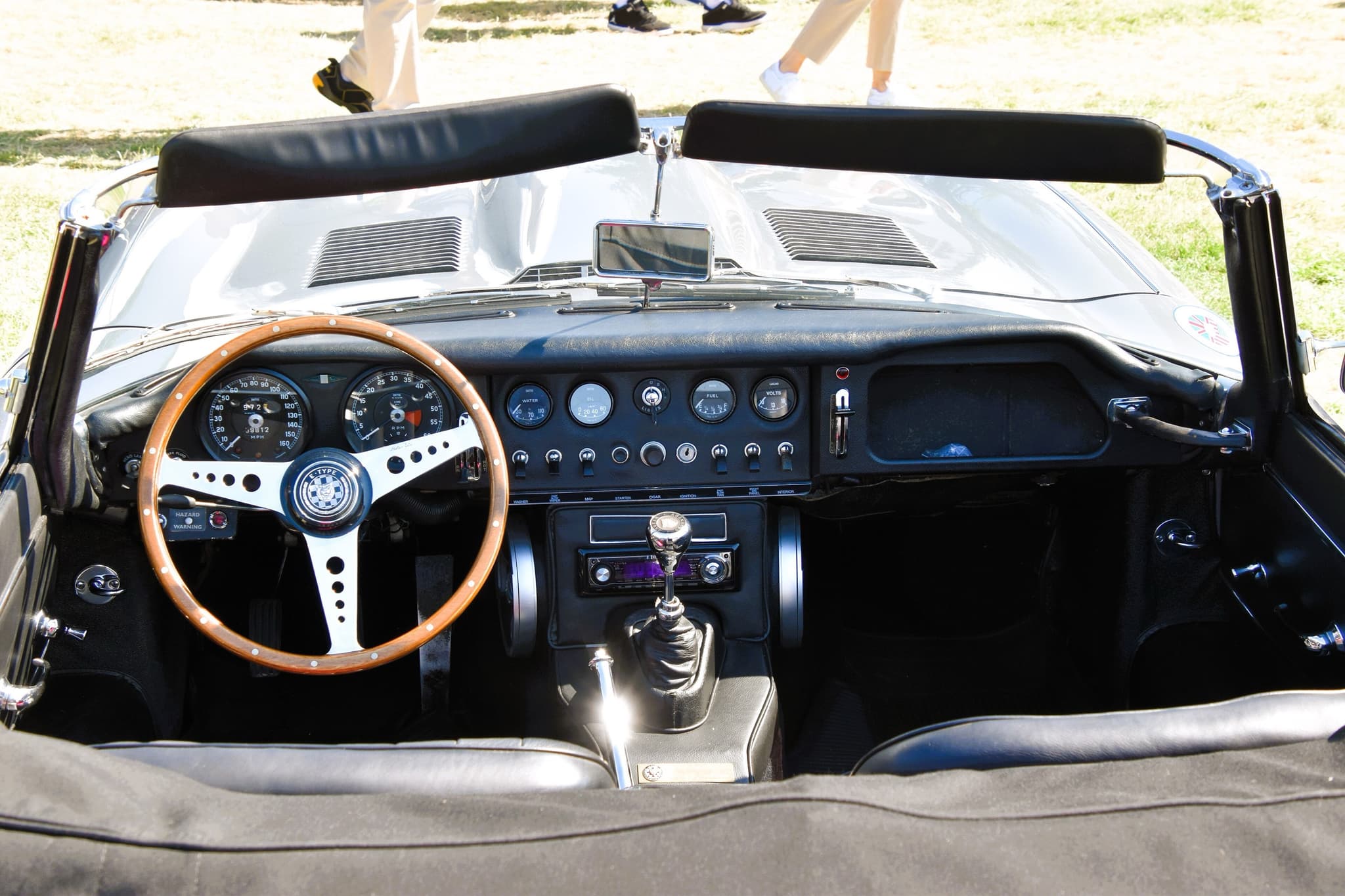
Production and markets
The production readings below lead with the XKEdata register's count for the Series 1, which leaves out the open-headlamp cars of 1967–68 (the register counts those apart, and they are on the Series 2 page), and break it down by engine, body and the early runs; the 3.8's readings include Jaguar's own figure. Production figures sets every count side by side. By the register's count, about four in five of these cars had left-hand drive.
Home buyers had to wait: Jaguar sold the car abroad first and began home-market sales only in July 1961, the month its first right-hand-drive coupé was built. Cars for America had a 3.54 to 1 axle, against the 3.07 that the 4.2 used at home, by Motor Sport's account of 1965.
It did not at first replace the car before it: at the launch, Motor Sport reported, the XK150 was still listed, and the history tells how the two overlapped. Its successor was the Series 2 of 1968. Against its rivals, Motor Sport's list of November 1964, when the 4.2 was announced, priced Ferrari's new 275 GT coupé at nearly three times as much as the 4.2 coupé.source 6source 11source 1source 12source 10source 5source 3
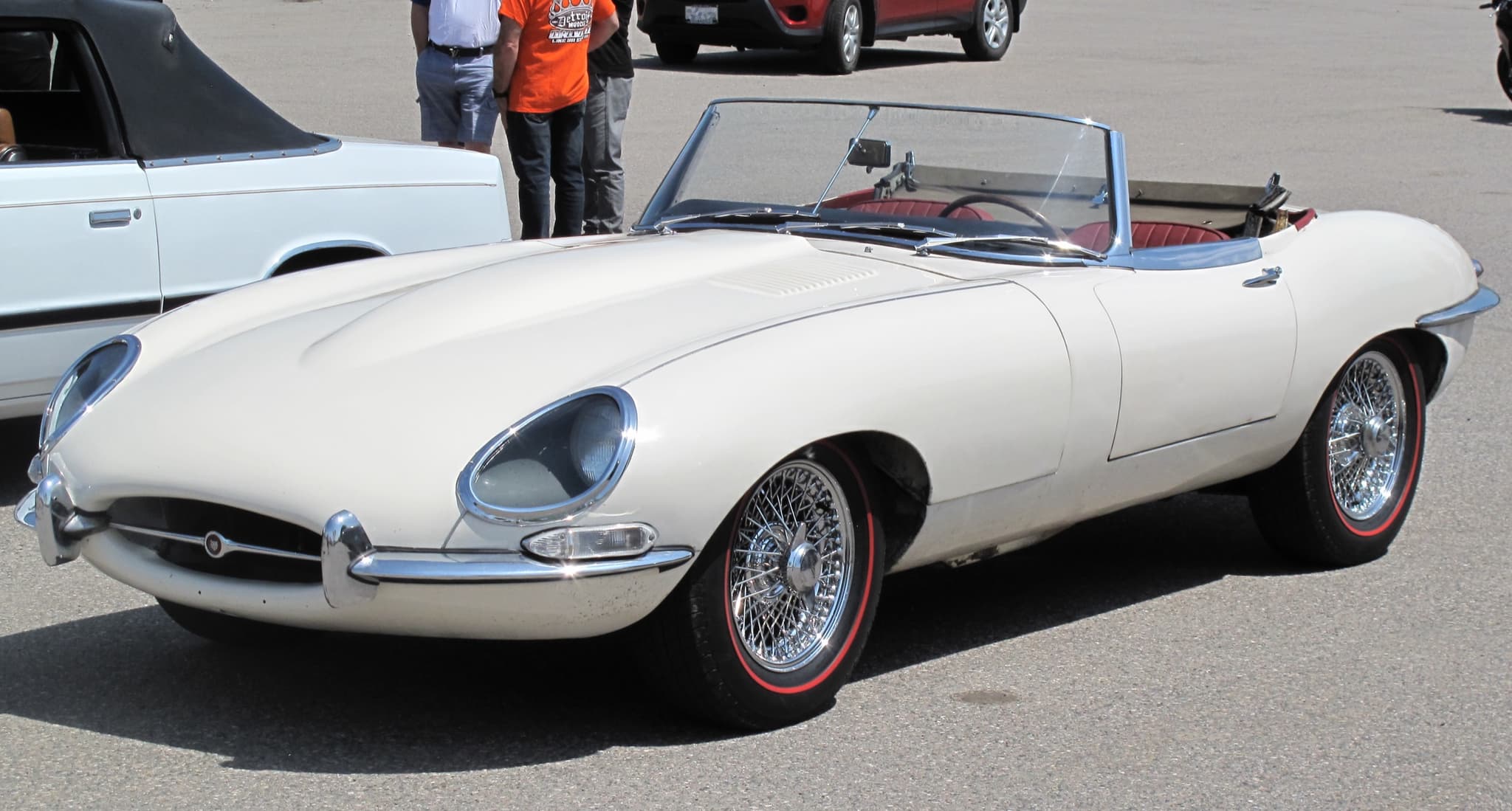
Specification: FHC
Production
Sources for Production, FHC
- Price new
- Several figures in print.Bill Boddy, "The New 3.8-Litre Jaguar E-Type G.T.", Motor Sport, Apr 1961, p. 35source 5; Automotive News (Crain Communications), via Internet Archive, "Port-of-Entry Prices on Imported Cars", 11 Sep 1961, vol. 37 no. 3828source 13
- Built
- One good source.Jaguar Daimler Heritage Trust, Research Guide No. 001F: Chassis Number Runs and Change Points by model – Jaguar E-type, Issue 3, January 2023source 1
| Price new | "£1,550 + £646 19s. 2d. purchase tax = £2,196 19s. 2d." Price new, FHC Several figures in print.
|
|---|---|
| Built | 860001 (July 1961) to 861799 (August 1964); 885001 (March 1961) to 890872 (August 1964) |
Engine
Sources for Engine, FHC
- Cylinders
- One good source.The import value, kept. Bill Boddy, "The New 3.8-Litre Jaguar E-Type G.T.", Motor Sport, Apr 1961, p. 35source 5
| Cylinders | "six-cylinder twin-cam XK engine" |
|---|
Performance
Sources for Performance, FHC
- Power
- One good source.Gross; the import value (265 / 198 / 269) kept. Bill Boddy, "The New 3.8-Litre Jaguar E-Type G.T.", Motor Sport, Apr 1961, p. 35source 5
| Power | "developing 265 b.h.p. at 5,500 r.p.m." |
|---|
Body and chassis
Sources for Body and chassis, FHC
- Body
- One good source.The import's "Fixed Head Coupe", in the form its children and siblings use. Bill Boddy, "The New 3.8-Litre Jaguar E-Type G.T.", Motor Sport, Apr 1961, p. 35source 5
| Body | the fixed-head coupé |
|---|
Specification: Flat Floor
Production
Sources for Production, Flat Floor
- Built
- One good source.Jaguar Clubs of North America, Series 1 E-Type Judge's Guide (draft), part 1: Intro–Exterior, Draft, version of 21 Jul 2026source 2
- Designers
- One good source.E-Type design team, 1957-61; the coupé roof and tailgate from Bob Blake's mock-up by the Trust's account (ERRATA R9). François Prins, "Evolution of the E-Type", Jaguar Daimler Heritage Trustsource 14
- Built at
- One good source.Bill Boddy, "The New 3.8-Litre Jaguar E-Type G.T.", Motor Sport, Apr 1961, p. 35source 5
| Built | last flat-floor cars 860175 RHD and 885503 LHD; footwells from 860176 and 885504 (SDB P.51, 2nd issue, June 1962) |
|---|---|
| Designers | Malcolm Sayer shaped the body; William Heynes, chief engineer, "Heynes was the driving force behind this venture" |
| Built at | "will be made by Jaguar at their Coventry factory" |
Engine
Sources for Engine, Flat Floor
- Engine
- One good source.The maker's own designation: Jaguar's Series 2 brochure (Oct 1968) names its "'XK' engine". Bill Boddy, "The New 3.8-Litre Jaguar E-Type G.T.", Motor Sport, Apr 1961, p. 35source 5
- Engine maker
- One good source.Bill Boddy, "The New 3.8-Litre Jaguar E-Type G.T.", Motor Sport, Apr 1961, p. 35source 5
- Engine position
- One good source.Bill Boddy, "The New 3.8-Litre Jaguar E-Type G.T.", Motor Sport, Apr 1961, p. 35source 5
- Valve gear
- One good source.Bill Boddy, "The New 3.8-Litre Jaguar E-Type G.T.", Motor Sport, Apr 1961, p. 35source 5
- Compression ratio
- One good source.Standard; 8:1 available. Bill Boddy, "The New 3.8-Litre Jaguar E-Type G.T.", Motor Sport, Apr 1961, p. 35source 5
- Fuel system
- One good source.Bill Boddy, "The New 3.8-Litre Jaguar E-Type G.T.", Motor Sport, Apr 1961, p. 35source 5
- Cooling
- One good source.Bill Boddy, "The New 3.8-Litre Jaguar E-Type G.T.", Motor Sport, Apr 1961, p. 35source 5
- Cylinder layout
- One good source.Motor Sport, "The 4.2-Litre Jaguar E-type" ("A lengthy road test of the 150 m.p.h. E-Type"), Jan 1965, p. 23source 10
- Cylinders
- One good source.Bill Boddy, "The New 3.8-Litre Jaguar E-Type G.T.", Motor Sport, Apr 1961, p. 35source 5
- Fuel
- One good source.Bill Boddy, "The New 3.8-Litre Jaguar E-Type G.T.", Motor Sport, Apr 1961, p. 35source 5
| Engine | "The six-cylinder twin-cam XK engine is used in S-type 3.8-litre triple-carburetter form" |
|---|---|
| Engine maker | "will be made by Jaguar at their Coventry factory"; "The six-cylinder twin-cam XK engine is used" |
| Engine position | "The sub-frame carries the engine and all ancillaries, together with the front suspension and steering gear" |
| Valve gear | "twin-cam" |
| Compression ratio | "using the 9-to-1 compression-ratio" |
| Fuel system | "S-type 3.8-litre triple-carburetter form" |
| Cooling | "The pressurised cooling system incorporates the new Lucas electric fan"; "The radiator is of the high efficiency cross-flow type" |
| Cylinder layout | "The cylinders have been repositioned somewhat, numbers 2 and 5 remaining in their original position, with 3 and 4 moving together and 1 and 6 moving towards the ends of the block" |
| Cylinders | "six-cylinder twin-cam XK engine" |
| Fuel | "Fuel is supplied by a submerged Lucas electric pump incorporated in the petrol tank" |
Performance
Sources for Performance, Flat Floor
- Power
- One good source.Gross (British practice of the day; ERRATA-generations §5); kW and PS by the schema's conversion. Bill Boddy, "The New 3.8-Litre Jaguar E-Type G.T.", Motor Sport, Apr 1961, p. 35source 5
- Torque
- One good source.Nm and kgf-m by the schema's conversion. Bill Boddy, "The New 3.8-Litre Jaguar E-Type G.T.", Motor Sport, Apr 1961, p. 35source 5
| Power | "developing 265 b.h.p. at 5,500 r.p.m." |
|---|---|
| Torque | "260 lb./ft. torque at 4,000 r.p.m." (lb ft) |
Running gear
Sources for Running gear, Flat Floor
- Steering
- One good source.Bill Boddy, "The New 3.8-Litre Jaguar E-Type G.T.", Motor Sport, Apr 1961, p. 35source 5
- Gearbox
- One good source.Bill Boddy, "The New 3.8-Litre Jaguar E-Type G.T.", Motor Sport, Apr 1961, p. 35source 5
- Gears
- One good source.Bill Boddy, "The New 3.8-Litre Jaguar E-Type G.T.", Motor Sport, Apr 1961, p. 35source 5
- Layout
- One good source.Bill Boddy, "The New 3.8-Litre Jaguar E-Type G.T.", Motor Sport, Apr 1961, p. 35source 5
- Front brakes
- One good source.Bill Boddy, "The New 3.8-Litre Jaguar E-Type G.T.", Motor Sport, Apr 1961, p. 35source 5
- Rear brakes
- One good source.Bill Boddy, "The New 3.8-Litre Jaguar E-Type G.T.", Motor Sport, Apr 1961, p. 35source 5
- Front suspension
- One good source.Bill Boddy, "The New 3.8-Litre Jaguar E-Type G.T.", Motor Sport, Apr 1961, p. 35source 5
- Rear suspension
- One good source.Bill Boddy, "The New 3.8-Litre Jaguar E-Type G.T.", Motor Sport, Apr 1961, p. 35source 5
- Tyres
- One good source.Bill Boddy, "The New 3.8-Litre Jaguar E-Type G.T.", Motor Sport, Apr 1961, p. 35source 5
- Wheels
- One good source.15 in from the 6.40 x 15 tyre size. Bill Boddy, "The New 3.8-Litre Jaguar E-Type G.T.", Motor Sport, Apr 1961, p. 35source 5
- Final drive
- One good source.Bill Boddy, "The New 3.8-Litre Jaguar E-Type G.T.", Motor Sport, Apr 1961, p. 35source 5
- Clutch
- One good source.Bill Boddy, "The New 3.8-Litre Jaguar E-Type G.T.", Motor Sport, Apr 1961, p. 35source 5
- Starter
- One good source.Bill Boddy, "The New 3.8-Litre Jaguar E-Type G.T.", Motor Sport, Apr 1961, p. 35source 5
| Steering | "Rack-and-pinion steering is fitted" |
|---|---|
| Gearbox | "This is manually operated by a centrally positioned gear-lever and has synchromesh on top, third and second gears" |
| Gears | "to a Jaguar four-speed gearbox" |
| Layout | "the top link is the half-shaft-universally jointed at both ends"; "The axle unit is fitted with a limited slip differential" |
| Front brakes | "Dunlop disc-brakes on all four wheels, 11-in. at the front"; "A Dunlop bellows-type servo is fitted" |
| Rear brakes | "10-in. inboard at the back"; "A Dunlop bellows-type servo is fitted" |
| Front suspension | "independent suspension based on transverse wishbones and torsion bars"; "Telescopic dampers are fitted"; "an anti-roll bar links the two lower sets of wishbones" |
| Rear suspension | "two tubular links"; "the top link is the half-shaft"; "a radius arm on each side of the car"; "twin coil-springs on each side" enclosing "telescopic hydraulic dampers" |
| Tyres | "Centre-lock 72 spoke wire wheels normally carry 6.40 x 15 Dunlop RS 5 tyres" |
| Wheels | "Centre-lock 72 spoke wire wheels normally carry 6.40 x 15 Dunlop RS 5 tyres" |
| Final drive | the front-mounted engine and "Jaguar four-speed gearbox" drive the differential carried in the rear sub-frame |
| Clutch | "a hydraulically-operated 10-in. Borg and Beck single dry plate clutch" |
| Starter | "starter (button)" among the facia switches |
Body and chassis
Sources for Body and chassis, Flat Floor
- Body
- One good source.Bill Boddy, "The New 3.8-Litre Jaguar E-Type G.T.", Motor Sport, Apr 1961, p. 35source 5
- Body material
- One good source.Bill Boddy, "The New 3.8-Litre Jaguar E-Type G.T.", Motor Sport, Apr 1961, p. 35source 5
- Seats
- One good source.Bill Boddy, "The New 3.8-Litre Jaguar E-Type G.T.", Motor Sport, Apr 1961, p. 35source 5
- Chassis material
- One good source.Bill Boddy, "The New 3.8-Litre Jaguar E-Type G.T.", Motor Sport, Apr 1961, p. 35source 5
- Chassis
- One good source.Bill Boddy, "The New 3.8-Litre Jaguar E-Type G.T.", Motor Sport, Apr 1961, p. 35source 5
| Body | the fixed-head coupé |
|---|---|
| Body material | "a body monocoque almost entirely of 20 g. sheet steel being welded up as a load-carrying structure" |
| Seats | "In both cases, the cars are two-seaters" |
| Chassis material | "a body monocoque almost entirely of 20 g. sheet steel" |
| Chassis | "the Jaguar stressed-skin method is used, dispensing with a chassis frame"; "a body monocoque" |
Dimensions and weight
Sources for Dimensions and weight, Flat Floor
- Length
- One good source.Length; 175.3 in = 445.3 cm. Bill Boddy, "The New 3.8-Litre Jaguar E-Type G.T.", Motor Sport, Apr 1961, p. 35source 5
- Width
- One good source.Width, 1961 (the 4.2 data panel of 1965 gives 5 ft 5 1/4 in); 65 in printed, cm by the schema's conversion. Bill Boddy, "The New 3.8-Litre Jaguar E-Type G.T.", Motor Sport, Apr 1961, p. 35source 5
- Height
- One good source.Height, printed for the E-type without naming the body; the sheet keeps its live rounding (48 in, 122 cm). Bill Boddy, "The New 3.8-Litre Jaguar E-Type G.T.", Motor Sport, Apr 1961, p. 35source 5
- Wheelbase
- One good source.Bill Boddy, "The New 3.8-Litre Jaguar E-Type G.T.", Motor Sport, Apr 1961, p. 35source 5
- Ground clearance
- One good source.Bill Boddy, "The New 3.8-Litre Jaguar E-Type G.T.", Motor Sport, Apr 1961, p. 35source 5
- Fuel tank
- One good source.Imperial gallons; the sheet keeps its live 63.6 L. Bill Boddy, "The New 3.8-Litre Jaguar E-Type G.T.", Motor Sport, Apr 1961, p. 35source 5
- Dry weight
- One good source.22 1/2 cwt = 2,520 lb, the maker's dry weight; kg converted. Bill Boddy, "The New 3.8-Litre Jaguar E-Type G.T.", Motor Sport, Apr 1961, p. 35source 5
| Length | "dimensions of 14 ft. 7 5/16 in. x 5 ft. 5 in. x 4 ft. 0 1/8 in." |
|---|---|
| Width | "5 ft. 5 in." |
| Height | "4 ft. 0 1/8" |
| Wheelbase | "a wheelbase of 8 ft." |
| Ground clearance | "Ground clearance is quoted as 5 1/2 in." |
| Fuel tank | "The fuel tank holds 14 gallons." |
| Dry weight | "dry weights as 22 cwt. for the two-seater, 22 1/2 cwt for the coupé" |
Specification: 3.8 Roadster (flat floor)
Production
Sources for Production, 3.8 Roadster (flat floor)
- Built
- One good source.Jaguar Clubs of North America, Series 1 E-Type Judge's Guide (draft), part 1: Intro–Exterior, Draft, version of 21 Jul 2026source 2
- Designers
- One good source.E-Type design team, 1957-61. François Prins, "Evolution of the E-Type", Jaguar Daimler Heritage Trustsource 14
- Built at
- One good source.Bill Boddy, "The New 3.8-Litre Jaguar E-Type G.T.", Motor Sport, Apr 1961, p. 35source 5
| Built | last flat-floor cars 850357 RHD and 876581 LHD; footwells from 850358 and 876582 (SDB P.51, 2nd issue, June 1962) |
|---|---|
| Designers | Malcolm Sayer shaped the body; William Heynes, chief engineer, "Heynes was the driving force behind this venture" |
| Built at | "will be made by Jaguar at their Coventry factory" |
Engine
Sources for Engine, 3.8 Roadster (flat floor)
- Engine
- One good source.The maker's own designation: Jaguar's Series 2 brochure (Oct 1968) names its "'XK' engine". Bill Boddy, "The New 3.8-Litre Jaguar E-Type G.T.", Motor Sport, Apr 1961, p. 35source 5
- Engine maker
- One good source.Bill Boddy, "The New 3.8-Litre Jaguar E-Type G.T.", Motor Sport, Apr 1961, p. 35source 5
- Capacity
- One good source.The 1962 roadster road test; 231 cu in by the schema's conversion. Bill Boddy, "By E-Type To Monaco", Motor Sport, Jul 1962, p. 59source 9
- Engine position
- One good source.Bill Boddy, "The New 3.8-Litre Jaguar E-Type G.T.", Motor Sport, Apr 1961, p. 35source 5
- Valve gear
- One good source.Bill Boddy, "The New 3.8-Litre Jaguar E-Type G.T.", Motor Sport, Apr 1961, p. 35source 5
- Compression ratio
- One good source.Standard; 8:1 available. Bill Boddy, "The New 3.8-Litre Jaguar E-Type G.T.", Motor Sport, Apr 1961, p. 35source 5
- Fuel system
- One good source.Bill Boddy, "The New 3.8-Litre Jaguar E-Type G.T.", Motor Sport, Apr 1961, p. 35source 5
- Carburettors
- One good source.The 1962 roadster road test, as read in specifications.md (S3532). Bill Boddy, "By E-Type To Monaco", Motor Sport, Jul 1962, p. 59source 9
- Cooling
- One good source.Bill Boddy, "The New 3.8-Litre Jaguar E-Type G.T.", Motor Sport, Apr 1961, p. 35source 5
- Cylinder layout
- One good source.Motor Sport, "The 4.2-Litre Jaguar E-type" ("A lengthy road test of the 150 m.p.h. E-Type"), Jan 1965, p. 23source 10
- Cylinders
- One good source.Bill Boddy, "The New 3.8-Litre Jaguar E-Type G.T.", Motor Sport, Apr 1961, p. 35source 5
- Fuel
- One good source.Bill Boddy, "The New 3.8-Litre Jaguar E-Type G.T.", Motor Sport, Apr 1961, p. 35source 5
| Engine | "The six-cylinder twin-cam XK engine is used in S-type 3.8-litre triple-carburetter form" |
|---|---|
| Engine maker | "will be made by Jaguar at their Coventry factory"; "The six-cylinder twin-cam XK engine is used" |
| Capacity | "a very hard-driven 3,781-c.c. engine" (cc) |
| Engine position | "The sub-frame carries the engine and all ancillaries, together with the front suspension and steering gear" |
| Valve gear | "twin-cam" |
| Compression ratio | "using the 9-to-1 compression-ratio" |
| Fuel system | "S-type 3.8-litre triple-carburetter form" |
| Carburettors | three 2-in. SU HD8 carburettors |
| Cooling | "The pressurised cooling system incorporates the new Lucas electric fan"; "The radiator is of the high efficiency cross-flow type" |
| Cylinder layout | "The cylinders have been repositioned somewhat, numbers 2 and 5 remaining in their original position, with 3 and 4 moving together and 1 and 6 moving towards the ends of the block" |
| Cylinders | "six-cylinder twin-cam XK engine" |
| Fuel | "Fuel is supplied by a submerged Lucas electric pump incorporated in the petrol tank" |
Performance
Sources for Performance, 3.8 Roadster (flat floor)
- Power
- One good source.Gross (British practice of the day; ERRATA-generations §5); kW and PS by the schema's conversion. Bill Boddy, "The New 3.8-Litre Jaguar E-Type G.T.", Motor Sport, Apr 1961, p. 35source 5
- Torque
- One good source.Nm and kgf-m by the schema's conversion. Bill Boddy, "The New 3.8-Litre Jaguar E-Type G.T.", Motor Sport, Apr 1961, p. 35source 5
| Power | "developing 265 b.h.p. at 5,500 r.p.m." |
|---|---|
| Torque | "260 lb./ft. torque at 4,000 r.p.m." (lb ft) |
Running gear
Sources for Running gear, 3.8 Roadster (flat floor)
- Steering
- One good source.Bill Boddy, "The New 3.8-Litre Jaguar E-Type G.T.", Motor Sport, Apr 1961, p. 35source 5
- Gearbox
- One good source.Bill Boddy, "The New 3.8-Litre Jaguar E-Type G.T.", Motor Sport, Apr 1961, p. 35source 5
- Gears
- One good source.Bill Boddy, "The New 3.8-Litre Jaguar E-Type G.T.", Motor Sport, Apr 1961, p. 35source 5
- Layout
- One good source.Bill Boddy, "The New 3.8-Litre Jaguar E-Type G.T.", Motor Sport, Apr 1961, p. 35source 5
- Front brakes
- One good source.Bill Boddy, "The New 3.8-Litre Jaguar E-Type G.T.", Motor Sport, Apr 1961, p. 35source 5
- Rear brakes
- One good source.Bill Boddy, "The New 3.8-Litre Jaguar E-Type G.T.", Motor Sport, Apr 1961, p. 35source 5
- Front suspension
- One good source.Bill Boddy, "The New 3.8-Litre Jaguar E-Type G.T.", Motor Sport, Apr 1961, p. 35source 5
- Rear suspension
- One good source.Bill Boddy, "The New 3.8-Litre Jaguar E-Type G.T.", Motor Sport, Apr 1961, p. 35source 5
- Tyres
- One good source.Bill Boddy, "The New 3.8-Litre Jaguar E-Type G.T.", Motor Sport, Apr 1961, p. 35source 5
- Wheels
- One good source.15 in from the 6.40 x 15 tyre size. Bill Boddy, "The New 3.8-Litre Jaguar E-Type G.T.", Motor Sport, Apr 1961, p. 35source 5
- Final drive
- One good source.Bill Boddy, "The New 3.8-Litre Jaguar E-Type G.T.", Motor Sport, Apr 1961, p. 35source 5
- Clutch
- One good source.Bill Boddy, "The New 3.8-Litre Jaguar E-Type G.T.", Motor Sport, Apr 1961, p. 35source 5
- Starter
- One good source.Bill Boddy, "The New 3.8-Litre Jaguar E-Type G.T.", Motor Sport, Apr 1961, p. 35source 5
| Steering | "Rack-and-pinion steering is fitted" |
|---|---|
| Gearbox | "This is manually operated by a centrally positioned gear-lever and has synchromesh on top, third and second gears" |
| Gears | "to a Jaguar four-speed gearbox" |
| Layout | "the top link is the half-shaft-universally jointed at both ends"; "The axle unit is fitted with a limited slip differential" |
| Front brakes | "Dunlop disc-brakes on all four wheels, 11-in. at the front"; "A Dunlop bellows-type servo is fitted" |
| Rear brakes | "10-in. inboard at the back"; "A Dunlop bellows-type servo is fitted" |
| Front suspension | "independent suspension based on transverse wishbones and torsion bars"; "Telescopic dampers are fitted"; "an anti-roll bar links the two lower sets of wishbones" |
| Rear suspension | "two tubular links"; "the top link is the half-shaft"; "a radius arm on each side of the car"; "twin coil-springs on each side" enclosing "telescopic hydraulic dampers" |
| Tyres | "Centre-lock 72 spoke wire wheels normally carry 6.40 x 15 Dunlop RS 5 tyres" |
| Wheels | "Centre-lock 72 spoke wire wheels normally carry 6.40 x 15 Dunlop RS 5 tyres" |
| Final drive | the front-mounted engine and "Jaguar four-speed gearbox" drive the differential carried in the rear sub-frame |
| Clutch | "a hydraulically-operated 10-in. Borg and Beck single dry plate clutch" |
| Starter | "starter (button)" among the facia switches |
Body and chassis
Sources for Body and chassis, 3.8 Roadster (flat floor)
- Body
- One good source.Bill Boddy, "The New 3.8-Litre Jaguar E-Type G.T.", Motor Sport, Apr 1961, p. 35source 5
- Body material
- One good source.Bill Boddy, "The New 3.8-Litre Jaguar E-Type G.T.", Motor Sport, Apr 1961, p. 35source 5
- Seats
- One good source.Bill Boddy, "The New 3.8-Litre Jaguar E-Type G.T.", Motor Sport, Apr 1961, p. 35source 5
- Chassis material
- One good source.Bill Boddy, "The New 3.8-Litre Jaguar E-Type G.T.", Motor Sport, Apr 1961, p. 35source 5
- Chassis
- One good source.Bill Boddy, "The New 3.8-Litre Jaguar E-Type G.T.", Motor Sport, Apr 1961, p. 35source 5
| Body | the open sports car, "with or without detachable hard-top" |
|---|---|
| Body material | "a body monocoque almost entirely of 20 g. sheet steel being welded up as a load-carrying structure" |
| Seats | "In both cases, the cars are two-seaters" |
| Chassis material | "a body monocoque almost entirely of 20 g. sheet steel" |
| Chassis | "the Jaguar stressed-skin method is used, dispensing with a chassis frame"; "a body monocoque" |
Dimensions and weight
Sources for Dimensions and weight, 3.8 Roadster (flat floor)
- Length
- One good source.Length; 175.3 in = 445.3 cm. Bill Boddy, "The New 3.8-Litre Jaguar E-Type G.T.", Motor Sport, Apr 1961, p. 35source 5
- Width
- One good source.Width, 1961 (the 4.2 data panel of 1965 gives 5 ft 5 1/4 in); 65 in printed, cm by the schema's conversion. Bill Boddy, "The New 3.8-Litre Jaguar E-Type G.T.", Motor Sport, Apr 1961, p. 35source 5
- Height
- One good source.Height, printed for the E-type without naming the body; the sheet keeps its live rounding (48 in, 122 cm). Bill Boddy, "The New 3.8-Litre Jaguar E-Type G.T.", Motor Sport, Apr 1961, p. 35source 5
- Wheelbase
- One good source.Bill Boddy, "The New 3.8-Litre Jaguar E-Type G.T.", Motor Sport, Apr 1961, p. 35source 5
- Ground clearance
- One good source.Bill Boddy, "The New 3.8-Litre Jaguar E-Type G.T.", Motor Sport, Apr 1961, p. 35source 5
- Fuel tank
- One good source.Imperial gallons; the sheet keeps its live 63.6 L. Bill Boddy, "The New 3.8-Litre Jaguar E-Type G.T.", Motor Sport, Apr 1961, p. 35source 5
- Dry weight
- One good source.22 cwt = 2,464 lb, the maker's dry weight; kg converted. Bill Boddy, "The New 3.8-Litre Jaguar E-Type G.T.", Motor Sport, Apr 1961, p. 35source 5
| Length | "dimensions of 14 ft. 7 5/16 in. x 5 ft. 5 in. x 4 ft. 0 1/8 in." |
|---|---|
| Width | "5 ft. 5 in." |
| Height | "4 ft. 0 1/8" |
| Wheelbase | "a wheelbase of 8 ft." |
| Ground clearance | "Ground clearance is quoted as 5 1/2 in." |
| Fuel tank | "The fuel tank holds 14 gallons." |
| Dry weight | "dry weights as 22 cwt. for the two-seater, 22 1/2 cwt for the coupé" |
Specification: 3.8 Coupé (outside latch)
Production
Sources for Production, 3.8 Coupé (outside latch)
- Price new
- One good source.Coupé. Bill Boddy, "The New 3.8-Litre Jaguar E-Type G.T.", Motor Sport, Apr 1961, p. 35source 5
- Built
- One good source.Jaguar Clubs of North America, Series 1 E-Type Judge's Guide (draft), part 1: Intro–Exterior, Draft, version of 21 Jul 2026source 2
- Designers
- One good source.E-Type design team, 1957-61; the coupé roof and tailgate from Bob Blake's mock-up by the Trust's account (ERRATA R9). François Prins, "Evolution of the E-Type", Jaguar Daimler Heritage Trustsource 14
- Built at
- One good source.Bill Boddy, "The New 3.8-Litre Jaguar E-Type G.T.", Motor Sport, Apr 1961, p. 35source 5
| Price new | "£1,550 + £646 19s. 2d. purchase tax = £2,196 19s. 2d." |
|---|---|
| Built | external bonnet locks discontinued at 860005 RHD and 885021 LHD (SDB P.46); latches inside from October 1961 (Service Bulletin N.8) |
| Designers | Malcolm Sayer shaped the body; William Heynes, chief engineer, "Heynes was the driving force behind this venture" |
| Built at | "will be made by Jaguar at their Coventry factory" |
Engine
Sources for Engine, 3.8 Coupé (outside latch)
- Engine
- One good source.The maker's own designation: Jaguar's Series 2 brochure (Oct 1968) names its "'XK' engine". Bill Boddy, "The New 3.8-Litre Jaguar E-Type G.T.", Motor Sport, Apr 1961, p. 35source 5
- Engine maker
- One good source.Bill Boddy, "The New 3.8-Litre Jaguar E-Type G.T.", Motor Sport, Apr 1961, p. 35source 5
- Engine position
- One good source.Bill Boddy, "The New 3.8-Litre Jaguar E-Type G.T.", Motor Sport, Apr 1961, p. 35source 5
- Valve gear
- One good source.Bill Boddy, "The New 3.8-Litre Jaguar E-Type G.T.", Motor Sport, Apr 1961, p. 35source 5
- Compression ratio
- One good source.Standard; 8:1 available. Bill Boddy, "The New 3.8-Litre Jaguar E-Type G.T.", Motor Sport, Apr 1961, p. 35source 5
- Fuel system
- One good source.Bill Boddy, "The New 3.8-Litre Jaguar E-Type G.T.", Motor Sport, Apr 1961, p. 35source 5
- Cooling
- One good source.Bill Boddy, "The New 3.8-Litre Jaguar E-Type G.T.", Motor Sport, Apr 1961, p. 35source 5
- Cylinder layout
- One good source.Motor Sport, "The 4.2-Litre Jaguar E-type" ("A lengthy road test of the 150 m.p.h. E-Type"), Jan 1965, p. 23source 10
- Cylinders
- One good source.Bill Boddy, "The New 3.8-Litre Jaguar E-Type G.T.", Motor Sport, Apr 1961, p. 35source 5
- Fuel
- One good source.Bill Boddy, "The New 3.8-Litre Jaguar E-Type G.T.", Motor Sport, Apr 1961, p. 35source 5
| Engine | "The six-cylinder twin-cam XK engine is used in S-type 3.8-litre triple-carburetter form" |
|---|---|
| Engine maker | "will be made by Jaguar at their Coventry factory"; "The six-cylinder twin-cam XK engine is used" |
| Engine position | "The sub-frame carries the engine and all ancillaries, together with the front suspension and steering gear" |
| Valve gear | "twin-cam" |
| Compression ratio | "using the 9-to-1 compression-ratio" |
| Fuel system | "S-type 3.8-litre triple-carburetter form" |
| Cooling | "The pressurised cooling system incorporates the new Lucas electric fan"; "The radiator is of the high efficiency cross-flow type" |
| Cylinder layout | "The cylinders have been repositioned somewhat, numbers 2 and 5 remaining in their original position, with 3 and 4 moving together and 1 and 6 moving towards the ends of the block" |
| Cylinders | "six-cylinder twin-cam XK engine" |
| Fuel | "Fuel is supplied by a submerged Lucas electric pump incorporated in the petrol tank" |
Performance
Sources for Performance, 3.8 Coupé (outside latch)
- Power
- One good source.Gross (British practice of the day; ERRATA-generations §5); kW and PS by the schema's conversion. Bill Boddy, "The New 3.8-Litre Jaguar E-Type G.T.", Motor Sport, Apr 1961, p. 35source 5
- Torque
- One good source.Nm and kgf-m by the schema's conversion. Bill Boddy, "The New 3.8-Litre Jaguar E-Type G.T.", Motor Sport, Apr 1961, p. 35source 5
- Top speed
- One good source.The Autocar's test of 9600 HP (885002), a works-prepared press car on Dunlop R5 racing tyres, March 1961. Motor Sport, "Jaguar E-type: the end of production and end of an era – but not of a legend", May 1975, p. 29source 6
- 0–60 mph
- One good source.The Autocar's 9600 HP, 1961. Motor Sport, "Jaguar E-type: the end of production and end of an era – but not of a legend", May 1975, p. 29source 6
| Power | "developing 265 b.h.p. at 5,500 r.p.m." |
|---|---|
| Torque | "260 lb./ft. torque at 4,000 r.p.m." (lb ft) |
| Top speed | 150.4 mph mean |
| 0–60 mph | 6.9 s |
Running gear
Sources for Running gear, 3.8 Coupé (outside latch)
- Steering
- One good source.Bill Boddy, "The New 3.8-Litre Jaguar E-Type G.T.", Motor Sport, Apr 1961, p. 35source 5
- Gearbox
- One good source.Bill Boddy, "The New 3.8-Litre Jaguar E-Type G.T.", Motor Sport, Apr 1961, p. 35source 5
- Gears
- One good source.Bill Boddy, "The New 3.8-Litre Jaguar E-Type G.T.", Motor Sport, Apr 1961, p. 35source 5
- Layout
- One good source.Bill Boddy, "The New 3.8-Litre Jaguar E-Type G.T.", Motor Sport, Apr 1961, p. 35source 5
- Front brakes
- One good source.Bill Boddy, "The New 3.8-Litre Jaguar E-Type G.T.", Motor Sport, Apr 1961, p. 35source 5
- Rear brakes
- One good source.Bill Boddy, "The New 3.8-Litre Jaguar E-Type G.T.", Motor Sport, Apr 1961, p. 35source 5
- Front suspension
- One good source.Bill Boddy, "The New 3.8-Litre Jaguar E-Type G.T.", Motor Sport, Apr 1961, p. 35source 5
- Rear suspension
- One good source.Bill Boddy, "The New 3.8-Litre Jaguar E-Type G.T.", Motor Sport, Apr 1961, p. 35source 5
- Tyres
- One good source.Bill Boddy, "The New 3.8-Litre Jaguar E-Type G.T.", Motor Sport, Apr 1961, p. 35source 5
- Wheels
- One good source.15 in from the 6.40 x 15 tyre size. Bill Boddy, "The New 3.8-Litre Jaguar E-Type G.T.", Motor Sport, Apr 1961, p. 35source 5
- Final drive
- One good source.Bill Boddy, "The New 3.8-Litre Jaguar E-Type G.T.", Motor Sport, Apr 1961, p. 35source 5
- Clutch
- One good source.Bill Boddy, "The New 3.8-Litre Jaguar E-Type G.T.", Motor Sport, Apr 1961, p. 35source 5
- Starter
- One good source.Bill Boddy, "The New 3.8-Litre Jaguar E-Type G.T.", Motor Sport, Apr 1961, p. 35source 5
| Steering | "Rack-and-pinion steering is fitted" |
|---|---|
| Gearbox | "This is manually operated by a centrally positioned gear-lever and has synchromesh on top, third and second gears" |
| Gears | "to a Jaguar four-speed gearbox" |
| Layout | "the top link is the half-shaft-universally jointed at both ends"; "The axle unit is fitted with a limited slip differential" |
| Front brakes | "Dunlop disc-brakes on all four wheels, 11-in. at the front"; "A Dunlop bellows-type servo is fitted" |
| Rear brakes | "10-in. inboard at the back"; "A Dunlop bellows-type servo is fitted" |
| Front suspension | "independent suspension based on transverse wishbones and torsion bars"; "Telescopic dampers are fitted"; "an anti-roll bar links the two lower sets of wishbones" |
| Rear suspension | "two tubular links"; "the top link is the half-shaft"; "a radius arm on each side of the car"; "twin coil-springs on each side" enclosing "telescopic hydraulic dampers" |
| Tyres | "Centre-lock 72 spoke wire wheels normally carry 6.40 x 15 Dunlop RS 5 tyres" |
| Wheels | "Centre-lock 72 spoke wire wheels normally carry 6.40 x 15 Dunlop RS 5 tyres" |
| Final drive | the front-mounted engine and "Jaguar four-speed gearbox" drive the differential carried in the rear sub-frame |
| Clutch | "a hydraulically-operated 10-in. Borg and Beck single dry plate clutch" |
| Starter | "starter (button)" among the facia switches |
Body and chassis
Sources for Body and chassis, 3.8 Coupé (outside latch)
- Body
- One good source.Bill Boddy, "The New 3.8-Litre Jaguar E-Type G.T.", Motor Sport, Apr 1961, p. 35source 5
- Body material
- One good source.Bill Boddy, "The New 3.8-Litre Jaguar E-Type G.T.", Motor Sport, Apr 1961, p. 35source 5
- Seats
- One good source.Bill Boddy, "The New 3.8-Litre Jaguar E-Type G.T.", Motor Sport, Apr 1961, p. 35source 5
- Chassis material
- One good source.Bill Boddy, "The New 3.8-Litre Jaguar E-Type G.T.", Motor Sport, Apr 1961, p. 35source 5
- Chassis
- One good source.Bill Boddy, "The New 3.8-Litre Jaguar E-Type G.T.", Motor Sport, Apr 1961, p. 35source 5
| Body | the fixed-head coupé |
|---|---|
| Body material | "a body monocoque almost entirely of 20 g. sheet steel being welded up as a load-carrying structure" |
| Seats | "In both cases, the cars are two-seaters" |
| Chassis material | "a body monocoque almost entirely of 20 g. sheet steel" |
| Chassis | "the Jaguar stressed-skin method is used, dispensing with a chassis frame"; "a body monocoque" |
Dimensions and weight
Sources for Dimensions and weight, 3.8 Coupé (outside latch)
- Length
- One good source.Length; 175.3 in = 445.3 cm. Bill Boddy, "The New 3.8-Litre Jaguar E-Type G.T.", Motor Sport, Apr 1961, p. 35source 5
- Width
- One good source.Width, 1961 (the 4.2 data panel of 1965 gives 5 ft 5 1/4 in); 65 in printed, cm by the schema's conversion. Bill Boddy, "The New 3.8-Litre Jaguar E-Type G.T.", Motor Sport, Apr 1961, p. 35source 5
- Height
- One good source.Height, printed for the E-type without naming the body; the sheet keeps its live rounding (48 in, 122 cm). Bill Boddy, "The New 3.8-Litre Jaguar E-Type G.T.", Motor Sport, Apr 1961, p. 35source 5
- Wheelbase
- One good source.Bill Boddy, "The New 3.8-Litre Jaguar E-Type G.T.", Motor Sport, Apr 1961, p. 35source 5
- Ground clearance
- One good source.Bill Boddy, "The New 3.8-Litre Jaguar E-Type G.T.", Motor Sport, Apr 1961, p. 35source 5
- Fuel tank
- One good source.Imperial gallons; the sheet keeps its live 63.6 L. Bill Boddy, "The New 3.8-Litre Jaguar E-Type G.T.", Motor Sport, Apr 1961, p. 35source 5
- Dry weight
- One good source.22 1/2 cwt = 2,520 lb, the maker's dry weight; kg converted. Bill Boddy, "The New 3.8-Litre Jaguar E-Type G.T.", Motor Sport, Apr 1961, p. 35source 5
| Length | "dimensions of 14 ft. 7 5/16 in. x 5 ft. 5 in. x 4 ft. 0 1/8 in." |
|---|---|
| Width | "5 ft. 5 in." |
| Height | "4 ft. 0 1/8" |
| Wheelbase | "a wheelbase of 8 ft." |
| Ground clearance | "Ground clearance is quoted as 5 1/2 in." |
| Fuel tank | "The fuel tank holds 14 gallons." |
| Dry weight | "dry weights as 22 cwt. for the two-seater, 22 1/2 cwt for the coupé" |
Specification: Outside Bonnet Latch
Production
Sources for Production, Outside Bonnet Latch
- Price new
- One good source.Open two-seater. Bill Boddy, "The New 3.8-Litre Jaguar E-Type G.T.", Motor Sport, Apr 1961, p. 35source 5
- Built
- One good source.Jaguar Clubs of North America, Series 1 E-Type Judge's Guide (draft), part 1: Intro–Exterior, Draft, version of 21 Jul 2026source 2
- Designers
- One good source.E-Type design team, 1957-61. François Prins, "Evolution of the E-Type", Jaguar Daimler Heritage Trustsource 14
- Built at
- One good source.Bill Boddy, "The New 3.8-Litre Jaguar E-Type G.T.", Motor Sport, Apr 1961, p. 35source 5
| Price new | "£1,480 + £617 15s. 10d. purchase tax = £2,097 15s. 10d" |
|---|---|
| Built | external bonnet locks discontinued at 850092 RHD and 875386 LHD (SDB P.46); latches inside from October 1961 (Service Bulletin N.8) |
| Designers | Malcolm Sayer shaped the body; William Heynes, chief engineer, "Heynes was the driving force behind this venture" |
| Built at | "will be made by Jaguar at their Coventry factory" |
Engine
Sources for Engine, Outside Bonnet Latch
- Engine
- One good source.The maker's own designation: Jaguar's Series 2 brochure (Oct 1968) names its "'XK' engine". Bill Boddy, "The New 3.8-Litre Jaguar E-Type G.T.", Motor Sport, Apr 1961, p. 35source 5
- Engine maker
- One good source.Bill Boddy, "The New 3.8-Litre Jaguar E-Type G.T.", Motor Sport, Apr 1961, p. 35source 5
- Engine position
- One good source.Bill Boddy, "The New 3.8-Litre Jaguar E-Type G.T.", Motor Sport, Apr 1961, p. 35source 5
- Valve gear
- One good source.Bill Boddy, "The New 3.8-Litre Jaguar E-Type G.T.", Motor Sport, Apr 1961, p. 35source 5
- Compression ratio
- One good source.Standard; 8:1 available. Bill Boddy, "The New 3.8-Litre Jaguar E-Type G.T.", Motor Sport, Apr 1961, p. 35source 5
- Fuel system
- One good source.Bill Boddy, "The New 3.8-Litre Jaguar E-Type G.T.", Motor Sport, Apr 1961, p. 35source 5
- Cooling
- One good source.Bill Boddy, "The New 3.8-Litre Jaguar E-Type G.T.", Motor Sport, Apr 1961, p. 35source 5
- Cylinder layout
- One good source.Motor Sport, "The 4.2-Litre Jaguar E-type" ("A lengthy road test of the 150 m.p.h. E-Type"), Jan 1965, p. 23source 10
- Cylinders
- One good source.Bill Boddy, "The New 3.8-Litre Jaguar E-Type G.T.", Motor Sport, Apr 1961, p. 35source 5
- Fuel
- One good source.Bill Boddy, "The New 3.8-Litre Jaguar E-Type G.T.", Motor Sport, Apr 1961, p. 35source 5
| Engine | "The six-cylinder twin-cam XK engine is used in S-type 3.8-litre triple-carburetter form" |
|---|---|
| Engine maker | "will be made by Jaguar at their Coventry factory"; "The six-cylinder twin-cam XK engine is used" |
| Engine position | "The sub-frame carries the engine and all ancillaries, together with the front suspension and steering gear" |
| Valve gear | "twin-cam" |
| Compression ratio | "using the 9-to-1 compression-ratio" |
| Fuel system | "S-type 3.8-litre triple-carburetter form" |
| Cooling | "The pressurised cooling system incorporates the new Lucas electric fan"; "The radiator is of the high efficiency cross-flow type" |
| Cylinder layout | "The cylinders have been repositioned somewhat, numbers 2 and 5 remaining in their original position, with 3 and 4 moving together and 1 and 6 moving towards the ends of the block" |
| Cylinders | "six-cylinder twin-cam XK engine" |
| Fuel | "Fuel is supplied by a submerged Lucas electric pump incorporated in the petrol tank" |
Performance
Sources for Performance, Outside Bonnet Latch
- Power
- One good source.Gross (British practice of the day; ERRATA-generations §5); kW and PS by the schema's conversion. Bill Boddy, "The New 3.8-Litre Jaguar E-Type G.T.", Motor Sport, Apr 1961, p. 35source 5
- Torque
- One good source.Nm and kgf-m by the schema's conversion. Bill Boddy, "The New 3.8-Litre Jaguar E-Type G.T.", Motor Sport, Apr 1961, p. 35source 5
| Power | "developing 265 b.h.p. at 5,500 r.p.m." |
|---|---|
| Torque | "260 lb./ft. torque at 4,000 r.p.m." (lb ft) |
Running gear
Sources for Running gear, Outside Bonnet Latch
- Steering
- One good source.Bill Boddy, "The New 3.8-Litre Jaguar E-Type G.T.", Motor Sport, Apr 1961, p. 35source 5
- Gearbox
- One good source.Bill Boddy, "The New 3.8-Litre Jaguar E-Type G.T.", Motor Sport, Apr 1961, p. 35source 5
- Gears
- One good source.Bill Boddy, "The New 3.8-Litre Jaguar E-Type G.T.", Motor Sport, Apr 1961, p. 35source 5
- Layout
- One good source.Bill Boddy, "The New 3.8-Litre Jaguar E-Type G.T.", Motor Sport, Apr 1961, p. 35source 5
- Front brakes
- One good source.Bill Boddy, "The New 3.8-Litre Jaguar E-Type G.T.", Motor Sport, Apr 1961, p. 35source 5
- Rear brakes
- One good source.Bill Boddy, "The New 3.8-Litre Jaguar E-Type G.T.", Motor Sport, Apr 1961, p. 35source 5
- Front suspension
- One good source.Bill Boddy, "The New 3.8-Litre Jaguar E-Type G.T.", Motor Sport, Apr 1961, p. 35source 5
- Rear suspension
- One good source.Bill Boddy, "The New 3.8-Litre Jaguar E-Type G.T.", Motor Sport, Apr 1961, p. 35source 5
- Tyres
- One good source.Bill Boddy, "The New 3.8-Litre Jaguar E-Type G.T.", Motor Sport, Apr 1961, p. 35source 5
- Wheels
- One good source.15 in from the 6.40 x 15 tyre size. Bill Boddy, "The New 3.8-Litre Jaguar E-Type G.T.", Motor Sport, Apr 1961, p. 35source 5
- Final drive
- One good source.Bill Boddy, "The New 3.8-Litre Jaguar E-Type G.T.", Motor Sport, Apr 1961, p. 35source 5
- Clutch
- One good source.Bill Boddy, "The New 3.8-Litre Jaguar E-Type G.T.", Motor Sport, Apr 1961, p. 35source 5
- Starter
- One good source.Bill Boddy, "The New 3.8-Litre Jaguar E-Type G.T.", Motor Sport, Apr 1961, p. 35source 5
| Steering | "Rack-and-pinion steering is fitted" |
|---|---|
| Gearbox | "This is manually operated by a centrally positioned gear-lever and has synchromesh on top, third and second gears" |
| Gears | "to a Jaguar four-speed gearbox" |
| Layout | "the top link is the half-shaft-universally jointed at both ends"; "The axle unit is fitted with a limited slip differential" |
| Front brakes | "Dunlop disc-brakes on all four wheels, 11-in. at the front"; "A Dunlop bellows-type servo is fitted" |
| Rear brakes | "10-in. inboard at the back"; "A Dunlop bellows-type servo is fitted" |
| Front suspension | "independent suspension based on transverse wishbones and torsion bars"; "Telescopic dampers are fitted"; "an anti-roll bar links the two lower sets of wishbones" |
| Rear suspension | "two tubular links"; "the top link is the half-shaft"; "a radius arm on each side of the car"; "twin coil-springs on each side" enclosing "telescopic hydraulic dampers" |
| Tyres | "Centre-lock 72 spoke wire wheels normally carry 6.40 x 15 Dunlop RS 5 tyres" |
| Wheels | "Centre-lock 72 spoke wire wheels normally carry 6.40 x 15 Dunlop RS 5 tyres" |
| Final drive | the front-mounted engine and "Jaguar four-speed gearbox" drive the differential carried in the rear sub-frame |
| Clutch | "a hydraulically-operated 10-in. Borg and Beck single dry plate clutch" |
| Starter | "starter (button)" among the facia switches |
Body and chassis
Sources for Body and chassis, Outside Bonnet Latch
- Body
- One good source.Bill Boddy, "The New 3.8-Litre Jaguar E-Type G.T.", Motor Sport, Apr 1961, p. 35source 5
- Body material
- One good source.Bill Boddy, "The New 3.8-Litre Jaguar E-Type G.T.", Motor Sport, Apr 1961, p. 35source 5
- Seats
- One good source.Bill Boddy, "The New 3.8-Litre Jaguar E-Type G.T.", Motor Sport, Apr 1961, p. 35source 5
- Chassis material
- One good source.Bill Boddy, "The New 3.8-Litre Jaguar E-Type G.T.", Motor Sport, Apr 1961, p. 35source 5
- Chassis
- One good source.Bill Boddy, "The New 3.8-Litre Jaguar E-Type G.T.", Motor Sport, Apr 1961, p. 35source 5
| Body | the open sports car, "with or without detachable hard-top" |
|---|---|
| Body material | "a body monocoque almost entirely of 20 g. sheet steel being welded up as a load-carrying structure" |
| Seats | "In both cases, the cars are two-seaters" |
| Chassis material | "a body monocoque almost entirely of 20 g. sheet steel" |
| Chassis | "the Jaguar stressed-skin method is used, dispensing with a chassis frame"; "a body monocoque" |
Dimensions and weight
Sources for Dimensions and weight, Outside Bonnet Latch
- Length
- One good source.Length; 175.3 in = 445.3 cm. Bill Boddy, "The New 3.8-Litre Jaguar E-Type G.T.", Motor Sport, Apr 1961, p. 35source 5
- Width
- One good source.Width, 1961 (the 4.2 data panel of 1965 gives 5 ft 5 1/4 in); 65 in printed, cm by the schema's conversion. Bill Boddy, "The New 3.8-Litre Jaguar E-Type G.T.", Motor Sport, Apr 1961, p. 35source 5
- Height
- One good source.Height, printed for the E-type without naming the body; the sheet keeps its live rounding (48 in, 122 cm). Bill Boddy, "The New 3.8-Litre Jaguar E-Type G.T.", Motor Sport, Apr 1961, p. 35source 5
- Wheelbase
- One good source.Bill Boddy, "The New 3.8-Litre Jaguar E-Type G.T.", Motor Sport, Apr 1961, p. 35source 5
- Ground clearance
- One good source.Bill Boddy, "The New 3.8-Litre Jaguar E-Type G.T.", Motor Sport, Apr 1961, p. 35source 5
- Fuel tank
- One good source.Imperial gallons; the sheet keeps its live 63.6 L. Bill Boddy, "The New 3.8-Litre Jaguar E-Type G.T.", Motor Sport, Apr 1961, p. 35source 5
- Dry weight
- One good source.22 cwt = 2,464 lb, the maker's dry weight; kg converted. Bill Boddy, "The New 3.8-Litre Jaguar E-Type G.T.", Motor Sport, Apr 1961, p. 35source 5
| Length | "dimensions of 14 ft. 7 5/16 in. x 5 ft. 5 in. x 4 ft. 0 1/8 in." |
|---|---|
| Width | "5 ft. 5 in." |
| Height | "4 ft. 0 1/8" |
| Wheelbase | "a wheelbase of 8 ft." |
| Ground clearance | "Ground clearance is quoted as 5 1/2 in." |
| Fuel tank | "The fuel tank holds 14 gallons." |
| Dry weight | "dry weights as 22 cwt. for the two-seater, 22 1/2 cwt for the coupé" |
Specification: Roadster
Production
Sources for Production, Roadster
- Price new
- Several figures in print.Bill Boddy, "The New 3.8-Litre Jaguar E-Type G.T.", Motor Sport, Apr 1961, p. 35source 5; Automotive News (Crain Communications), via Internet Archive, "Port-of-Entry Prices on Imported Cars", 11 Sep 1961, vol. 37 no. 3828source 13
- Built
- One good source.Jaguar Daimler Heritage Trust, Research Guide No. 001F: Chassis Number Runs and Change Points by model – Jaguar E-type, Issue 3, January 2023source 1
| Price new | "£1,480 + £617 15s. 10d. purchase tax = £2,097 15s. 10d" Price new, Roadster Several figures in print.
|
|---|---|
| Built | 850001 (March 1961) to 850943 (August 1964); 875001 (March) to 881886 (August 1964) |
Engine
Sources for Engine, Roadster
- Capacity
- One good source.The 1962 roadster road test; 231 cu in by the schema's conversion. Bill Boddy, "By E-Type To Monaco", Motor Sport, Jul 1962, p. 59source 9
- Cylinders
- One good source.The import value, kept. Bill Boddy, "The New 3.8-Litre Jaguar E-Type G.T.", Motor Sport, Apr 1961, p. 35source 5
| Capacity | "a very hard-driven 3,781-c.c. engine" (cc) |
|---|---|
| Cylinders | "six-cylinder twin-cam XK engine" |
Performance
Sources for Performance, Roadster
- Power
- One good source.Gross; the import value (265 / 198 / 269) kept. Bill Boddy, "The New 3.8-Litre Jaguar E-Type G.T.", Motor Sport, Apr 1961, p. 35source 5
| Power | "developing 265 b.h.p. at 5,500 r.p.m." |
|---|
Body and chassis
Sources for Body and chassis, Roadster
- Body
- One good source.The import value, kept. Bill Boddy, "The New 3.8-Litre Jaguar E-Type G.T.", Motor Sport, Apr 1961, p. 35source 5
| Body | open two-seater |
|---|
Specification: Standard
Production
Sources for Production, Standard
- Built
- One good source.Jaguar Daimler Heritage Trust, Research Guide No. 001F: Chassis Number Runs and Change Points by model – Jaguar E-type, Issue 3, January 2023source 1
| Built | first 1962 numbers 860134, 885399; last cars 861799, 890872 (August 1964) |
|---|
Body and chassis
Sources for Body and chassis, Standard
- Body
- One good source.Column heading of the 1961-64 runs. Jaguar Daimler Heritage Trust, Research Guide No. 001F: Chassis Number Runs and Change Points by model – Jaguar E-type, Issue 3, January 2023source 1
| Body | Fixed-head Coupe |
|---|
Specification: Standard
Production
Sources for Production, Standard
- Built
- One good source.Jaguar Daimler Heritage Trust, Research Guide No. 001F: Chassis Number Runs and Change Points by model – Jaguar E-type, Issue 3, January 2023source 1
| Built | first 1962 numbers 850328, 876471; last cars 850943, 881886 (August 1964) |
|---|
Engine
Sources for Engine, Standard
- Capacity
- One good source.The 1962 roadster road test; 231 cu in by the schema's conversion. Bill Boddy, "By E-Type To Monaco", Motor Sport, Jul 1962, p. 59source 9
- Valve gear
- One good source.The 1962 roadster road test. Bill Boddy, "By E-Type To Monaco", Motor Sport, Jul 1962, p. 59source 9
- Carburettors
- One good source.The 1962 roadster road test, as read in specifications.md (S3532). Bill Boddy, "By E-Type To Monaco", Motor Sport, Jul 1962, p. 59source 9
| Capacity | "a very hard-driven 3,781-c.c. engine" (cc) |
|---|---|
| Valve gear | "high-compression pistons and twin o.h. camshafts" |
| Carburettors | three 2-in. SU HD8 carburettors |
Performance
Sources for Performance, Standard
- Power
- One good source.The 1962 roadster road test; gross (British practice of the day); rpm not printed; kW and PS by the schema's conversion. Bill Boddy, "By E-Type To Monaco", Motor Sport, Jul 1962, p. 59source 9
- Torque
- One good source.The 1962 roadster road test; Nm and kgf-m by the schema's conversion. Bill Boddy, "By E-Type To Monaco", Motor Sport, Jul 1962, p. 59source 9
| Power | "this 265-b.h.p. sports car" (bhp) |
|---|---|
| Torque | "power and torque (260 lb./ft. at 4,000 r.p.m.)" (lb ft) |
Running gear
Sources for Running gear, Standard
- Steering
- One good source.The 1962 roadster road test. Bill Boddy, "By E-Type To Monaco", Motor Sport, Jul 1962, p. 59source 9
- Front brakes
- One good source.The 1962 roadster road test; no size printed. Bill Boddy, "By E-Type To Monaco", Motor Sport, Jul 1962, p. 59source 9
- Rear brakes
- One good source.The 1962 roadster road test; no size printed. Bill Boddy, "By E-Type To Monaco", Motor Sport, Jul 1962, p. 59source 9
- Front suspension
- One good source.The 1962 roadster road test. Bill Boddy, "By E-Type To Monaco", Motor Sport, Jul 1962, p. 59source 9
- Rear suspension
- One good source.The 1962 roadster road test. Bill Boddy, "By E-Type To Monaco", Motor Sport, Jul 1962, p. 59source 9
| Steering | "The steering, by rack-and-pinion" |
|---|---|
| Front brakes | "the servo-actuated Dunlop disc brakes on all four wheels" |
| Rear brakes | "the servo-actuated Dunlop disc brakes on all four wheels" |
| Front suspension | "all-round independent suspension" |
| Rear suspension | "all-round independent suspension" |
Body and chassis
Sources for Body and chassis, Standard
- Body
- One good source.Column heading of the 1961-64 runs. Jaguar Daimler Heritage Trust, Research Guide No. 001F: Chassis Number Runs and Change Points by model – Jaguar E-type, Issue 3, January 2023source 1
- Seats
- One good source.Jaguar Daimler Heritage Trust, Research Guide No. 001F: Chassis Number Runs and Change Points by model – Jaguar E-type, Issue 3, January 2023source 1
| Body | Open Two-Seater |
|---|---|
| Seats | Open Two-Seater |
Specification: 4.2 Coupé
Production
Sources for Production, 4.2 Coupé
- Price new
- One good source.Already this figure at the 4.2's announcement in November 1964 (motor-sport-1964-11-new-cars; ERRATA-generations C19). Motor Sport, "The 4.2-Litre Jaguar E-type" ("A lengthy road test of the 150 m.p.h. E-Type"), Jan 1965, p. 23source 10
- Built
- One good source.Jaguar Daimler Heritage Trust, Research Guide No. 001F: Chassis Number Runs and Change Points by model – Jaguar E-type, Issue 3, January 2023source 1
- Built at
- One good source.The makers' address in the data panel. Motor Sport, "The 4.2-Litre Jaguar E-type" ("A lengthy road test of the 150 m.p.h. E-Type"), Jan 1965, p. 23source 10
| Price new | "£1,648 (total, £1,992 17s. 11d.)" |
|---|---|
| Built | 1E 20001 (August 1964), 1E 30001 (August 1964) |
| Built at | "Jaguar Cars Ltd., Browns Lane, Coventry" |
Engine
Sources for Engine, 4.2 Coupé
- Engine maker
- One good source.Motor Sport, "The 4.2-Litre Jaguar E-type" ("A lengthy road test of the 150 m.p.h. E-Type"), Jan 1965, p. 23source 10
- Capacity
- One good source.258 cu in by the schema's conversion. Motor Sport, "The 4.2-Litre Jaguar E-type" ("A lengthy road test of the 150 m.p.h. E-Type"), Jan 1965, p. 23source 10
- Valve gear
- One good source.Motor Sport, "The 4.2-Litre Jaguar E-type" ("A lengthy road test of the 150 m.p.h. E-Type"), Jan 1965, p. 23source 10
- Bore × stroke
- One good source.Motor Sport, "The 4.2-Litre Jaguar E-type" ("A lengthy road test of the 150 m.p.h. E-Type"), Jan 1965, p. 23source 10
- Compression ratio
- One good source.Motor Sport, "The 4.2-Litre Jaguar E-type" ("A lengthy road test of the 150 m.p.h. E-Type"), Jan 1965, p. 23source 10
- Fuel system
- One good source.Motor Sport, "The 4.2-Litre Jaguar E-type" ("A lengthy road test of the 150 m.p.h. E-Type"), Jan 1965, p. 23source 10
- Carburettors
- One good source.To the open-headlamp change; the US Stromberg cars begin later, with the September 1967 numbers (ERRATA-generations C5). Motor Sport, "The 4.2-Litre Jaguar E-type" ("A lengthy road test of the 150 m.p.h. E-Type"), Jan 1965, p. 23source 10
- Cylinder layout
- One good source.Motor Sport, "The 4.2-Litre Jaguar E-type" ("A lengthy road test of the 150 m.p.h. E-Type"), Jan 1965, p. 23source 10
- Cylinders
- One good source.Motor Sport, "The 4.2-Litre Jaguar E-type" ("A lengthy road test of the 150 m.p.h. E-Type"), Jan 1965, p. 23source 10
- Fuel
- One good source.Motor Sport, "The 4.2-Litre Jaguar E-type" ("A lengthy road test of the 150 m.p.h. E-Type"), Jan 1965, p. 23source 10
| Engine maker | "Jaguar Cars Ltd., Browns Lane, Coventry" |
|---|---|
| Capacity | "Six cylinders, 92.07 x 106 mm. (4,235 c.c.)" |
| Valve gear | "Twin overhead camshafts." |
| Bore × stroke | 92.07 x 106 mm |
| Compression ratio | "9-to-1 compression ratio" |
| Fuel system | "the three 2-in. S.U. carburetters" |
| Carburettors | "the three 2-in. S.U. carburetters" |
| Cylinder layout | "The cylinders have been repositioned somewhat, numbers 2 and 5 remaining in their original position, with 3 and 4 moving together and 1 and 6 moving towards the ends of the block" |
| Cylinders | "Six cylinders, 92.07 x 106 mm. (4,235 c.c.)" |
| Fuel | "on Super Shell and similar grade petrols" |
Performance
Sources for Performance, 4.2 Coupé
- Power
- One good source.Jaguar's rating; US cars with twin Strombergs from the September 1967 numbers have no rating in a primary source read, and the 246 hp figure is never put on a sheet as Jaguar's (ERRATA-generations W4). Motor Sport, "The 4.2-Litre Jaguar E-type" ("A lengthy road test of the 150 m.p.h. E-Type"), Jan 1965, p. 23source 10
- Torque
- One good source.Rpm not given. Richard Heseltine, "Jaguar E-type", Motor Sport, Mar 2007, p. 80source 15
- Top speed
- One good source.D. S. J.'s own 4.2 coupé by rev counter, 3.07 axle. Denis Jenkinson, "Two years with the Jaguar E-type", Motor Sport, Apr 1967, p. 22source 16
- 0–60 mph
- One good source.This coupé road test, January 1965; best run 7.2 s. Motor Sport, "The 4.2-Litre Jaguar E-type" ("A lengthy road test of the 150 m.p.h. E-Type"), Jan 1965, p. 23source 10
- 0–100 mph
- One good source.As read in versions-series-1.md (S3010 data panel); best run 17.4 s. Motor Sport, "The 4.2-Litre Jaguar E-type" ("A lengthy road test of the 150 m.p.h. E-Type"), Jan 1965, p. 23source 10
- Standing start
- One good source.As read in specifications.md (S3533). Motor Sport, "The 4.2-Litre Jaguar E-type" ("A lengthy road test of the 150 m.p.h. E-Type"), Jan 1965, p. 23source 10
| Power | "265 b.h.p. at 5,400 r.p.m." |
|---|---|
| Torque | 283 lb ft |
| Top speed | about 143 mph |
| 0–60 mph | "0 – 60 m.p.h. … 7.3 (7.2) sec." (s) |
| 0–100 mph | 0-100 mph 17.6 (17.4) sec. (s) |
| Standing start | standing quarter-mile 15.1 sec. |
Running gear
Sources for Running gear, 4.2 Coupé
- Steering
- One good source.Motor Sport, "The 4.2-Litre Jaguar E-type" ("A lengthy road test of the 150 m.p.h. E-Type"), Jan 1965, p. 23source 10
- Gearbox
- One good source.Motor Sport, "The 4.2-Litre Jaguar E-type" ("A lengthy road test of the 150 m.p.h. E-Type"), Jan 1965, p. 23source 10
- Gears
- One good source.Motor Sport, "The 4.2-Litre Jaguar E-type" ("A lengthy road test of the 150 m.p.h. E-Type"), Jan 1965, p. 23source 10
- Wheels
- One good source.15 in from the tyre size. Motor Sport, "The 4.2-Litre Jaguar E-type" ("A lengthy road test of the 150 m.p.h. E-Type"), Jan 1965, p. 23source 10
- Clutch
- One good source.Motor Sport, "The 4.2-Litre Jaguar E-type" ("A lengthy road test of the 150 m.p.h. E-Type"), Jan 1965, p. 23source 10
- Starter
- One good source.Motor Sport, "The 4.2-Litre Jaguar E-type" ("A lengthy road test of the 150 m.p.h. E-Type"), Jan 1965, p. 23source 10
| Steering | "The rack-and-pinion steering is unchanged" |
|---|---|
| Gearbox | "The new box has unbeatable syncromesh" (baulk-ring synchromesh) |
| Gears | First, 8.23; 2nd, 5.34; 3rd, 3.90; top, 3.07 |
| Wheels | "6.40 x 15 Dunlop RS5 on wire wheels." |
| Clutch | "A diaphragm spring clutch is fitted to the 4.2" |
| Starter | "a new pre-engaged starter which remains in mesh all the time the starter button is being pressed" |
Body and chassis
Sources for Body and chassis, 4.2 Coupé
| Body | "The rear compartment of the 4.2 coupé" |
|---|---|
| Seats | "The car is essentially a 2-seater" |
Dimensions and weight
Sources for Dimensions and weight, 4.2 Coupé
- Length
- One good source.Length 175.3 in. Motor Sport, "The 4.2-Litre Jaguar E-type" ("A lengthy road test of the 150 m.p.h. E-Type"), Jan 1965, p. 23source 10
- Width
- One good source.65.25 in; the sheet keeps its live 165.7 cm / 65.2 in. Motor Sport, "The 4.2-Litre Jaguar E-type" ("A lengthy road test of the 150 m.p.h. E-Type"), Jan 1965, p. 23source 10
- Height
- One good source.Motor Sport, "The 4.2-Litre Jaguar E-type" ("A lengthy road test of the 150 m.p.h. E-Type"), Jan 1965, p. 23source 10
- Wheelbase
- One good source.Motor Sport, "The 4.2-Litre Jaguar E-type" ("A lengthy road test of the 150 m.p.h. E-Type"), Jan 1965, p. 23source 10
- Fuel tank
- One good source.Motor Sport, "The 4.2-Litre Jaguar E-type" ("A lengthy road test of the 150 m.p.h. E-Type"), Jan 1965, p. 23source 10
- Dry weight
- One good source.22 1/2 cwt = 2,520 lb; kg converted. Motor Sport, "The 4.2-Litre Jaguar E-type" ("A lengthy road test of the 150 m.p.h. E-Type"), Jan 1965, p. 23source 10
| Length | "Dimensions: 14 ft. 7-5/16 in x 5 ft. 5-1/4 in. x 4 ft. 0-1/8 in. (high)" |
|---|---|
| Width | "5 ft. 5-1/4 in." |
| Height | "4 ft. 0-1/8 in. (high)" |
| Wheelbase | "Wheelbase: 8 ft. 0 in." |
| Fuel tank | "Fuel capacity: 14 gallons (Range approximately 260 miles)." |
| Dry weight | "1 ton 2 cwt. 2 qtr. (maker's dry weight)." |
Specification: 2+2
Production
Sources for Production, 2+2
- Price new
- One good source.As read in versions-2-plus-2.md (S3012). Bill Boddy and Denis Jenkinson, "The Jaguar E-type 2+2", Motor Sport, Apr 1966, p. 18source 4
- Built
- One good source.Jaguar Daimler Heritage Trust, Research Guide No. 001F: Chassis Number Runs and Change Points by model – Jaguar E-type, Issue 3, January 2023source 1
| Price new | £2,245 8s 9d manual; £2,385 12s 1d automatic |
|---|---|
| Built | 1E 50001 (September 1965), 1E 75001 (October 1965) |
Performance
Sources for Performance, 2+2
- Power
- One good source.Rpm not printed; kW and PS by the schema's conversion. Bill Boddy and Denis Jenkinson, "The Jaguar E-type 2+2", Motor Sport, Apr 1966, p. 18source 4
| Power | "with 265 b.h.p." |
|---|
Body and chassis
| Body | the 2+2 against "a 2-seater E-type coupe" |
|---|---|
| Seats | "The Jaguar E-type 2+2" |
Dimensions and weight
Sources for Dimensions and weight, 2+2
- Wheelbase
- One good source.As read in outlaw8-tree.md (S2516) and versions-2-plus-2.md. Bill Boddy and Denis Jenkinson, "The Jaguar E-type 2+2", Motor Sport, Apr 1966, p. 18source 4
| Wheelbase | wheelbase 8 ft. lengthened to 8 ft. 9 in. |
|---|
Production
Production: how far the sources agree
- 15,498, 3.8L, the register's "Built" count (OTS 7,828 + FHC 7,670); Jaguar's 15,481 counts cars sold (motor-sport-1975-05-e-type-end-of-production)
- One good source.
- 15,481, 3.8L, Jaguar's figure, cars "sold", 1961-64
- One good source.
- 15,496, 3.8L, Skilleter's figures, OTS 7,827 + FHC 7,669
- One good source.
- 7,670, FHC, the register's "Built" count, 1,798 RHD + 5,872 LHD; Skilleter's 7,669 (motor-sport-1989-04-e-type-38-42-v12) agrees within one car (ERRATA-generations §2a)
- One good source.
- 7,669, FHC, Skilleter's figure
- One good source.
- 678, Flat Floor, "The first 2,616 (1,938 OTS and 678 FHC) 3.8L flat floor E-Types were produced"; Jaguar's Service Department Bulletin P.51 as reproduced by the JCNA draft guide; 175 RHD + 503 LHD
- One good source.
- 1,938, 3.8 Roadster (flat floor), "The first 2,616 (1,938 OTS and 678 FHC) 3.8L flat floor E-Types were produced"; Jaguar's Service Department Bulletin P.51 as reproduced by the JCNA draft guide; 357 RHD + 1,581 LHD
- One good source.
- 24, 3.8 Coupé (outside latch), coupés 860001-860004 RHD (4) and 885001-885020 LHD (20): 4 + 20 = 24 (our sum of the guide's ranges); SDB P.46 (January 1962) as reproduced by the JCNA draft guide (ERRATA-generations C2: 500 in all)
- One good source.
- 476, Outside Bonnet Latch, roadsters 850001-850091 RHD (91) and 875001-875385 LHD (385): 91 + 385 = 476 (our sum of the guide's ranges); SDB P.46 (January 1962) as reproduced by the JCNA draft guide (ERRATA-generations C2: 500 in all)
- One good source.
- 7,828, Roadster, the register's "Built" count, 942 RHD + 6,886 LHD; Skilleter's 7,827 (motor-sport-1989-04-e-type-38-42-v12) agrees within one car (ERRATA-generations §2a)
- One good source.
- 7,827, Roadster, Skilleter's figure
- One good source.
- 31,693, the register's "Built" count, its own "Series 1" row: 15,498 + 16,195, excluding the 6,726 Series 1½ cars (counted on series-1-5); Jaguar's series figures (15,481 3.8s "sold"; 22,908 4.2s, which include the Series 1.5) do not split at the same point (ERRATA-generations §2a)
- One good source.
- 5,830, 4.2 Coupé, the register's "Built" count to the SDB P.59 open-headlamp numbers, 1,582 RHD + 4,248 LHD
- One good source.
- 3,616, the register's "Built" count to the open-headlamp change, 973 RHD + 2,643 LHD; Series 1 only (5,599 with the Series 1.5 2+2s, which the tree holds on its own node)
- One good source.
15,4983.8L, the register's "Built" count (OTS 7,828 + FHC 7,670); Jaguar's 15,481 counts cars sold (motor-sport-1975-05-e-type-end-of-production)
XKEdata (xke.collectordata.com), "Statistics"source 11
15,4813.8L, Jaguar's figure, cars "sold", 1961-64
Motor Sport, "Jaguar E-type: the end of production and end of an era – but not of a legend", May 1975, p. 29source 6
15,4963.8L, Skilleter's figures, OTS 7,827 + FHC 7,669
William Kimberley, "The Jaguar E-Type 3.8, 4.2 & V12", Motor Sport, Apr 1989, p. 81source 12
7,670FHC, the register's "Built" count, 1,798 RHD + 5,872 LHD; Skilleter's 7,669 (motor-sport-1989-04-e-type-38-42-v12) agrees within one car (ERRATA-generations §2a)
XKEdata (xke.collectordata.com), "Statistics"source 11
7,669FHC, Skilleter's figure
William Kimberley, "The Jaguar E-Type 3.8, 4.2 & V12", Motor Sport, Apr 1989, p. 81source 12
678Flat Floor, "The first 2,616 (1,938 OTS and 678 FHC) 3.8L flat floor E-Types were produced"; Jaguar's Service Department Bulletin P.51 as reproduced by the JCNA draft guide; 175 RHD + 503 LHD
Jaguar Clubs of North America, Series 1 E-Type Judge's Guide (draft), part 1: Intro–Exterior, Draft, version of 21 Jul 2026source 2
1,9383.8 Roadster (flat floor), "The first 2,616 (1,938 OTS and 678 FHC) 3.8L flat floor E-Types were produced"; Jaguar's Service Department Bulletin P.51 as reproduced by the JCNA draft guide; 357 RHD + 1,581 LHD
Jaguar Clubs of North America, Series 1 E-Type Judge's Guide (draft), part 1: Intro–Exterior, Draft, version of 21 Jul 2026source 2
243.8 Coupé (outside latch), coupés 860001-860004 RHD (4) and 885001-885020 LHD (20): 4 + 20 = 24 (our sum of the guide's ranges); SDB P.46 (January 1962) as reproduced by the JCNA draft guide (ERRATA-generations C2: 500 in all)
Jaguar Clubs of North America, Series 1 E-Type Judge's Guide (draft), part 1: Intro–Exterior, Draft, version of 21 Jul 2026source 2
476Outside Bonnet Latch, roadsters 850001-850091 RHD (91) and 875001-875385 LHD (385): 91 + 385 = 476 (our sum of the guide's ranges); SDB P.46 (January 1962) as reproduced by the JCNA draft guide (ERRATA-generations C2: 500 in all)
Jaguar Clubs of North America, Series 1 E-Type Judge's Guide (draft), part 1: Intro–Exterior, Draft, version of 21 Jul 2026source 2
7,828Roadster, the register's "Built" count, 942 RHD + 6,886 LHD; Skilleter's 7,827 (motor-sport-1989-04-e-type-38-42-v12) agrees within one car (ERRATA-generations §2a)
XKEdata (xke.collectordata.com), "Statistics"source 11
7,827Roadster, Skilleter's figure
William Kimberley, "The Jaguar E-Type 3.8, 4.2 & V12", Motor Sport, Apr 1989, p. 81source 12
31,693the register's "Built" count, its own "Series 1" row: 15,498 + 16,195, excluding the 6,726 Series 1½ cars (counted on series-1-5); Jaguar's series figures (15,481 3.8s "sold"; 22,908 4.2s, which include the Series 1.5) do not split at the same point (ERRATA-generations §2a)
XKEdata (xke.collectordata.com), "Statistics"source 11
5,8304.2 Coupé, the register's "Built" count to the SDB P.59 open-headlamp numbers, 1,582 RHD + 4,248 LHD
XKEdata (xke.collectordata.com), "Statistics"source 11
3,616the register's "Built" count to the open-headlamp change, 973 RHD + 2,643 LHD; Series 1 only (5,599 with the Series 1.5 2+2s, which the tree holds on its own node)
XKEdata (xke.collectordata.com), "Statistics"source 11
Sources
Sources are given as plain text; their addresses are on the sources page.
- Primarymade at the time, by the maker or by people who were there
- Referenceserious later work: clubs, specialists, magazines, books
- Jaguar Daimler Heritage Trust, Research Guide No. 001F: Chassis Number Runs and Change Points by model – Jaguar E-type, Issue 3, January 2023, 3.8 and 4.2 tables, first and last numbers; notes: the RA engine prefix; 4.2 table, August and September 1964; the September 1967 row; 3.8 table: the first right-hand-drive coupé; p. 1, 3.8 table; p. 1, 4.2 table. Primary
- Jaguar Clubs of North America, Series 1 E-Type Judge's Guide (draft), part 1: Intro–Exterior, Draft, version of 21 Jul 2026, introduction: the name "Series 1"; boot lid emblems; p. 5, flat floors; pp. 5, 9, outside bonnet latches. Reference
- Motor Sport, "New cars" (Earls Court), Nov 1964, p. 13, p. 13, the 4.2 announced; p. 13: the engine, gearbox, clutch, alternator, servo and seats; p. 13, Ferrari's 275 GT. Primary
- Bill Boddy and Denis Jenkinson, "The Jaguar E-type 2+2", Motor Sport, Apr 1966, p. 18, p. 18, the 2+2; last paragraph; text; title. Primary
- Bill Boddy, "The New 3.8-Litre Jaguar E-Type G.T.", Motor Sport, Apr 1961, p. 35, p. 35, the specification: engine, structure, brakes, transmission; p. 35, "does not replace any other Jaguar model"; price list; engine paragraph; opening paragraphs; opening paragraph; opening and engine paragraphs; body paragraph; performance paragraph; cooling paragraph; fuel paragraph; steering paragraph; transmission paragraph; suspension paragraphs; brakes paragraph; wheels paragraph; facia paragraph; dimensions paragraph; weights paragraph. Primary
- Motor Sport, "Jaguar E-type: the end of production and end of an era – but not of a legend", May 1975, p. 29, the D-type layout; Jaguar's production figures, para. 4; para 2; para 4. Primary
- Jaguar Daimler Heritage Trust, "1961 Jaguar E-type 77 RW: The First E-type OTS", "the aged Moss box". Primary
- Bill Boddy, "On the road with the V12 E-type Jaguar", Motor Sport, Jan 1972, p. 36, Jaguar's changes in the first three years; Jaguar's changes, 1964–67. Primary
- Bill Boddy, "By E-Type To Monaco", Motor Sport, Jul 1962, p. 59, p. 59, the gearbox; text. Primary
- Motor Sport, "The 4.2-Litre Jaguar E-type" ("A lengthy road test of the 150 m.p.h. E-Type"), Jan 1965, p. 23, p. 23: the 3.8 and 4.2 compared; the gearbox; the verdict; the axle ratios for home and America; engine section; data panel; data panel, "Makers"; text; transmission section. Primary
- XKEdata (xke.collectordata.com), "Statistics", statistics, Series 1 and "Series 1.5" by body and steering side; statistics, Series 1 3.8; statistics, Series 1; statistics, Series 1 4.2; statistics, Series 1 4.2 2+2. Reference
- William Kimberley, "The Jaguar E-Type 3.8, 4.2 & V12", Motor Sport, Apr 1989, p. 81, p. 81, sales from July 1961; para 6. Reference
- Automotive News (Crain Communications), via Internet Archive, "Port-of-Entry Prices on Imported Cars", 11 Sep 1961, vol. 37 no. 3828, import price table. Primary
- François Prins, "Evolution of the E-Type", Jaguar Daimler Heritage Trust, design section. Reference
- Richard Heseltine, "Jaguar E-type", Motor Sport, Mar 2007, p. 80, feature. Reference
- Denis Jenkinson, "Two years with the Jaguar E-type", Motor Sport, Apr 1967, p. 22, text. Primary