Jaguar E-Type Specs
Three engines, two wheelbases and three bodies, from 1961 to 1974: the E-Type's figures as Jaguar and the period road tests printed them, each power figure with the rating its source used, and the truth about the top speed the first road tests recorded.
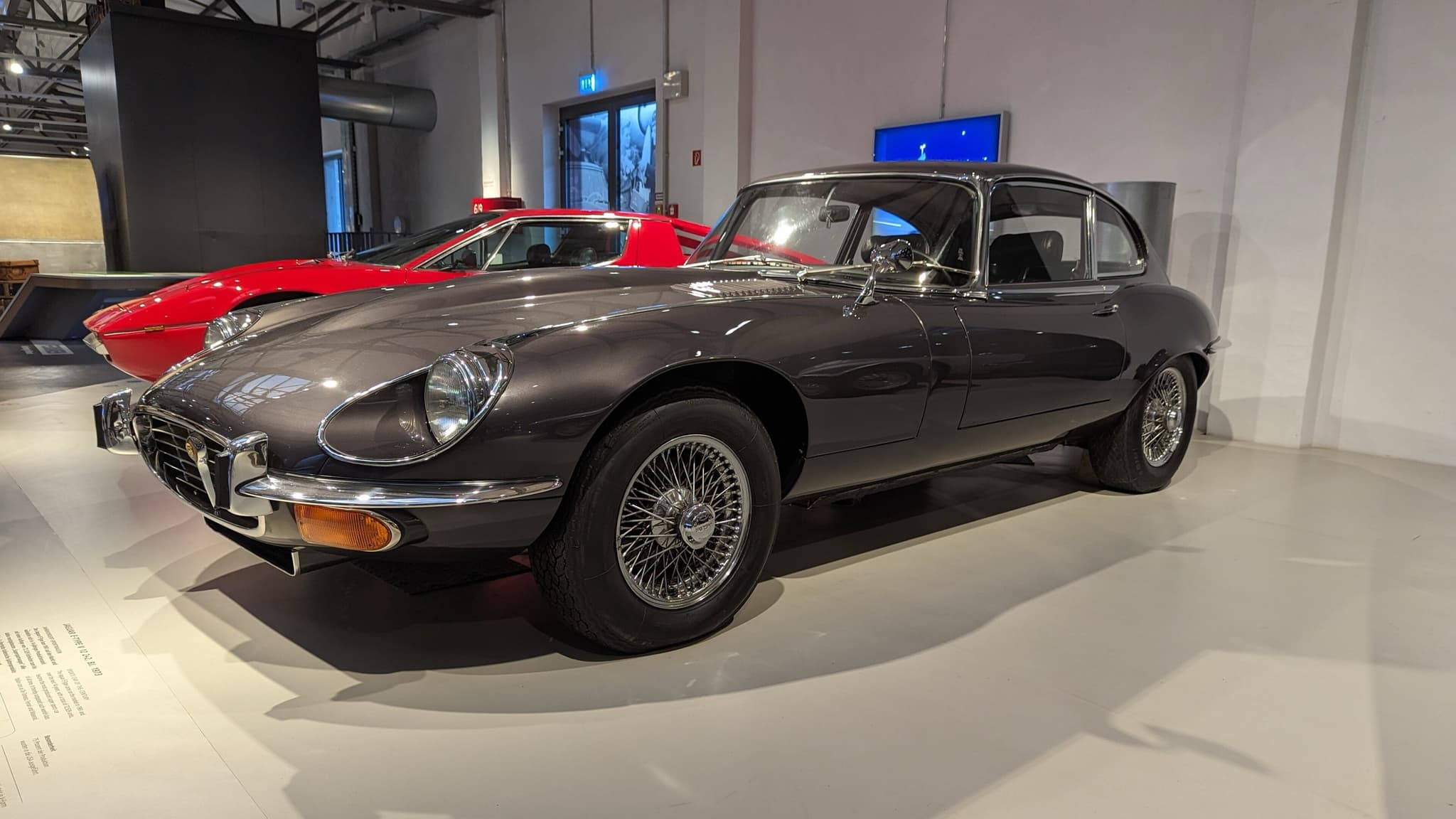
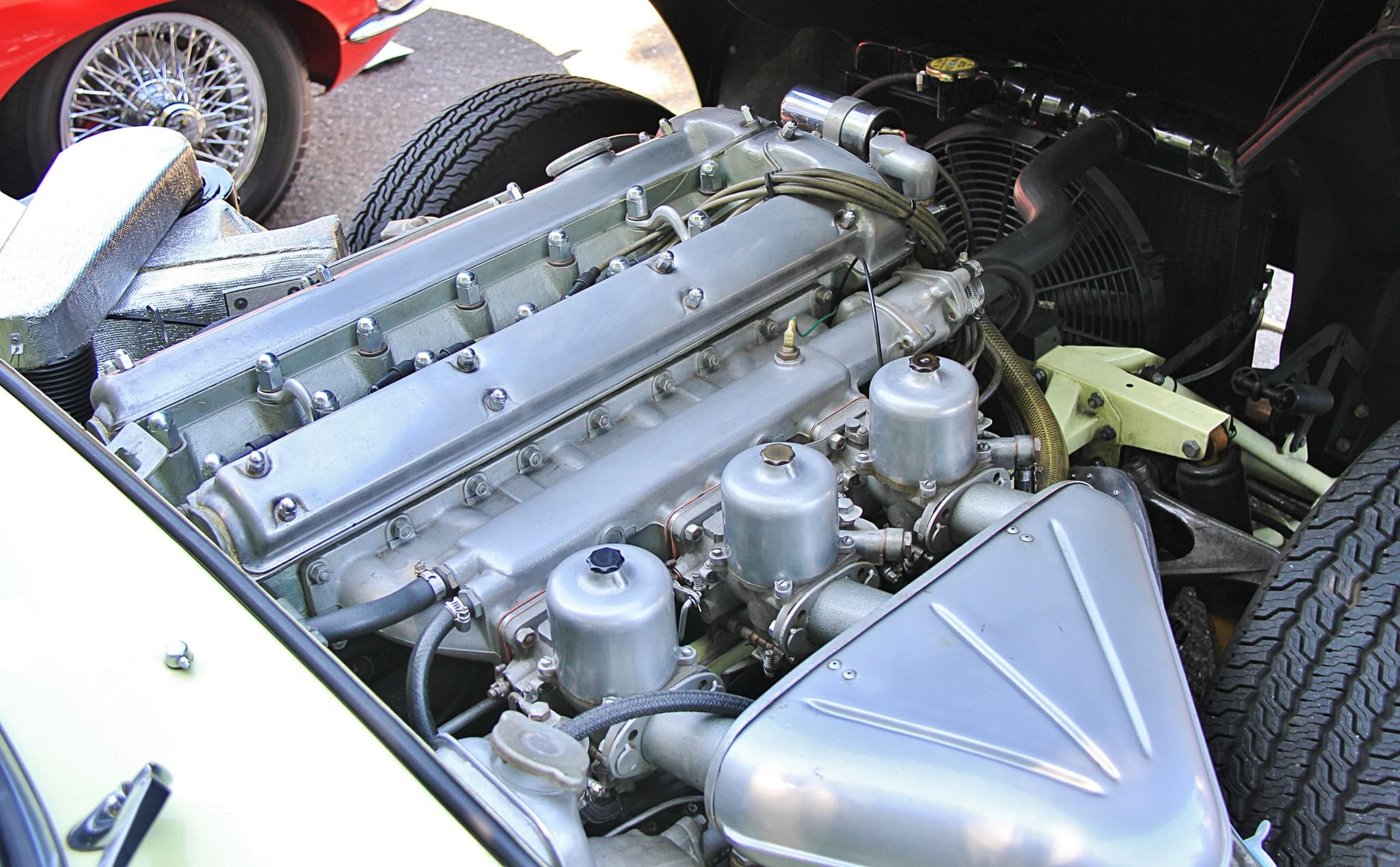
Between 1961 and 1974 the E-Type changed underneath three times. The six-cylinder 3.8 of 1961 gave way in October 1964 to the 4.2, bored out with its cylinders re-spaced, which gave the same rated power with more pulling power lower down. The 2+2 of 1966 stretched the wheelbase. And the Series 3 of 1971 put a V12 under the bonnet (hood) and every remaining body on the longer wheelbase. Through all of it the car kept its steel centre section, its tubular front frame and its independent rear suspension in a detachable cage.
The tables below set the versions side by side, every figure as Jaguar or a period test printed it. This page explains what the figures measure, because two power figures for the same engine can both be right, and one famous top speed was true of only two cars.source 1source 2source 3source 4
Reading the tables
Each column is one version, and each figure comes from a document of its day: Motor Sport's specification of the 3.8 at its launch in April 1961, its long road test of the 4.2 coupé in January 1965, Jaguar's British brochure for the Series 2 of October 1968, and the American brochure for the V12 of March 1971. The Series 3 roadster's performance comes from the Jaguar Heritage Trust, whose roadster is the last E-Type built.
Some of the Series 3's figures are American. The V12 brochure was printed for the United States, so its length is over American bumpers, and its fuel tank is given in US gallons. Weights carry the basis their source names: Jaguar's "dry" weight for the six-cylinder cars, without fuel, oil or water, and none at all for the American V12's.
Where the sources disagree, the tables show one figure and an asterisk, and the note behind the asterisk gives the others with their sources. The Lightweight's column is the competition car, whose page tells its story: Jaguar E-Type Lightweight.source 1source 2source 5source 6source 7source 8
Power, and how it was rated
British makers of the 1960s quoted power gross, the bare engine's figure. The six-cylinder E-Type's figure is gross. The 3.8 had the engine of the XK150S, with its three carburettors, as Motor Sport noted in 1961.
The 4.2 of 1964 kept the same rated power and reached it a little lower in the rev range. Its gain was torque, and Jaguar's British brochure for the Series 2 gives the torque with its engine speed, which the earlier sources leave out. The engines page tells how the bigger engine was made. Home-market Series 2 cars kept three SU carburettors. American cars from the 1968 model year had two Zenith-Strombergs and their emission controls instead, and no primary source read gives their rating.
The V12 was announced in 1971 with two figures for the same engine, a DIN figure, for the engine as installed, and a higher gross one. Motor Sport printed both, and Jaguar's American brochure gave the gross figures. By 1975 Jaguar was quoting a lower DIN figure, "obliged to quote the DIN figure" in Motor Sport's words, and the Jaguar Heritage Trust gives the same. When the rating changed, no source read says; both readings stand in the tables, each with its date.
The V12's torque has one loose end. The American brochure gives its gross torque at a higher engine speed than the DIN figure, but Motor Sport's figures for cylinder pressure, which match both torques by our arithmetic, put both at the lower speed. One of the two is a slip; this site follows the brochure.
A six's gross figure and the V12's DIN figure are not a like-for-like pair. Read across the columns, the V12's margin over the six was larger than the printed figures suggest.source 1source 2source 5source 3source 6source 9source 8
Top speed, and the press cars of 1961
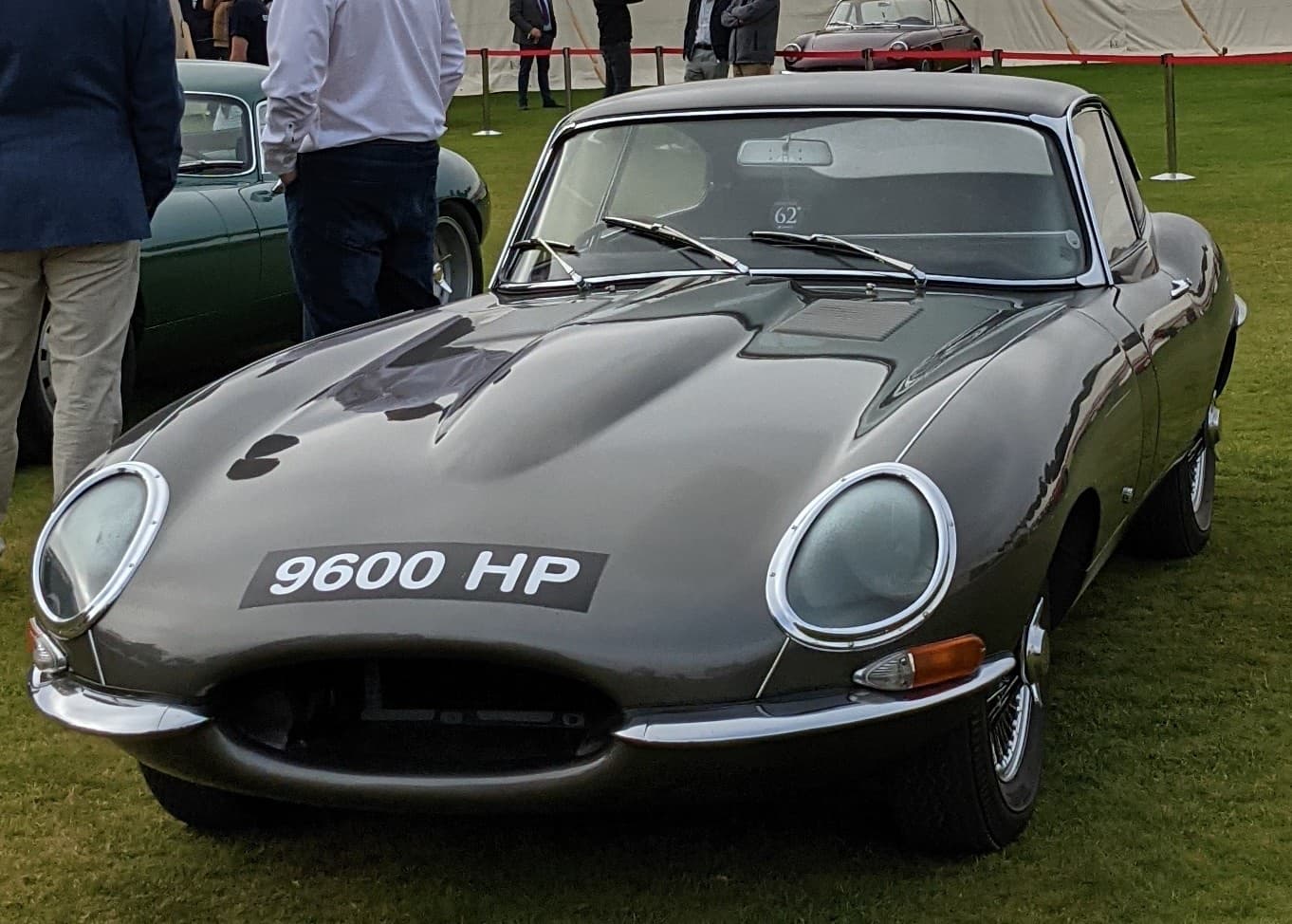
Motor Sport's launch report in April 1961 gave the E-Type as "capable of 155 m.p.h. on the 3.31-to-1 axle ratio or 165 m.p.h. with the 3.07-to-1 ratio", and the two British weekly magazines' road tests seemed to bear out the claim. Both tested works press cars, The Autocar the coupé 9600 HP and The Motor the roadster 77 RW. The tables give The Autocar's mean maximum under the 3.8 coupé.
The cars were not quite standard. The Autocar's coupé ran on Dunlop's R5 racing tyres, "initially optional", which gave it slightly taller gearing, as Motor Sport reported in 1975. Paul Skilleter calls the press cars "rather well-prepared". Charles Bulmer of The Motor later told Philip Porter that 77 RW's engine had been specially prepared. Motor Sport wrote in 1989 that the speed was "subsequently found to be unattainable on cars other than the especially prepared press test cars".
Bill Boddy, who wrote that report, drove a left-hand-drive coupé on the M1 a week before the launch and worked out a speed as high as the claim from its engine speed, a figure calculated from the rev counter, not timed; the 9600 HP page quotes him. Owners found less. Denis Jenkinson of Motor Sport, who owned E-Types of his own, wrote in 1971:
When the weekly magazines road-tested the original 3.8-litre 'E'-type in 1961, they recorded a very dubious 150 m.p.h., a figure that no private-owner I have met has ever approached. My first 4.2-litre coupé had an honest maximum of 143 m.p.h. and the present 4.2-litre roadster has to struggle to get over 130 m.p.h.
He put the later roadster's loss down to its bigger radiator opening, its exposed headlamps, the air swirling round the open cockpit and a small loss of power from the cure for the early engines' thirst for oil. The V12 was faster than the late sixes, but not everywhere: on its 1972 test Motor Sport noted that the tyre pressures America's and Canada's federal rules required held the car well below its maximum. The tables give each figure with the car it was measured on.
Acceleration and 0–60
The acceleration times in the tables come from different kinds of test, and each says which: The Autocar's 0–60 mph for the prepared 9600 HP; Motor Sport's test of the 4.2 coupé in 1965; and, for the V12, the Jaguar Heritage Trust's figures for its own roadster and the American brochure's claim for the standing quarter-mile. None is a figure for an ordinary 3.8 bought from a showroom.
The 4.2 was no quicker against the watch, and Motor Sport explained why. Its test car was not at its best either: the testers suspected retarded ignition had cost it some performance.
Because the new engine is heavier than the old 3.8-litre, and sound-damping has also increased weight, to a total of about a cwt., there is no noticeable increase in performance
What the bigger engine gave was flexibility in the higher gears, which no 0–60 mph time shows.source 9source 2source 6source 8
Dimensions and weights
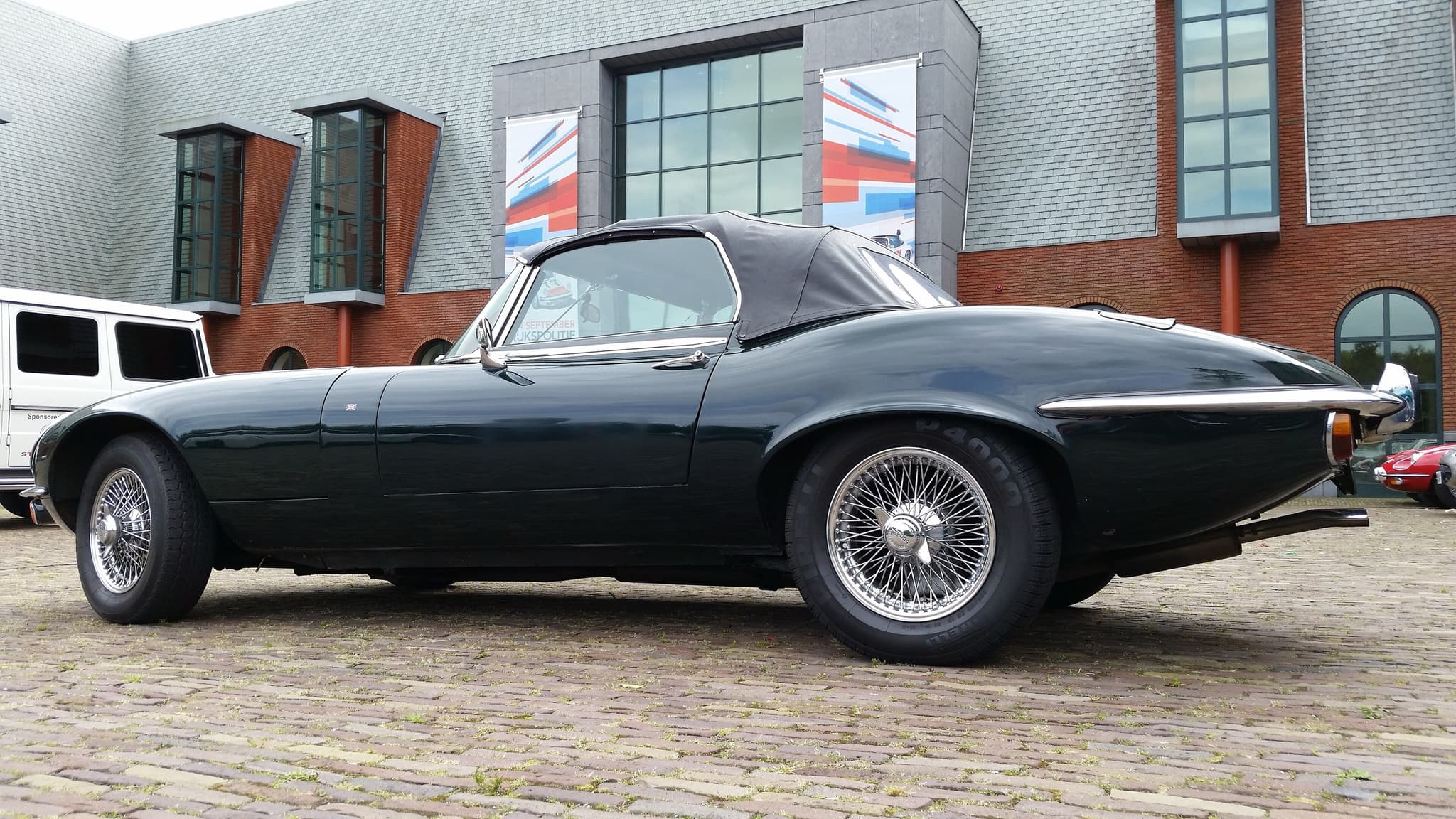
There were two wheelbases. The Series 1 and Series 2 two-seaters kept the original one, and the 2+2 of 1966 added 229 mm (9 in), all of it in the cabin, with longer doors and a taller windscreen (windshield); Motor Sport measured the screen's extra height itself and found it smaller than the handouts said. From 1971 the roadster shared the 2+2's longer wheelbase, since the Series 3 was built in those two bodies only, and its flared wheel arches covered wider tracks.
Most of the period figures carry a caveat. Motor Sport's 1961 height is printed for the E-Type without naming the body, though its text points to the coupé; its width grew by 6 mm (¼ in) in the 1965 data panel. The Series 3's length, width and height are the American brochure's. Weights grew: in 1975 Motor Sport gave the V12 coupé as "well over 30 cwt", against the maker's dry weights of the first cars, and figures of different kinds are never set against each other in the tables.
The fuel tank stayed the same size through the six-cylinder cars and grew for the Series 3, and the same check applies to its units: the American brochure's figure is in US gallons, the British sources' in imperial ones.source 1source 2source 14source 5source 4source 6source 9
Production
Sources for Production, by version
- Price new
- 3.8 Coupé (outside latch): One good source.Coupé. Bill Boddy, "The New 3.8-Litre Jaguar E-Type G.T.", Motor Sport, Apr 1961, p. 35source 1
- 4.2 Coupé: One good source.Already this figure at the 4.2's announcement in November 1964 (motor-sport-1964-11-new-cars; ERRATA-generations C19). Motor Sport, "The 4.2-Litre Jaguar E-type" ("A lengthy road test of the 150 m.p.h. E-Type"), Jan 1965, p. 23source 2
- Series 3 V12 2+2: One good source.The earliest 2+2 price in a source read (the live £3,369 for 1971 has no source); ERRATA-generations §5, §6. Bill Boddy, "On the road with the V12 E-type Jaguar", Motor Sport, Jan 1972, p. 36source 7
- Built
- 3.8 Roadster (flat floor): One good source.Jaguar Clubs of North America, Series 1 E-Type Judge's Guide (draft), part 1: Intro–Exterior, Draft, version of 21 Jul 2026source 15
- 3.8 Coupé (outside latch): One good source.Jaguar Clubs of North America, Series 1 E-Type Judge's Guide (draft), part 1: Intro–Exterior, Draft, version of 21 Jul 2026source 15
- 4.2 Coupé: One good source.Jaguar Daimler Heritage Trust, Research Guide No. 001F: Chassis Number Runs and Change Points by model – Jaguar E-type, Issue 3, January 2023source 16
- Series 2 2+2: One good source.The 2R "1971 model year" prefix appears only in the open and fixed-head runs (2R 13621, 2R 27981), so no 2+2 carries 1971. Jaguar Daimler Heritage Trust, Research Guide No. 001F: Chassis Number Runs and Change Points by model – Jaguar E-type, Issue 3, January 2023source 16
- Series 3 V12 Roadster: One good source.Jaguar Daimler Heritage Trust, Research Guide No. 001F: Chassis Number Runs and Change Points by model – Jaguar E-type, Issue 3, January 2023source 16
- Series 3 V12 2+2: One good source.Jaguar Daimler Heritage Trust, Research Guide No. 001F: Chassis Number Runs and Change Points by model – Jaguar E-type, Issue 3, January 2023source 16
- Lightweight: One good source.Eleven in 1963, the last delivered in 1964. Jaguar Land Rover (Jaguar media newsroom), "The Lightweight E-type is Reborn" (press release), 14 May 2014source 17
- Designers
- 3.8 Roadster (flat floor): One good source.E-Type design team, 1957-61. François Prins, "Evolution of the E-Type", Jaguar Daimler Heritage Trustsource 18
- 3.8 Coupé (outside latch): One good source.E-Type design team, 1957-61; the coupé roof and tailgate from Bob Blake's mock-up by the Trust's account (ERRATA R9). François Prins, "Evolution of the E-Type", Jaguar Daimler Heritage Trustsource 18
- Series 3 V12 Roadster: One good source.Motor-sport-1971-04-new-jaguar-v12: "Messrs. Hassan and Mundy ... have evolved for Jaguar ... V12 engine". Jaguar Daimler Heritage Trust, "1974 Jaguar E-type Series 3 V12 OTS HDU 555N: The Last E-type Built"source 8
- Series 3 V12 2+2: One good source.Motor-sport-1971-04-new-jaguar-v12: "Messrs. Hassan and Mundy ... have evolved for Jaguar ... V12 engine". Jaguar Daimler Heritage Trust, "1974 Jaguar E-type Series 3 V12 OTS HDU 555N: The Last E-type Built"source 8
- Built at
- 3.8 Roadster (flat floor): One good source.Bill Boddy, "The New 3.8-Litre Jaguar E-Type G.T.", Motor Sport, Apr 1961, p. 35source 1
- 3.8 Coupé (outside latch): One good source.Bill Boddy, "The New 3.8-Litre Jaguar E-Type G.T.", Motor Sport, Apr 1961, p. 35source 1
- 4.2 Coupé: One good source.The makers' address in the data panel. Motor Sport, "The 4.2-Litre Jaguar E-type" ("A lengthy road test of the 150 m.p.h. E-Type"), Jan 1965, p. 23source 2
- Series 2 2+2: One good source.The makers' address; OCR text: quotations given with the OCR's slips corrected (e.g. "manocoque"). Jaguar Cars Ltd, Coventry, Jaguar "E" Type range Series 2 (sales brochure), UK, 10/1968source 5
- Series 3 V12 Roadster: One good source.Engines built at Radford, cars assembled at Browns Lane, Allesley (Coventry: "Coventry factory", motor-sport-1972-01-v12-e-type-on-the-road). Bill Boddy, "The new Jaguar V12", Motor Sport, Apr 1971, p. 61source 3
- Series 3 V12 2+2: One good source.Engines built at Radford, cars assembled at Browns Lane, Allesley (Coventry: "Coventry factory", motor-sport-1972-01-v12-e-type-on-the-road). Bill Boddy, "The new Jaguar V12", Motor Sport, Apr 1971, p. 61source 3
- Lightweight: One good source.Jaguar Land Rover (Jaguar media newsroom), "Jaguar Land Rover Special Operations Reveals 'New' Lightweight E-type" (press release), 12 Aug 2014source 19
| Item | 3.8 Roadster (flat floor) | 3.8 Coupé (outside latch) | 4.2 Coupé | Series 2 2+2 | Series 3 V12 Roadster | Series 3 V12 2+2 | Lightweight |
|---|---|---|---|---|---|---|---|
| Price new | Not in the sources read | "£1,550 + £646 19s. 2d. purchase tax = £2,196 19s. 2d." | "£1,648 (total, £1,992 17s. 11d.)" | Not in the sources read | Not in the sources read | "£3,387" | Not in the sources read |
| Built | last flat-floor cars 850357 RHD and 876581 LHD; footwells from 850358 and 876582 (SDB P.51, 2nd issue, June 1962) | external bonnet locks discontinued at 860005 RHD and 885021 LHD (SDB P.46); latches inside from October 1961 (Service Bulletin N.8) | 1E 20001 (August 1964), 1E 30001 (August 1964) | 1R 35001 (August 1968), 1R 40001 (August 1968); last 1R 36041 (July 1970), 1R 44287 (July 1970) | 1S 20001 (December 1970) and 1S 1001 (February 1971) to 1S 26120 and 1S 2872 (June 1974) | 2+2 runs from 1S 50001 and 1S 70001 (1970, month unknown) to 1S 52116 (August 1973) and 1S 75183 (July 1973) | built 1963, "the last in 1964" |
| Designers | Malcolm Sayer shaped the body; William Heynes, chief engineer, "Heynes was the driving force behind this venture" | Malcolm Sayer shaped the body; William Heynes, chief engineer, "Heynes was the driving force behind this venture" | Not in the sources read | Not in the sources read | the V12 "had been designed and developed by Walter Hassan and Harry Mundy" | the V12 "had been designed and developed by Walter Hassan and Harry Mundy" | Not in the sources read |
| Built at | "will be made by Jaguar at their Coventry factory" | "will be made by Jaguar at their Coventry factory" | "Jaguar Cars Ltd., Browns Lane, Coventry" | JAGUAR CARS LTD COVENTRY ENGLAND | "a great many more complete at the Radford factory"; "transported to the Jaguar assembly plant at Browns Lane, Allesley" | "a great many more complete at the Radford factory"; "transported to the Jaguar assembly plant at Browns Lane, Allesley" | the 2014 cars assembled at Browns Lane "close to where the original Lightweight E-types were assembled in 1963/64" |
Engine
Sources for Engine, by version
- Engine
- 3.8 Roadster (flat floor): One good source.The maker's own designation: Jaguar's Series 2 brochure (Oct 1968) names its "'XK' engine". Bill Boddy, "The New 3.8-Litre Jaguar E-Type G.T.", Motor Sport, Apr 1961, p. 35source 1
- 3.8 Coupé (outside latch): One good source.The maker's own designation: Jaguar's Series 2 brochure (Oct 1968) names its "'XK' engine". Bill Boddy, "The New 3.8-Litre Jaguar E-Type G.T.", Motor Sport, Apr 1961, p. 35source 1
- Series 2 2+2: One good source.Jaguar's UK brochure, October 1968; OCR text: quotations given with the OCR's slips corrected (e.g. "manocoque"). Jaguar Cars Ltd, Coventry, Jaguar "E" Type range Series 2 (sales brochure), UK, 10/1968source 5
- Lightweight: One good source.As read in versions-lightweight.md (S4004). Gordon Cruickshank, "Jaguar's Lightweight E Types", Motor Sport, Sep 1984, p. 33source 20
- Engine maker
- 3.8 Roadster (flat floor): One good source.Bill Boddy, "The New 3.8-Litre Jaguar E-Type G.T.", Motor Sport, Apr 1961, p. 35source 1
- 3.8 Coupé (outside latch): One good source.Bill Boddy, "The New 3.8-Litre Jaguar E-Type G.T.", Motor Sport, Apr 1961, p. 35source 1
- 4.2 Coupé: One good source.Motor Sport, "The 4.2-Litre Jaguar E-type" ("A lengthy road test of the 150 m.p.h. E-Type"), Jan 1965, p. 23source 2
- Series 2 2+2: One good source.OCR text: quotations given with the OCR's slips corrected (e.g. "manocoque"). Jaguar Cars Ltd, Coventry, Jaguar "E" Type range Series 2 (sales brochure), UK, 10/1968source 5
- Series 3 V12 Roadster: One good source.Bill Boddy, "The new Jaguar V12", Motor Sport, Apr 1971, p. 61source 3
- Series 3 V12 2+2: One good source.Bill Boddy, "The new Jaguar V12", Motor Sport, Apr 1971, p. 61source 3
- Lightweight: One good source.Jaguar Land Rover (Jaguar media newsroom), "The Lightweight E-type is Reborn" (press release), 14 May 2014source 17
- Capacity
- 3.8 Roadster (flat floor): One good source.The 1962 roadster road test; 231 cu in by the schema's conversion. Bill Boddy, "By E-Type To Monaco", Motor Sport, Jul 1962, p. 59source 21
- 4.2 Coupé: One good source.258 cu in by the schema's conversion. Motor Sport, "The 4.2-Litre Jaguar E-type" ("A lengthy road test of the 150 m.p.h. E-Type"), Jan 1965, p. 23source 2
- Series 2 2+2: One good source.258 cu in by the schema's conversion; OCR text: quotations given with the OCR's slips corrected (e.g. "manocoque"). Jaguar Cars Ltd, Coventry, Jaguar "E" Type range Series 2 (sales brochure), UK, 10/1968source 5
- Series 3 V12 Roadster: One good source.326 cu in by the schema's conversion, as its siblings. Bill Boddy, "The new Jaguar V12", Motor Sport, Apr 1971, p. 61source 3
- Series 3 V12 2+2: One good source.Bill Boddy, "The new Jaguar V12", Motor Sport, Apr 1971, p. 61source 3
- Lightweight: One good source.The period capacity in cc is not printed for these engines; 3,868 cc is the 2014 cars' (ERRATA-competition C36). Jaguar Land Rover (Jaguar media newsroom), "The Lightweight E-type is Reborn" (press release), 14 May 2014source 17
- Engine position
- 3.8 Roadster (flat floor): One good source.Bill Boddy, "The New 3.8-Litre Jaguar E-Type G.T.", Motor Sport, Apr 1961, p. 35source 1
- 3.8 Coupé (outside latch): One good source.Bill Boddy, "The New 3.8-Litre Jaguar E-Type G.T.", Motor Sport, Apr 1961, p. 35source 1
- Series 2 2+2: One good source.OCR text: quotations given with the OCR's slips corrected (e.g. "manocoque"). Jaguar Cars Ltd, Coventry, Jaguar "E" Type range Series 2 (sales brochure), UK, 10/1968source 5
- Series 3 V12 Roadster: One good source.Denis Jenkinson, "Driving the V12 Jaguar", Motor Sport, Apr 1971, p. 64source 4
- Series 3 V12 2+2: One good source.Denis Jenkinson, "Driving the V12 Jaguar", Motor Sport, Apr 1971, p. 64source 4
- Block
- Series 2 2+2: One good source.OCR text: quotations given with the OCR's slips corrected (e.g. "manocoque"). Jaguar Cars Ltd, Coventry, Jaguar "E" Type range Series 2 (sales brochure), UK, 10/1968source 5
- Series 3 V12 Roadster: One good source."light-alloy" in motor-sport-1972-01-v12-e-type-on-the-road. Bill Boddy, "The new Jaguar V12", Motor Sport, Apr 1971, p. 61source 3
- Series 3 V12 2+2: One good source."light-alloy" in motor-sport-1972-01-v12-e-type-on-the-road. Bill Boddy, "The new Jaguar V12", Motor Sport, Apr 1971, p. 61source 3
- Lightweight: One good source.Jaguar Land Rover (Jaguar media newsroom), "The Lightweight E-type is Reborn" (press release), 14 May 2014source 17
- Cylinder head
- Series 2 2+2: One good source.OCR text: quotations given with the OCR's slips corrected (e.g. "manocoque"). Jaguar Cars Ltd, Coventry, Jaguar "E" Type range Series 2 (sales brochure), UK, 10/1968source 5
- Series 3 V12 Roadster: One good source.Bill Boddy, "The new Jaguar V12", Motor Sport, Apr 1971, p. 61source 3
- Series 3 V12 2+2: One good source.Bill Boddy, "The new Jaguar V12", Motor Sport, Apr 1971, p. 61source 3
- Valve gear
- 3.8 Roadster (flat floor): One good source.Bill Boddy, "The New 3.8-Litre Jaguar E-Type G.T.", Motor Sport, Apr 1961, p. 35source 1
- 3.8 Coupé (outside latch): One good source.Bill Boddy, "The New 3.8-Litre Jaguar E-Type G.T.", Motor Sport, Apr 1961, p. 35source 1
- 4.2 Coupé: One good source.Motor Sport, "The 4.2-Litre Jaguar E-type" ("A lengthy road test of the 150 m.p.h. E-Type"), Jan 1965, p. 23source 2
- Series 2 2+2: One good source.OCR text: quotations given with the OCR's slips corrected (e.g. "manocoque"). Jaguar Cars Ltd, Coventry, Jaguar "E" Type range Series 2 (sales brochure), UK, 10/1968source 5
- Series 3 V12 Roadster: One good source.One camshaft per bank. Bill Boddy, "The new Jaguar V12", Motor Sport, Apr 1971, p. 61source 3
- Series 3 V12 2+2: One good source.One camshaft per bank. Bill Boddy, "The new Jaguar V12", Motor Sport, Apr 1971, p. 61source 3
- Bore × stroke
- 4.2 Coupé: One good source.Motor Sport, "The 4.2-Litre Jaguar E-type" ("A lengthy road test of the 150 m.p.h. E-Type"), Jan 1965, p. 23source 2
- Series 2 2+2: One good source.OCR text: quotations given with the OCR's slips corrected (e.g. "manocoque"). Jaguar Cars Ltd, Coventry, Jaguar "E" Type range Series 2 (sales brochure), UK, 10/1968source 5
- Series 3 V12 Roadster: One good source.The imperial 3.54 x 2.76 in matches the US brochure's 3.543 x 2.756 in. Bill Boddy, "The new Jaguar V12", Motor Sport, Apr 1971, p. 61source 3
- Series 3 V12 2+2: One good source.The imperial 3.54 x 2.76 in matches the US brochure's 3.543 x 2.756 in. Bill Boddy, "The new Jaguar V12", Motor Sport, Apr 1971, p. 61source 3
- Compression ratio
- 3.8 Roadster (flat floor): One good source.Standard; 8:1 available. Bill Boddy, "The New 3.8-Litre Jaguar E-Type G.T.", Motor Sport, Apr 1961, p. 35source 1
- 3.8 Coupé (outside latch): One good source.Standard; 8:1 available. Bill Boddy, "The New 3.8-Litre Jaguar E-Type G.T.", Motor Sport, Apr 1961, p. 35source 1
- 4.2 Coupé: One good source.Motor Sport, "The 4.2-Litre Jaguar E-type" ("A lengthy road test of the 150 m.p.h. E-Type"), Jan 1965, p. 23source 2
- Series 3 V12 Roadster: One good source.Bill Boddy, "The new Jaguar V12", Motor Sport, Apr 1971, p. 61source 3
- Series 3 V12 2+2: One good source.Bill Boddy, "The new Jaguar V12", Motor Sport, Apr 1971, p. 61source 3
- Fuel system
- 3.8 Roadster (flat floor): One good source.Bill Boddy, "The New 3.8-Litre Jaguar E-Type G.T.", Motor Sport, Apr 1961, p. 35source 1
- 3.8 Coupé (outside latch): One good source.Bill Boddy, "The New 3.8-Litre Jaguar E-Type G.T.", Motor Sport, Apr 1961, p. 35source 1
- 4.2 Coupé: One good source.Motor Sport, "The 4.2-Litre Jaguar E-type" ("A lengthy road test of the 150 m.p.h. E-Type"), Jan 1965, p. 23source 2
- Series 2 2+2: One good source.OCR text: quotations given with the OCR's slips corrected (e.g. "manocoque"). Jaguar Cars Ltd, Coventry, Jaguar "E" Type range Series 2 (sales brochure), UK, 10/1968source 5
- Series 3 V12 Roadster: One good source.Bill Boddy, "The new Jaguar V12", Motor Sport, Apr 1971, p. 61source 3
- Series 3 V12 2+2: One good source.Bill Boddy, "The new Jaguar V12", Motor Sport, Apr 1971, p. 61source 3
- Carburettors
- 3.8 Roadster (flat floor): One good source.The 1962 roadster road test, as read in specifications.md (S3532). Bill Boddy, "By E-Type To Monaco", Motor Sport, Jul 1962, p. 59source 21
- 4.2 Coupé: One good source.To the open-headlamp change; the US Stromberg cars begin later, with the September 1967 numbers (ERRATA-generations C5). Motor Sport, "The 4.2-Litre Jaguar E-type" ("A lengthy road test of the 150 m.p.h. E-Type"), Jan 1965, p. 23source 2
- Series 3 V12 Roadster: One good source.US brochure; motor-sport-1971-04-new-jaguar-v12 prints "four Zenith 175CDSE carburetters"; ERRATA-generations C11: every V12 had four. British Leyland Motors Inc., Leonia, New Jersey, "The Ultimate Cat": Jaguar V-12 E-type (sales brochure), USA, 1971source 6
- Series 3 V12 2+2: One good source.US brochure; motor-sport-1971-04-new-jaguar-v12 prints "four Zenith 175CDSE carburetters"; ERRATA-generations C11: every V12 had four. British Leyland Motors Inc., Leonia, New Jersey, "The Ultimate Cat": Jaguar V-12 E-type (sales brochure), USA, 1971source 6
- Cooling
- 3.8 Roadster (flat floor): One good source.Bill Boddy, "The New 3.8-Litre Jaguar E-Type G.T.", Motor Sport, Apr 1961, p. 35source 1
- 3.8 Coupé (outside latch): One good source.Bill Boddy, "The New 3.8-Litre Jaguar E-Type G.T.", Motor Sport, Apr 1961, p. 35source 1
- Series 2 2+2: One good source.OCR text: quotations given with the OCR's slips corrected (e.g. "manocoque"). Jaguar Cars Ltd, Coventry, Jaguar "E" Type range Series 2 (sales brochure), UK, 10/1968source 5
- Series 3 V12 Roadster: One good source.Bill Boddy, "The new Jaguar V12", Motor Sport, Apr 1971, p. 61source 3
- Series 3 V12 2+2: One good source.Bill Boddy, "The new Jaguar V12", Motor Sport, Apr 1971, p. 61source 3
- Cylinder layout
- 3.8 Roadster (flat floor): One good source.Motor Sport, "The 4.2-Litre Jaguar E-type" ("A lengthy road test of the 150 m.p.h. E-Type"), Jan 1965, p. 23source 2
- 3.8 Coupé (outside latch): One good source.Motor Sport, "The 4.2-Litre Jaguar E-type" ("A lengthy road test of the 150 m.p.h. E-Type"), Jan 1965, p. 23source 2
- 4.2 Coupé: One good source.Motor Sport, "The 4.2-Litre Jaguar E-type" ("A lengthy road test of the 150 m.p.h. E-Type"), Jan 1965, p. 23source 2
- Series 3 V12 Roadster: One good source.Bill Boddy, "On the road with the V12 E-type Jaguar", Motor Sport, Jan 1972, p. 36source 7
- Series 3 V12 2+2: One good source.Bill Boddy, "On the road with the V12 E-type Jaguar", Motor Sport, Jan 1972, p. 36source 7
- Cylinders
- 3.8 Roadster (flat floor): One good source.Bill Boddy, "The New 3.8-Litre Jaguar E-Type G.T.", Motor Sport, Apr 1961, p. 35source 1
- 3.8 Coupé (outside latch): One good source.Bill Boddy, "The New 3.8-Litre Jaguar E-Type G.T.", Motor Sport, Apr 1961, p. 35source 1
- 4.2 Coupé: One good source.Motor Sport, "The 4.2-Litre Jaguar E-type" ("A lengthy road test of the 150 m.p.h. E-Type"), Jan 1965, p. 23source 2
- Series 2 2+2: One good source.OCR text: quotations given with the OCR's slips corrected (e.g. "manocoque"). Jaguar Cars Ltd, Coventry, Jaguar "E" Type range Series 2 (sales brochure), UK, 10/1968source 5
- Series 3 V12 Roadster: One good source.Bill Boddy, "On the road with the V12 E-type Jaguar", Motor Sport, Jan 1972, p. 36source 7
- Series 3 V12 2+2: One good source.Bill Boddy, "On the road with the V12 E-type Jaguar", Motor Sport, Jan 1972, p. 36source 7
- Lightweight: One good source.As read in outlaw8-tree.md (S2512). Jaguar Land Rover (Jaguar media newsroom), "The Lightweight E-type is Reborn" (press release), 14 May 2014source 17
- Fuel
- 3.8 Roadster (flat floor): One good source.Bill Boddy, "The New 3.8-Litre Jaguar E-Type G.T.", Motor Sport, Apr 1961, p. 35source 1
- 3.8 Coupé (outside latch): One good source.Bill Boddy, "The New 3.8-Litre Jaguar E-Type G.T.", Motor Sport, Apr 1961, p. 35source 1
- 4.2 Coupé: One good source.Motor Sport, "The 4.2-Litre Jaguar E-type" ("A lengthy road test of the 150 m.p.h. E-Type"), Jan 1965, p. 23source 2
- Series 2 2+2: One good source.OCR text: quotations given with the OCR's slips corrected (e.g. "manocoque"). Jaguar Cars Ltd, Coventry, Jaguar "E" Type range Series 2 (sales brochure), UK, 10/1968source 5
- Series 3 V12 Roadster: One good source.Bill Boddy, "The new Jaguar V12", Motor Sport, Apr 1971, p. 61source 3
- Series 3 V12 2+2: One good source.Bill Boddy, "On the road with the V12 E-type Jaguar", Motor Sport, Jan 1972, p. 36source 7
- Ignition
- Series 2 2+2: One good source.OCR text: quotations given with the OCR's slips corrected (e.g. "manocoque"). Jaguar Cars Ltd, Coventry, Jaguar "E" Type range Series 2 (sales brochure), UK, 10/1968source 5
- Series 3 V12 Roadster: One good source.Bill Boddy, "On the road with the V12 E-type Jaguar", Motor Sport, Jan 1972, p. 36source 7
- Series 3 V12 2+2: One good source.Bill Boddy, "On the road with the V12 E-type Jaguar", Motor Sport, Jan 1972, p. 36source 7
- Lubrication
- Series 2 2+2: One good source.OCR text: quotations given with the OCR's slips corrected (e.g. "manocoque"). Jaguar Cars Ltd, Coventry, Jaguar "E" Type range Series 2 (sales brochure), UK, 10/1968source 5
- Series 3 V12 Roadster: One good source.British Leyland Motors Inc., Leonia, New Jersey, "The Ultimate Cat": Jaguar V-12 E-type (sales brochure), USA, 1971source 6
- Series 3 V12 2+2: One good source.British Leyland Motors Inc., Leonia, New Jersey, "The Ultimate Cat": Jaguar V-12 E-type (sales brochure), USA, 1971source 6
- Lightweight: One good source.V2 with jaguar-2014-05-lightweight-reborn (ERRATA-competition §5). Gordon Cruickshank, "Jaguar's Lightweight E Types", Motor Sport, Sep 1984, p. 33source 20
| Item | 3.8 Roadster (flat floor) | 3.8 Coupé (outside latch) | 4.2 Coupé | Series 2 2+2 | Series 3 V12 Roadster | Series 3 V12 2+2 | Lightweight |
|---|---|---|---|---|---|---|---|
| Engine | "The six-cylinder twin-cam XK engine is used in S-type 3.8-litre triple-carburetter form" | "The six-cylinder twin-cam XK engine is used in S-type 3.8-litre triple-carburetter form" | Not in the sources read | "4.2 litre, 6 cylinder, twin overhead camshaft three carburetter 265 b.h.p. 'XK' engine" | Not in the sources read | Not in the sources read | 3.8-litre XK, aluminium block, wide-angle head, dry sump, fuel injection |
| Engine maker | "will be made by Jaguar at their Coventry factory"; "The six-cylinder twin-cam XK engine is used" | "will be made by Jaguar at their Coventry factory"; "The six-cylinder twin-cam XK engine is used" | "Jaguar Cars Ltd., Browns Lane, Coventry" | "4.2 litre XK Jaguar engine" | "Messrs. Hassan and Mundy, directed originally by Heynes and Baily, have evolved for Jaguar a significantly compact, 300-b.h.p. V12 engine" | "Messrs. Hassan and Mundy, directed originally by Heynes and Baily, have evolved for Jaguar a significantly compact, 300-b.h.p. V12 engine" | built by Jaguar's competition department |
| Capacity | "a very hard-driven 3,781-c.c. engine" (cc) | Not in the sources read | "Six cylinders, 92.07 x 106 mm. (4,235 c.c.)" | cubic capacity 4235 c.c. (258.43 cu. in.) | "the new 90 x 70-mm. (5,343-c.c.) engine" (cc) | "the new 90 x 70-mm. (5,343-c.c.) engine" (cc) | 3.8-litre (L) |
| Engine position | "The sub-frame carries the engine and all ancillaries, together with the front suspension and steering gear" | "The sub-frame carries the engine and all ancillaries, together with the front suspension and steering gear" | Not in the sources read | "Front sub-frame of high tensile steel tubing carries engine unit" | the square-tube front frame "completely re-designed" to take the V12 | the square-tube front frame "completely re-designed" to take the V12 | Not in the sources read |
| Block | Not in the sources read | Not in the sources read | Not in the sources read | Chrome iron cylinder block fitted with dry type cylinder liners | "The cylinder block is an alloy casting, with wet c.i. liners." | "The cylinder block is an alloy casting, with wet c.i. liners." | "all-aluminum body and engine block" |
| Cylinder head | Not in the sources read | Not in the sources read | Not in the sources read | Special "straight port" cylinder head of high tensile aluminium alloy | "The heads are sand-cast alloy" | "The heads are sand-cast alloy" | Not in the sources read |
| Valve gear | "twin-cam" | "twin-cam" | "Twin overhead camshafts." | twin overhead camshafts operating large valves of 70° included angle | "a single o.h. camshaft actuating in-line vertical valves" | "a single o.h. camshaft actuating in-line vertical valves" | Not in the sources read |
| Bore × stroke | Not in the sources read | Not in the sources read | 92.07 x 106 mm | 92.07 mm. bore, 106 mm. stroke (3.6257 by 4.1732") | "the new 90 x 70-mm. (5,343-c.c.) engine" | "the new 90 x 70-mm. (5,343-c.c.) engine" | Not in the sources read |
| Compression ratio | "using the 9-to-1 compression-ratio" | "using the 9-to-1 compression-ratio" | "9-to-1 compression ratio" | Not in the sources read | "on a 9-to-1 c.r." | "on a 9-to-1 c.r." | Not in the sources read |
| Fuel system | "S-type 3.8-litre triple-carburetter form" | "S-type 3.8-litre triple-carburetter form" | "the three 2-in. S.U. carburetters" | Three S.U. carburetters, Type HD9 (OCR "HD8"/"HBA" on other pages) | "Carburation is by four Zenith 175CDSE carburetters, two on the outside of each block" | "Carburation is by four Zenith 175CDSE carburetters, two on the outside of each block" | Not in the sources read |
| Carburettors | three 2-in. SU HD8 carburettors | Not in the sources read | "the three 2-in. S.U. carburetters" | Not in the sources read | four Zenith-Stromberg 175 CD2SE | four Zenith-Stromberg 175 CD2SE | Not in the sources read |
| Cooling | "The pressurised cooling system incorporates the new Lucas electric fan"; "The radiator is of the high efficiency cross-flow type" | "The pressurised cooling system incorporates the new Lucas electric fan"; "The radiator is of the high efficiency cross-flow type" | Not in the sources read | "Pressurised cooling system with thermostatically controlled, electrically driven twin fans"; "Cross flow radiator" | "cooling water from the radiator"; "The centrifugal impeller-type water pump feeds both banks of cylinders" | "cooling water from the radiator"; "The centrifugal impeller-type water pump feeds both banks of cylinders" | Not in the sources read |
| Cylinder layout | "The cylinders have been repositioned somewhat, numbers 2 and 5 remaining in their original position, with 3 and 4 moving together and 1 and 6 moving towards the ends of the block" | "The cylinders have been repositioned somewhat, numbers 2 and 5 remaining in their original position, with 3 and 4 moving together and 1 and 6 moving towards the ends of the block" | "The cylinders have been repositioned somewhat, numbers 2 and 5 remaining in their original position, with 3 and 4 moving together and 1 and 6 moving towards the ends of the block" | Not in the sources read | "the new light-alloy 60° V12 single-cam-per-block power unit" | "the new light-alloy 60° V12 single-cam-per-block power unit" | Not in the sources read |
| Cylinders | "six-cylinder twin-cam XK engine" | "six-cylinder twin-cam XK engine" | "Six cylinders, 92.07 x 106 mm. (4,235 c.c.)" | "4.2 litre, 6 cylinder, twin overhead camshaft three carburetter 265 b.h.p. 'XK' engine" | "the new light-alloy 60° V12 single-cam-per-block power unit" | "the new light-alloy 60° V12 single-cam-per-block power unit" | 3.8-litre six with "all-aluminum body and engine block" |
| Fuel | "Fuel is supplied by a submerged Lucas electric pump incorporated in the petrol tank" | "Fuel is supplied by a submerged Lucas electric pump incorporated in the petrol tank" | "on Super Shell and similar grade petrols" | "Petrol filter incorporated into fuel line" | "enabling 97-octane petrol to be used" | "The V12 runs happily on four-star fuel" | Not in the sources read |
| Ignition | Not in the sources read | Not in the sources read | Not in the sources read | Vacuum and centrifugal automatic ignition control, [oil-filled] coil ignition (OCR "Oil coil ignition") | "its Lucas Opus transistorised ignition" | "its Lucas Opus transistorised ignition" | Not in the sources read |
| Lubrication | Not in the sources read | Not in the sources read | Not in the sources read | Forced lubrication by submerged pump system incorporating a full flow filter | sump 11.5 US quarts | sump 11.5 US quarts | aluminium block, wide-angle head, dry sump, fuel injection |
Performance
Sources for Performance, by version
- Power
- 3.8 Roadster (flat floor): One good source.Gross (British practice of the day; ERRATA-generations §5); kW and PS by the schema's conversion. Bill Boddy, "The New 3.8-Litre Jaguar E-Type G.T.", Motor Sport, Apr 1961, p. 35source 1
- 3.8 Coupé (outside latch): One good source.Gross (British practice of the day; ERRATA-generations §5); kW and PS by the schema's conversion. Bill Boddy, "The New 3.8-Litre Jaguar E-Type G.T.", Motor Sport, Apr 1961, p. 35source 1
- 4.2 Coupé: One good source.Jaguar's rating; US cars with twin Strombergs from the September 1967 numbers have no rating in a primary source read, and the 246 hp figure is never put on a sheet as Jaguar's (ERRATA-generations W4). Motor Sport, "The 4.2-Litre Jaguar E-type" ("A lengthy road test of the 150 m.p.h. E-Type"), Jan 1965, p. 23source 2
- Series 3 V12 Roadster: One good source.DIN, as announced in 1971 (ERRATA-generations C6: never 266 as the launch figure; 314 gross at 6,200 rpm is the other rating). Bill Boddy, "On the road with the V12 E-type Jaguar", Motor Sport, Jan 1972, p. 36source 7
- Series 3 V12 2+2: One good source.DIN, as announced in 1971 (ERRATA-generations C6: never 266 as the launch figure; 314 gross at 6,200 rpm is the other rating). Bill Boddy, "On the road with the V12 E-type Jaguar", Motor Sport, Jan 1972, p. 36source 7
- Lightweight: Several figures in print.Motor Sport, "Jaguar E-type: the end of production and end of an era – but not of a legend", May 1975, p. 29source 9
- Torque
- 3.8 Roadster (flat floor): One good source.Nm and kgf-m by the schema's conversion. Bill Boddy, "The New 3.8-Litre Jaguar E-Type G.T.", Motor Sport, Apr 1961, p. 35source 1
- 3.8 Coupé (outside latch): One good source.Nm and kgf-m by the schema's conversion. Bill Boddy, "The New 3.8-Litre Jaguar E-Type G.T.", Motor Sport, Apr 1961, p. 35source 1
- 4.2 Coupé: One good source.Rpm not given. Richard Heseltine, "Jaguar E-type", Motor Sport, Mar 2007, p. 80source 22
- Series 3 V12 Roadster: One good source.Bill Boddy, "The new Jaguar V12", Motor Sport, Apr 1971, p. 61source 3
- Series 3 V12 2+2: Several figures in print.Bill Boddy, "The new Jaguar V12", Motor Sport, Apr 1971, p. 61source 3; British Leyland Motors Inc., Leonia, New Jersey, "The Ultimate Cat": Jaguar V-12 E-type (sales brochure), USA, 1971source 6
- Top speed
- 3.8 Coupé (outside latch): One good source.The Autocar's test of 9600 HP (885002), a works-prepared press car on Dunlop R5 racing tyres, March 1961. Motor Sport, "Jaguar E-type: the end of production and end of an era – but not of a legend", May 1975, p. 29source 9
- 4.2 Coupé: One good source.D. S. J.'s own 4.2 coupé by rev counter, 3.07 axle. Denis Jenkinson, "Two years with the Jaguar E-type", Motor Sport, Apr 1967, p. 22source 13
- Series 3 V12 Roadster: One good source.Manual two-seater, the Trust's figure. Jaguar Daimler Heritage Trust, "1974 Jaguar E-type Series 3 V12 OTS HDU 555N: The Last E-type Built"source 8
- Series 3 V12 2+2: Several figures in print.Bill Boddy, "On the road with the V12 E-type Jaguar", Motor Sport, Jan 1972, p. 36source 7
- 0–60 mph
- 3.8 Coupé (outside latch): One good source.The Autocar's 9600 HP, 1961. Motor Sport, "Jaguar E-type: the end of production and end of an era – but not of a legend", May 1975, p. 29source 9
- 4.2 Coupé: One good source.This coupé road test, January 1965; best run 7.2 s. Motor Sport, "The 4.2-Litre Jaguar E-type" ("A lengthy road test of the 150 m.p.h. E-Type"), Jan 1965, p. 23source 2
- Series 3 V12 Roadster: One good source.Manual two-seater, the Trust's figure. Jaguar Daimler Heritage Trust, "1974 Jaguar E-type Series 3 V12 OTS HDU 555N: The Last E-type Built"source 8
- 0–100 mph
- 4.2 Coupé: One good source.As read in versions-series-1.md (S3010 data panel); best run 17.4 s. Motor Sport, "The 4.2-Litre Jaguar E-type" ("A lengthy road test of the 150 m.p.h. E-Type"), Jan 1965, p. 23source 2
- Standing start
- 4.2 Coupé: One good source.As read in specifications.md (S3533). Motor Sport, "The 4.2-Litre Jaguar E-type" ("A lengthy road test of the 150 m.p.h. E-Type"), Jan 1965, p. 23source 2
- Series 3 V12 Roadster: One good source.The maker's US claim, March 1971. British Leyland Motors Inc., Leonia, New Jersey, "The Ultimate Cat": Jaguar V-12 E-type (sales brochure), USA, 1971source 6
- Series 3 V12 2+2: One good source.Manual 2+2 test car. Bill Boddy, "On the road with the V12 E-type Jaguar", Motor Sport, Jan 1972, p. 36source 7
- Red line
- Series 3 V12 Roadster: One good source.The rev counter's red sector starts at 6,500 rpm. Bill Boddy, "On the road with the V12 E-type Jaguar", Motor Sport, Jan 1972, p. 36source 7
- Series 3 V12 2+2: One good source.The rev counter's red sector starts at 6,500 rpm. Bill Boddy, "On the road with the V12 E-type Jaguar", Motor Sport, Jan 1972, p. 36source 7
| Item | 3.8 Roadster (flat floor) | 3.8 Coupé (outside latch) | 4.2 Coupé | Series 2 2+2 | Series 3 V12 Roadster | Series 3 V12 2+2 | Lightweight |
|---|---|---|---|---|---|---|---|
| Power | "developing 265 b.h.p. at 5,500 r.p.m." | "developing 265 b.h.p. at 5,500 r.p.m." | "265 b.h.p. at 5,400 r.p.m." | Not in the sources read | "314 b.h.p.—272 (DIN) at 5,850 r.p.m." | "314 b.h.p.—272 (DIN) at 5,850 r.p.m." | about 300 bhp "the norm" Power, Lightweight Several figures in print.
|
| Torque | "260 lb./ft. torque at 4,000 r.p.m." (lb ft) | "260 lb./ft. torque at 4,000 r.p.m." (lb ft) | 283 lb ft | Not in the sources read | "Maximum torque of 349 lb./ft. (304 DIN) is achieved at 3,600 (3,800) r.p.m." (lb ft) | "Maximum torque of 349 lb./ft. (304 DIN) is achieved at 3,600 (3,800) r.p.m." (lb ft) Torque, Series 3 V12 2+2 Several figures in print.
| Not in the sources read |
| Top speed | Not in the sources read | 150.4 mph mean | about 143 mph | Not in the sources read | 146 mph | "143 m.p.h. in top" Top speed, Series 3 V12 2+2 Several figures in print.
| Not in the sources read |
| 0–60 mph | Not in the sources read | 6.9 s | "0 – 60 m.p.h. … 7.3 (7.2) sec." (s) | Not in the sources read | 0-60 mph 6.4 s | Not in the sources read | Not in the sources read |
| 0–100 mph | Not in the sources read | Not in the sources read | 0-100 mph 17.6 (17.4) sec. (s) | Not in the sources read | Not in the sources read | Not in the sources read | Not in the sources read |
| Standing start | Not in the sources read | Not in the sources read | standing quarter-mile 15.1 sec. | Not in the sources read | standing quarter-mile 14.8 sec. | the standing quarter-mile takes "14 1/2 sec." | Not in the sources read |
| Red line | Not in the sources read | Not in the sources read | Not in the sources read | Not in the sources read | "The engine runs up to 6,500 r.p.m." | "The engine runs up to 6,500 r.p.m." | Not in the sources read |
Running gear
Sources for Running gear, by version
- Steering
- 3.8 Roadster (flat floor): One good source.Bill Boddy, "The New 3.8-Litre Jaguar E-Type G.T.", Motor Sport, Apr 1961, p. 35source 1
- 3.8 Coupé (outside latch): One good source.Bill Boddy, "The New 3.8-Litre Jaguar E-Type G.T.", Motor Sport, Apr 1961, p. 35source 1
- 4.2 Coupé: One good source.Motor Sport, "The 4.2-Litre Jaguar E-type" ("A lengthy road test of the 150 m.p.h. E-Type"), Jan 1965, p. 23source 2
- Series 2 2+2: One good source.OCR text: quotations given with the OCR's slips corrected (e.g. "manocoque"). Jaguar Cars Ltd, Coventry, Jaguar "E" Type range Series 2 (sales brochure), UK, 10/1968source 5
- Series 3 V12 Roadster: One good source.US brochure, March 1971; standard on every Series 3 (jdht-rg001f-e-type-chassis-runs: no P prefix "as these had power steering as standard"). British Leyland Motors Inc., Leonia, New Jersey, "The Ultimate Cat": Jaguar V-12 E-type (sales brochure), USA, 1971source 6
- Series 3 V12 2+2: One good source.Standard on every Series 3 (jdht-rg001f-e-type-chassis-runs: no P prefix "as these had power steering as standard"). Bill Boddy, "On the road with the V12 E-type Jaguar", Motor Sport, Jan 1972, p. 36source 7
- Gearbox
- 3.8 Roadster (flat floor): One good source.Bill Boddy, "The New 3.8-Litre Jaguar E-Type G.T.", Motor Sport, Apr 1961, p. 35source 1
- 3.8 Coupé (outside latch): One good source.Bill Boddy, "The New 3.8-Litre Jaguar E-Type G.T.", Motor Sport, Apr 1961, p. 35source 1
- 4.2 Coupé: One good source.Motor Sport, "The 4.2-Litre Jaguar E-type" ("A lengthy road test of the 150 m.p.h. E-Type"), Jan 1965, p. 23source 2
- Series 2 2+2: One good source.OCR text: quotations given with the OCR's slips corrected (e.g. "manocoque"). Jaguar Cars Ltd, Coventry, Jaguar "E" Type range Series 2 (sales brochure), UK, 10/1968source 5
- Lightweight: One good source.Gordon Cruickshank, "Jaguar's Lightweight E Types", Motor Sport, Sep 1984, p. 33source 20
- Gears
- 3.8 Roadster (flat floor): One good source.Bill Boddy, "The New 3.8-Litre Jaguar E-Type G.T.", Motor Sport, Apr 1961, p. 35source 1
- 3.8 Coupé (outside latch): One good source.Bill Boddy, "The New 3.8-Litre Jaguar E-Type G.T.", Motor Sport, Apr 1961, p. 35source 1
- 4.2 Coupé: One good source.Motor Sport, "The 4.2-Litre Jaguar E-type" ("A lengthy road test of the 150 m.p.h. E-Type"), Jan 1965, p. 23source 2
- Series 2 2+2: One good source.OCR text: quotations given with the OCR's slips corrected (e.g. "manocoque"). Jaguar Cars Ltd, Coventry, Jaguar "E" Type range Series 2 (sales brochure), UK, 10/1968source 5
- Layout
- 3.8 Roadster (flat floor): One good source.Bill Boddy, "The New 3.8-Litre Jaguar E-Type G.T.", Motor Sport, Apr 1961, p. 35source 1
- 3.8 Coupé (outside latch): One good source.Bill Boddy, "The New 3.8-Litre Jaguar E-Type G.T.", Motor Sport, Apr 1961, p. 35source 1
- Series 2 2+2: One good source.OCR text: quotations given with the OCR's slips corrected (e.g. "manocoque"). Jaguar Cars Ltd, Coventry, Jaguar "E" Type range Series 2 (sales brochure), UK, 10/1968source 5
- Series 3 V12 Roadster: One good source.British Leyland Motors Inc., Leonia, New Jersey, "The Ultimate Cat": Jaguar V-12 E-type (sales brochure), USA, 1971source 6
- Series 3 V12 2+2: One good source.British Leyland Motors Inc., Leonia, New Jersey, "The Ultimate Cat": Jaguar V-12 E-type (sales brochure), USA, 1971source 6
- Front brakes
- 3.8 Roadster (flat floor): One good source.Bill Boddy, "The New 3.8-Litre Jaguar E-Type G.T.", Motor Sport, Apr 1961, p. 35source 1
- 3.8 Coupé (outside latch): One good source.Bill Boddy, "The New 3.8-Litre Jaguar E-Type G.T.", Motor Sport, Apr 1961, p. 35source 1
- Series 2 2+2: One good source.OCR text: quotations given with the OCR's slips corrected (e.g. "manocoque"). Jaguar Cars Ltd, Coventry, Jaguar "E" Type range Series 2 (sales brochure), UK, 10/1968source 5
- Series 3 V12 Roadster: One good source.Girling discs with a Lockheed servo on the 1972 test car (motor-sport-1972-01-v12-e-type-on-the-road). British Leyland Motors Inc., Leonia, New Jersey, "The Ultimate Cat": Jaguar V-12 E-type (sales brochure), USA, 1971source 6
- Series 3 V12 2+2: One good source.Girling discs with a Lockheed servo on the 1972 test car (motor-sport-1972-01-v12-e-type-on-the-road). British Leyland Motors Inc., Leonia, New Jersey, "The Ultimate Cat": Jaguar V-12 E-type (sales brochure), USA, 1971source 6
- Rear brakes
- 3.8 Roadster (flat floor): One good source.Bill Boddy, "The New 3.8-Litre Jaguar E-Type G.T.", Motor Sport, Apr 1961, p. 35source 1
- 3.8 Coupé (outside latch): One good source.Bill Boddy, "The New 3.8-Litre Jaguar E-Type G.T.", Motor Sport, Apr 1961, p. 35source 1
- Series 2 2+2: One good source.OCR text: quotations given with the OCR's slips corrected (e.g. "manocoque"). Jaguar Cars Ltd, Coventry, Jaguar "E" Type range Series 2 (sales brochure), UK, 10/1968source 5
- Series 3 V12 Roadster: One good source.British Leyland Motors Inc., Leonia, New Jersey, "The Ultimate Cat": Jaguar V-12 E-type (sales brochure), USA, 1971source 6
- Series 3 V12 2+2: One good source.British Leyland Motors Inc., Leonia, New Jersey, "The Ultimate Cat": Jaguar V-12 E-type (sales brochure), USA, 1971source 6
- Front suspension
- 3.8 Roadster (flat floor): One good source.Bill Boddy, "The New 3.8-Litre Jaguar E-Type G.T.", Motor Sport, Apr 1961, p. 35source 1
- 3.8 Coupé (outside latch): One good source.Bill Boddy, "The New 3.8-Litre Jaguar E-Type G.T.", Motor Sport, Apr 1961, p. 35source 1
- Series 2 2+2: One good source.OCR text: quotations given with the OCR's slips corrected (e.g. "manocoque"). Jaguar Cars Ltd, Coventry, Jaguar "E" Type range Series 2 (sales brochure), UK, 10/1968source 5
- Rear suspension
- 3.8 Roadster (flat floor): One good source.Bill Boddy, "The New 3.8-Litre Jaguar E-Type G.T.", Motor Sport, Apr 1961, p. 35source 1
- 3.8 Coupé (outside latch): One good source.Bill Boddy, "The New 3.8-Litre Jaguar E-Type G.T.", Motor Sport, Apr 1961, p. 35source 1
- Series 2 2+2: One good source.OCR text: quotations given with the OCR's slips corrected (e.g. "manocoque"). Jaguar Cars Ltd, Coventry, Jaguar "E" Type range Series 2 (sales brochure), UK, 10/1968source 5
- Series 3 V12 Roadster: One good source.US brochure, March 1971. British Leyland Motors Inc., Leonia, New Jersey, "The Ultimate Cat": Jaguar V-12 E-type (sales brochure), USA, 1971source 6
- Series 3 V12 2+2: One good source.US brochure, March 1971. British Leyland Motors Inc., Leonia, New Jersey, "The Ultimate Cat": Jaguar V-12 E-type (sales brochure), USA, 1971source 6
- Tyres
- 3.8 Roadster (flat floor): One good source.Bill Boddy, "The New 3.8-Litre Jaguar E-Type G.T.", Motor Sport, Apr 1961, p. 35source 1
- 3.8 Coupé (outside latch): One good source.Bill Boddy, "The New 3.8-Litre Jaguar E-Type G.T.", Motor Sport, Apr 1961, p. 35source 1
- Series 2 2+2: One good source.OCR text: quotations given with the OCR's slips corrected (e.g. "manocoque"). Jaguar Cars Ltd, Coventry, Jaguar "E" Type range Series 2 (sales brochure), UK, 10/1968source 5
- Series 3 V12 Roadster: One good source.US brochure, March 1971. British Leyland Motors Inc., Leonia, New Jersey, "The Ultimate Cat": Jaguar V-12 E-type (sales brochure), USA, 1971source 6
- Series 3 V12 2+2: One good source.Bill Boddy, "On the road with the V12 E-type Jaguar", Motor Sport, Jan 1972, p. 36source 7
- Wheels
- 3.8 Roadster (flat floor): One good source.15 in from the 6.40 x 15 tyre size. Bill Boddy, "The New 3.8-Litre Jaguar E-Type G.T.", Motor Sport, Apr 1961, p. 35source 1
- 3.8 Coupé (outside latch): One good source.15 in from the 6.40 x 15 tyre size. Bill Boddy, "The New 3.8-Litre Jaguar E-Type G.T.", Motor Sport, Apr 1961, p. 35source 1
- 4.2 Coupé: One good source.15 in from the tyre size. Motor Sport, "The 4.2-Litre Jaguar E-type" ("A lengthy road test of the 150 m.p.h. E-Type"), Jan 1965, p. 23source 2
- Series 2 2+2: One good source.15 in from the 185 x 15 tyres; OCR text: quotations given with the OCR's slips corrected (e.g. "manocoque"). Jaguar Cars Ltd, Coventry, Jaguar "E" Type range Series 2 (sales brochure), UK, 10/1968source 5
- Series 3 V12 Roadster: One good source.As read in specifications.md (S3546); 15 in from the tyres; motor-sport-1972-01-v12-e-type-on-the-road: "disc wheels became standard equipment". British Leyland Motors Inc., Leonia, New Jersey, "The Ultimate Cat": Jaguar V-12 E-type (sales brochure), USA, 1971source 6
- Series 3 V12 2+2: One good source.As read in specifications.md (S3546); 15 in from the tyres; motor-sport-1972-01-v12-e-type-on-the-road: "disc wheels became standard equipment". British Leyland Motors Inc., Leonia, New Jersey, "The Ultimate Cat": Jaguar V-12 E-type (sales brochure), USA, 1971source 6
- Lightweight: One good source.Gordon Cruickshank, "Jaguar's Lightweight E Types", Motor Sport, Sep 1984, p. 33source 20
- Final drive
- 3.8 Roadster (flat floor): One good source.Bill Boddy, "The New 3.8-Litre Jaguar E-Type G.T.", Motor Sport, Apr 1961, p. 35source 1
- 3.8 Coupé (outside latch): One good source.Bill Boddy, "The New 3.8-Litre Jaguar E-Type G.T.", Motor Sport, Apr 1961, p. 35source 1
- Series 2 2+2: One good source.OCR text: quotations given with the OCR's slips corrected (e.g. "manocoque"). Jaguar Cars Ltd, Coventry, Jaguar "E" Type range Series 2 (sales brochure), UK, 10/1968source 5
- Series 3 V12 Roadster: One good source.British Leyland Motors Inc., Leonia, New Jersey, "The Ultimate Cat": Jaguar V-12 E-type (sales brochure), USA, 1971source 6
- Series 3 V12 2+2: One good source.British Leyland Motors Inc., Leonia, New Jersey, "The Ultimate Cat": Jaguar V-12 E-type (sales brochure), USA, 1971source 6
- Clutch
- 3.8 Roadster (flat floor): One good source.Bill Boddy, "The New 3.8-Litre Jaguar E-Type G.T.", Motor Sport, Apr 1961, p. 35source 1
- 3.8 Coupé (outside latch): One good source.Bill Boddy, "The New 3.8-Litre Jaguar E-Type G.T.", Motor Sport, Apr 1961, p. 35source 1
- 4.2 Coupé: One good source.Motor Sport, "The 4.2-Litre Jaguar E-type" ("A lengthy road test of the 150 m.p.h. E-Type"), Jan 1965, p. 23source 2
- Series 2 2+2: One good source.OCR text: quotations given with the OCR's slips corrected (e.g. "manocoque"). Jaguar Cars Ltd, Coventry, Jaguar "E" Type range Series 2 (sales brochure), UK, 10/1968source 5
- Starter
- 3.8 Roadster (flat floor): One good source.Bill Boddy, "The New 3.8-Litre Jaguar E-Type G.T.", Motor Sport, Apr 1961, p. 35source 1
- 3.8 Coupé (outside latch): One good source.Bill Boddy, "The New 3.8-Litre Jaguar E-Type G.T.", Motor Sport, Apr 1961, p. 35source 1
- 4.2 Coupé: One good source.Motor Sport, "The 4.2-Litre Jaguar E-type" ("A lengthy road test of the 150 m.p.h. E-Type"), Jan 1965, p. 23source 2
- Series 2 2+2: One good source.OCR text: quotations given with the OCR's slips corrected (e.g. "manocoque"). Jaguar Cars Ltd, Coventry, Jaguar "E" Type range Series 2 (sales brochure), UK, 10/1968source 5
| Item | 3.8 Roadster (flat floor) | 3.8 Coupé (outside latch) | 4.2 Coupé | Series 2 2+2 | Series 3 V12 Roadster | Series 3 V12 2+2 | Lightweight |
|---|---|---|---|---|---|---|---|
| Steering | "Rack-and-pinion steering is fitted" | "Rack-and-pinion steering is fitted" | "The rack-and-pinion steering is unchanged" | "STEERING. Rack and pinion" | "Rack-and-pinion, power assisted." | "the rack-and-pinion power-steering" | Not in the sources read |
| Gearbox | "This is manually operated by a centrally positioned gear-lever and has synchromesh on top, third and second gears" | "This is manually operated by a centrally positioned gear-lever and has synchromesh on top, third and second gears" | "The new box has unbeatable syncromesh" (baulk-ring synchromesh) | Manually operated four speed, single helical all synchromesh gearbox | Not in the sources read | Not in the sources read | four-speed competition box on 11 of the 15 lightweights and semi-lightweights; ZF five-speed on four |
| Gears | "to a Jaguar four-speed gearbox" | "to a Jaguar four-speed gearbox" | First, 8.23; 2nd, 5.34; 3rd, 3.90; top, 3.07 | Manually operated four speed | Not in the sources read | Not in the sources read | Not in the sources read |
| Layout | "the top link is the half-shaft-universally jointed at both ends"; "The axle unit is fitted with a limited slip differential" | "the top link is the half-shaft-universally jointed at both ends"; "The axle unit is fitted with a limited slip differential" | Not in the sources read | Hardy Spicer needle bearing propeller shaft, Hypoid rear axle | "Rear: Wishbones with drive shaft forming upper link" | "Rear: Wishbones with drive shaft forming upper link" | Not in the sources read |
| Front brakes | "Dunlop disc-brakes on all four wheels, 11-in. at the front"; "A Dunlop bellows-type servo is fitted" | "Dunlop disc-brakes on all four wheels, 11-in. at the front"; "A Dunlop bellows-type servo is fitted" | Not in the sources read | Disc brakes ... fitted to all four wheels; suspended vacuum type servo | 11.18-in. ventilated front discs | 11.18-in. ventilated front discs | Not in the sources read |
| Rear brakes | "10-in. inboard at the back"; "A Dunlop bellows-type servo is fitted" | "10-in. inboard at the back"; "A Dunlop bellows-type servo is fitted" | Not in the sources read | rear brakes fitted inboard of half shafts adjacent to differential unit | 10.38-in. solid inboard rear discs | 10.38-in. solid inboard rear discs | Not in the sources read |
| Front suspension | "independent suspension based on transverse wishbones and torsion bars"; "Telescopic dampers are fitted"; "an anti-roll bar links the two lower sets of wishbones" | "independent suspension based on transverse wishbones and torsion bars"; "Telescopic dampers are fitted"; "an anti-roll bar links the two lower sets of wishbones" | Not in the sources read | Independent front suspension incorporating transverse wishbones and torsion bars controlled by telescopic hydraulic dampers. Anti-roll bar fitted to lower wishbones. | Not in the sources read | Not in the sources read | Not in the sources read |
| Rear suspension | "two tubular links"; "the top link is the half-shaft"; "a radius arm on each side of the car"; "twin coil-springs on each side" enclosing "telescopic hydraulic dampers" | "two tubular links"; "the top link is the half-shaft"; "a radius arm on each side of the car"; "twin coil-springs on each side" enclosing "telescopic hydraulic dampers" | Not in the sources read | a lower transverse tubular link ... a halfshaft universally jointed at each end ... a radius arm ... Twin coil springs, each enclosing a telescopic damper | "Rear: Wishbones with drive shaft forming upper link, radius arms, monotube hydraulic shock absorbers inside coil springs" | "Rear: Wishbones with drive shaft forming upper link, radius arms, monotube hydraulic shock absorbers inside coil springs" | Not in the sources read |
| Tyres | "Centre-lock 72 spoke wire wheels normally carry 6.40 x 15 Dunlop RS 5 tyres" | "Centre-lock 72 spoke wire wheels normally carry 6.40 x 15 Dunlop RS 5 tyres" | Not in the sources read | Dunlop 185 mm. by 15 ins. tyres with tubes | "Dunlop E70VR 15 SP sport radial-ply tires" | "The tyres are Dunlop E70Vr 15 Sport" | Not in the sources read |
| Wheels | "Centre-lock 72 spoke wire wheels normally carry 6.40 x 15 Dunlop RS 5 tyres" | "Centre-lock 72 spoke wire wheels normally carry 6.40 x 15 Dunlop RS 5 tyres" | "6.40 x 15 Dunlop RS5 on wire wheels." | Wire spoke wheels with centre lock hubs ... Optional bolt-on chrome-plated pressed-steel wheels available | Wheels: ventilated pressed steel, Dunlop E70VR15 SP Sport | Wheels: ventilated pressed steel, Dunlop E70VR15 SP Sport | "alloy wheels as used on the D-type" |
| Final drive | the front-mounted engine and "Jaguar four-speed gearbox" drive the differential carried in the rear sub-frame | the front-mounted engine and "Jaguar four-speed gearbox" drive the differential carried in the rear sub-frame | Not in the sources read | Hardy Spicer needle bearing propeller shaft, Hypoid rear axle | limited-slip differential; axle 3.54 manual, 3.31 automatic (US) | limited-slip differential; axle 3.54 manual, 3.31 automatic (US) | Not in the sources read |
| Clutch | "a hydraulically-operated 10-in. Borg and Beck single dry plate clutch" | "a hydraulically-operated 10-in. Borg and Beck single dry plate clutch" | "A diaphragm spring clutch is fitted to the 4.2" | Borg & Beck 9 1/2" DS clutch | Not in the sources read | Not in the sources read | Not in the sources read |
| Starter | "starter (button)" among the facia switches | "starter (button)" among the facia switches | "a new pre-engaged starter which remains in mesh all the time the starter button is being pressed" | "Pre-engaged starter motor" (2+2 page); "Starter motor" (other pages) | Not in the sources read | Not in the sources read | Not in the sources read |
Body and chassis
Sources for Body and chassis, by version
- Body
- 3.8 Roadster (flat floor): One good source.Bill Boddy, "The New 3.8-Litre Jaguar E-Type G.T.", Motor Sport, Apr 1961, p. 35source 1
- 3.8 Coupé (outside latch): One good source.Bill Boddy, "The New 3.8-Litre Jaguar E-Type G.T.", Motor Sport, Apr 1961, p. 35source 1
- 4.2 Coupé: One good source.Motor Sport, "The 4.2-Litre Jaguar E-type" ("A lengthy road test of the 150 m.p.h. E-Type"), Jan 1965, p. 23source 2
- Series 2 2+2: One good source.OCR text: quotations given with the OCR's slips corrected (e.g. "manocoque"). Jaguar Cars Ltd, Coventry, Jaguar "E" Type range Series 2 (sales brochure), UK, 10/1968source 5
- Series 3 V12 Roadster: One good source.Bill Boddy, "On the road with the V12 E-type Jaguar", Motor Sport, Jan 1972, p. 36source 7
- Series 3 V12 2+2: One good source.Bill Boddy, "On the road with the V12 E-type Jaguar", Motor Sport, Jan 1972, p. 36source 7
- Lightweight: One good source.Open two-seaters with aluminium hardtops; homologated as a "standard" roadster with options (jaguar-2014-05-lightweight-reborn). Motor Sport, "Jaguar E-type: the end of production and end of an era – but not of a legend", May 1975, p. 29source 9
- Body material
- 3.8 Roadster (flat floor): One good source.Bill Boddy, "The New 3.8-Litre Jaguar E-Type G.T.", Motor Sport, Apr 1961, p. 35source 1
- 3.8 Coupé (outside latch): One good source.Bill Boddy, "The New 3.8-Litre Jaguar E-Type G.T.", Motor Sport, Apr 1961, p. 35source 1
- Series 2 2+2: One good source.OCR text: quotations given with the OCR's slips corrected (e.g. "manocoque"). Jaguar Cars Ltd, Coventry, Jaguar "E" Type range Series 2 (sales brochure), UK, 10/1968source 5
- Lightweight: One good source.Motor Sport, "Jaguar E-type: the end of production and end of an era – but not of a legend", May 1975, p. 29source 9
- Panels
- Lightweight: One good source.Motor Sport, "Jaguar E-type: the end of production and end of an era – but not of a legend", May 1975, p. 29source 9
- Seats
- 3.8 Roadster (flat floor): One good source.Bill Boddy, "The New 3.8-Litre Jaguar E-Type G.T.", Motor Sport, Apr 1961, p. 35source 1
- 3.8 Coupé (outside latch): One good source.Bill Boddy, "The New 3.8-Litre Jaguar E-Type G.T.", Motor Sport, Apr 1961, p. 35source 1
- 4.2 Coupé: One good source.Motor Sport, "The 4.2-Litre Jaguar E-type" ("A lengthy road test of the 150 m.p.h. E-Type"), Jan 1965, p. 23source 2
- Series 2 2+2: One good source.OCR text: quotations given with the OCR's slips corrected (e.g. "manocoque"). Jaguar Cars Ltd, Coventry, Jaguar "E" Type range Series 2 (sales brochure), UK, 10/1968source 5
- Series 3 V12 Roadster: One good source.Jaguar Daimler Heritage Trust, Research Guide No. 001F: Chassis Number Runs and Change Points by model – Jaguar E-type, Issue 3, January 2023source 16
- Series 3 V12 2+2: One good source.Bill Boddy, "On the road with the V12 E-type Jaguar", Motor Sport, Jan 1972, p. 36source 7
- Chassis material
- 3.8 Roadster (flat floor): One good source.Bill Boddy, "The New 3.8-Litre Jaguar E-Type G.T.", Motor Sport, Apr 1961, p. 35source 1
- 3.8 Coupé (outside latch): One good source.Bill Boddy, "The New 3.8-Litre Jaguar E-Type G.T.", Motor Sport, Apr 1961, p. 35source 1
- Series 2 2+2: One good source.OCR text: quotations given with the OCR's slips corrected (e.g. "manocoque"). Jaguar Cars Ltd, Coventry, Jaguar "E" Type range Series 2 (sales brochure), UK, 10/1968source 5
- Lightweight: One good source.Motor Sport, "Jaguar E-type: the end of production and end of an era – but not of a legend", May 1975, p. 29source 9
- Chassis
- 3.8 Roadster (flat floor): One good source.Bill Boddy, "The New 3.8-Litre Jaguar E-Type G.T.", Motor Sport, Apr 1961, p. 35source 1
- 3.8 Coupé (outside latch): One good source.Bill Boddy, "The New 3.8-Litre Jaguar E-Type G.T.", Motor Sport, Apr 1961, p. 35source 1
- Series 2 2+2: One good source.OCR text: quotations given with the OCR's slips corrected (e.g. "manocoque"). Jaguar Cars Ltd, Coventry, Jaguar "E" Type range Series 2 (sales brochure), UK, 10/1968source 5
- Lightweight: One good source.Motor Sport, "Jaguar E-type: the end of production and end of an era – but not of a legend", May 1975, p. 29source 9
| Item | 3.8 Roadster (flat floor) | 3.8 Coupé (outside latch) | 4.2 Coupé | Series 2 2+2 | Series 3 V12 Roadster | Series 3 V12 2+2 | Lightweight |
|---|---|---|---|---|---|---|---|
| Body | the open sports car, "with or without detachable hard-top" | the fixed-head coupé | "The rear compartment of the 4.2 coupé" | "SERIES 2 'E' TYPE 2+2"; "Seating for four persons" | "a roadster (available with hard-top)" | "a 2 + 2 coupé and a roadster (available with hard-top)" | "Only 12 full lightweights were built, all hardtop roadsters with alloy monocoques and body panels" |
| Body material | "a body monocoque almost entirely of 20 g. sheet steel being welded up as a load-carrying structure" | "a body monocoque almost entirely of 20 g. sheet steel being welded up as a load-carrying structure" | Not in the sources read | "Stressed shell steel body of patented, monocoque construction" | Not in the sources read | Not in the sources read | "alloy monocoques and body panels" |
| Panels | Not in the sources read | Not in the sources read | Not in the sources read | Not in the sources read | Not in the sources read | Not in the sources read | "alloy monocoques and body panels" |
| Seats | "In both cases, the cars are two-seaters" | "In both cases, the cars are two-seaters" | "The car is essentially a 2-seater" | "Seating for four persons" | Open Two-Seater (column heading) | "a 2 + 2 coupé" | Not in the sources read |
| Chassis material | "a body monocoque almost entirely of 20 g. sheet steel" | "a body monocoque almost entirely of 20 g. sheet steel" | Not in the sources read | "Stressed shell steel body"; "Front sub-frame of high tensile steel tubing" | Not in the sources read | Not in the sources read | "alloy monocoques" |
| Chassis | "the Jaguar stressed-skin method is used, dispensing with a chassis frame"; "a body monocoque" | "the Jaguar stressed-skin method is used, dispensing with a chassis frame"; "a body monocoque" | Not in the sources read | "Stressed shell steel body of patented, monocoque construction" | Not in the sources read | Not in the sources read | "alloy monocoques" |
Dimensions and weight
Sources for Dimensions and weight, by version
- Length
- 3.8 Roadster (flat floor): One good source.Length; 175.3 in = 445.3 cm. Bill Boddy, "The New 3.8-Litre Jaguar E-Type G.T.", Motor Sport, Apr 1961, p. 35source 1
- 3.8 Coupé (outside latch): One good source.Length; 175.3 in = 445.3 cm. Bill Boddy, "The New 3.8-Litre Jaguar E-Type G.T.", Motor Sport, Apr 1961, p. 35source 1
- 4.2 Coupé: One good source.Length 175.3 in. Motor Sport, "The 4.2-Litre Jaguar E-type" ("A lengthy road test of the 150 m.p.h. E-Type"), Jan 1965, p. 23source 2
- Width
- 3.8 Roadster (flat floor): One good source.Width, 1961 (the 4.2 data panel of 1965 gives 5 ft 5 1/4 in); 65 in printed, cm by the schema's conversion. Bill Boddy, "The New 3.8-Litre Jaguar E-Type G.T.", Motor Sport, Apr 1961, p. 35source 1
- 3.8 Coupé (outside latch): One good source.Width, 1961 (the 4.2 data panel of 1965 gives 5 ft 5 1/4 in); 65 in printed, cm by the schema's conversion. Bill Boddy, "The New 3.8-Litre Jaguar E-Type G.T.", Motor Sport, Apr 1961, p. 35source 1
- 4.2 Coupé: One good source.65.25 in; the sheet keeps its live 165.7 cm / 65.2 in. Motor Sport, "The 4.2-Litre Jaguar E-type" ("A lengthy road test of the 150 m.p.h. E-Type"), Jan 1965, p. 23source 2
- Series 3 V12 Roadster: One good source.US brochure, March 1971. British Leyland Motors Inc., Leonia, New Jersey, "The Ultimate Cat": Jaguar V-12 E-type (sales brochure), USA, 1971source 6
- Series 3 V12 2+2: One good source.US brochure, March 1971. British Leyland Motors Inc., Leonia, New Jersey, "The Ultimate Cat": Jaguar V-12 E-type (sales brochure), USA, 1971source 6
- Height
- 3.8 Roadster (flat floor): One good source.Height, printed for the E-type without naming the body; the sheet keeps its live rounding (48 in, 122 cm). Bill Boddy, "The New 3.8-Litre Jaguar E-Type G.T.", Motor Sport, Apr 1961, p. 35source 1
- 3.8 Coupé (outside latch): One good source.Height, printed for the E-type without naming the body; the sheet keeps its live rounding (48 in, 122 cm). Bill Boddy, "The New 3.8-Litre Jaguar E-Type G.T.", Motor Sport, Apr 1961, p. 35source 1
- 4.2 Coupé: One good source.Motor Sport, "The 4.2-Litre Jaguar E-type" ("A lengthy road test of the 150 m.p.h. E-Type"), Jan 1965, p. 23source 2
- Series 2 2+2: One good source.50 in printed; cm by the schema's conversion; OCR text: quotations given with the OCR's slips corrected (e.g. "manocoque"). Jaguar Cars Ltd, Coventry, Jaguar "E" Type range Series 2 (sales brochure), UK, 10/1968source 5
- Series 3 V12 Roadster: One good source.US brochure, March 1971. British Leyland Motors Inc., Leonia, New Jersey, "The Ultimate Cat": Jaguar V-12 E-type (sales brochure), USA, 1971source 6
- Series 3 V12 2+2: One good source.US brochure, March 1971; printed figures. British Leyland Motors Inc., Leonia, New Jersey, "The Ultimate Cat": Jaguar V-12 E-type (sales brochure), USA, 1971source 6
- Wheelbase
- 3.8 Roadster (flat floor): One good source.Bill Boddy, "The New 3.8-Litre Jaguar E-Type G.T.", Motor Sport, Apr 1961, p. 35source 1
- 3.8 Coupé (outside latch): One good source.Bill Boddy, "The New 3.8-Litre Jaguar E-Type G.T.", Motor Sport, Apr 1961, p. 35source 1
- 4.2 Coupé: One good source.Motor Sport, "The 4.2-Litre Jaguar E-type" ("A lengthy road test of the 150 m.p.h. E-Type"), Jan 1965, p. 23source 2
- Series 2 2+2: One good source.OCR text: quotations given with the OCR's slips corrected (e.g. "manocoque"). Jaguar Cars Ltd, Coventry, Jaguar "E" Type range Series 2 (sales brochure), UK, 10/1968source 5
- Series 3 V12 Roadster: One good source.Both bodies (motor-sport-1972-01-v12-e-type-on-the-road: "both open and hard-top versions thus being nine inches longer than the old E-type"). British Leyland Motors Inc., Leonia, New Jersey, "The Ultimate Cat": Jaguar V-12 E-type (sales brochure), USA, 1971source 6
- Series 3 V12 2+2: One good source.Both bodies (motor-sport-1972-01-v12-e-type-on-the-road: "both open and hard-top versions thus being nine inches longer than the old E-type"). British Leyland Motors Inc., Leonia, New Jersey, "The Ultimate Cat": Jaguar V-12 E-type (sales brochure), USA, 1971source 6
- Ground clearance
- 3.8 Roadster (flat floor): One good source.Bill Boddy, "The New 3.8-Litre Jaguar E-Type G.T.", Motor Sport, Apr 1961, p. 35source 1
- 3.8 Coupé (outside latch): One good source.Bill Boddy, "The New 3.8-Litre Jaguar E-Type G.T.", Motor Sport, Apr 1961, p. 35source 1
- Fuel tank
- 3.8 Roadster (flat floor): One good source.Imperial gallons; the sheet keeps its live 63.6 L. Bill Boddy, "The New 3.8-Litre Jaguar E-Type G.T.", Motor Sport, Apr 1961, p. 35source 1
- 3.8 Coupé (outside latch): One good source.Imperial gallons; the sheet keeps its live 63.6 L. Bill Boddy, "The New 3.8-Litre Jaguar E-Type G.T.", Motor Sport, Apr 1961, p. 35source 1
- 4.2 Coupé: One good source.Motor Sport, "The 4.2-Litre Jaguar E-type" ("A lengthy road test of the 150 m.p.h. E-Type"), Jan 1965, p. 23source 2
- Series 2 2+2: One good source.14 gal printed; 64 L at the schema's precision (ERRATA-generations §6 writes it 63.6 l, the same figure); the AI 75 L / 16.5 gal is not a reading; OCR text: quotations given with the OCR's slips corrected (e.g. "manocoque"). Jaguar Cars Ltd, Coventry, Jaguar "E" Type range Series 2 (sales brochure), UK, 10/1968source 5
- Series 3 V12 Roadster: Several figures in print.Denis Jenkinson, "Driving the V12 Jaguar", Motor Sport, Apr 1971, p. 64source 4; British Leyland Motors Inc., Leonia, New Jersey, "The Ultimate Cat": Jaguar V-12 E-type (sales brochure), USA, 1971source 6
- Series 3 V12 2+2: One good source.Imperial gallons; the sheet keeps its live 82 L. Bill Boddy, "On the road with the V12 E-type Jaguar", Motor Sport, Jan 1972, p. 36source 7
- Dry weight
- 3.8 Roadster (flat floor): One good source.22 cwt = 2,464 lb, the maker's dry weight; kg converted. Bill Boddy, "The New 3.8-Litre Jaguar E-Type G.T.", Motor Sport, Apr 1961, p. 35source 1
- 3.8 Coupé (outside latch): One good source.22 1/2 cwt = 2,520 lb, the maker's dry weight; kg converted. Bill Boddy, "The New 3.8-Litre Jaguar E-Type G.T.", Motor Sport, Apr 1961, p. 35source 1
- 4.2 Coupé: One good source.22 1/2 cwt = 2,520 lb; kg converted. Motor Sport, "The 4.2-Litre Jaguar E-type" ("A lengthy road test of the 150 m.p.h. E-Type"), Jan 1965, p. 23source 2
| Item | 3.8 Roadster (flat floor) | 3.8 Coupé (outside latch) | 4.2 Coupé | Series 2 2+2 | Series 3 V12 Roadster | Series 3 V12 2+2 | Lightweight |
|---|---|---|---|---|---|---|---|
| Length | "dimensions of 14 ft. 7 5/16 in. x 5 ft. 5 in. x 4 ft. 0 1/8 in." | "dimensions of 14 ft. 7 5/16 in. x 5 ft. 5 in. x 4 ft. 0 1/8 in." | "Dimensions: 14 ft. 7-5/16 in x 5 ft. 5-1/4 in. x 4 ft. 0-1/8 in. (high)" | Not in the sources read | Not in the sources read | Not in the sources read | Not in the sources read |
| Width | "5 ft. 5 in." | "5 ft. 5 in." | "5 ft. 5-1/4 in." | Not in the sources read | width 66.06 in (1,678 mm) | width 66.06 in (1,678 mm) | Not in the sources read |
| Height | "4 ft. 0 1/8" | "4 ft. 0 1/8" | "4 ft. 0-1/8 in. (high)" | Overall height, 4 ft. 2 ins. | height convertible 48.13 in (1,223 mm) | height 2+2 51.13 in (1,299 mm) | Not in the sources read |
| Wheelbase | "a wheelbase of 8 ft." | "a wheelbase of 8 ft." | "Wheelbase: 8 ft. 0 in." | Wheelbase, 8 ft. 9 ins. | wheelbase 105 in (2,667 mm) | wheelbase 105 in (2,667 mm) | Not in the sources read |
| Ground clearance | "Ground clearance is quoted as 5 1/2 in." | "Ground clearance is quoted as 5 1/2 in." | Not in the sources read | Not in the sources read | Not in the sources read | Not in the sources read | Not in the sources read |
| Fuel tank | "The fuel tank holds 14 gallons." | "The fuel tank holds 14 gallons." | "Fuel capacity: 14 gallons (Range approximately 260 miles)." | "Tank of 14 imperial gallons capacity" | "there is now an 18 gallon petrol tank" Fuel tank, Series 3 V12 Roadster Several figures in print.
| "The petrol tank holds 18 gallons" | Not in the sources read |
| Dry weight | "dry weights as 22 cwt. for the two-seater, 22 1/2 cwt for the coupé" | "dry weights as 22 cwt. for the two-seater, 22 1/2 cwt for the coupé" | "1 ton 2 cwt. 2 qtr. (maker's dry weight)." | Not in the sources read | Not in the sources read | Not in the sources read | Not in the sources read |
Sources
Sources are given as plain text; their addresses are on the sources page.
- Primarymade at the time, by the maker or by people who were there
- Referenceserious later work: clubs, specialists, magazines, books
- Bill Boddy, "The New 3.8-Litre Jaguar E-Type G.T.", Motor Sport, Apr 1961, p. 35, p. 35, the general description and specification; p. 35, the dimensions, dry weights and price list; p. 35, the engine of the XK150S; p. 35, the axle ratios and Boddy's run on the M1; p. 35, the dimensions and the dry weights; price list; opening paragraph; engine paragraph; opening and engine paragraphs; body paragraph; performance paragraph; cooling paragraph; fuel paragraph; steering paragraph; transmission paragraph; suspension paragraphs; brakes paragraph; wheels paragraph; facia paragraph; opening paragraphs; dimensions paragraph; weights paragraph. Primary
- Motor Sport, "The 4.2-Litre Jaguar E-type" ("A lengthy road test of the 150 m.p.h. E-Type"), Jan 1965, p. 23, p. 23, the engine and the data panel; the data panel; p. 23, "Power output has not been increased"; the data panel; the press car's faults; the data panel, the width and the maker's dry weight; data panel; data panel, "Makers"; engine section; text; transmission section. Primary
- Bill Boddy, "The new Jaguar V12", Motor Sport, Apr 1971, p. 61, p. 61, the engine; p. 61, the DIN and gross ratings and the BMEP line; manufacture section; closing paragraph; technical description; fuel section. Primary
- Denis Jenkinson, "Driving the V12 Jaguar", Motor Sport, Apr 1971, p. 64, p. 64, the wheelbase of both bodies; p. 64, the weeklies' tests and the author's own cars; p. 64, the long wheelbase for both bodies; text. Primary
- Jaguar Cars Ltd, Coventry, Jaguar "E" Type range Series 2 (sales brochure), UK, 10/1968, the specification pages; the engine: three SU carburettors, the torque and its engine speed; the dimensions of each body; back page; Series 2 Features, engineering; specification pages; 2+2 page, Body; 2+2 specification page; Engine; Series 2 Features, engineering ("4.2 litre, 6 cylinder"); Fuel supply; Electrical equipment; Steering; Transmission; Brakes; Suspension, front; Suspension, rear; 2+2 page, Wheels and tyres; Wheels and tyres; 2+2 page; Body; 2+2 model, principal dimensions; 2+2 page, principal dimensions; 2+2 page, Fuel supply. Primary
- British Leyland Motors Inc., Leonia, New Jersey, "The Ultimate Cat": Jaguar V-12 E-type (sales brochure), USA, 1971, the specification page; the specification page, "Horsepower" and "Torque"; the specification page, "Performance"; the specification page, dimensions and weight; specification page; performance; specification page, Steering; specification page, Road wheels; dimensions; specification page, Fuel tank capacity. Primary
- Bill Boddy, "On the road with the V12 E-type Jaguar", Motor Sport, Jan 1972, p. 36, p. 36, the 2+2 test; p. 36, the speed in top and the federal tyre pressures; last paragraph; text. Primary
- Jaguar Daimler Heritage Trust, "1974 Jaguar E-type Series 3 V12 OTS HDU 555N: The Last E-type Built", the performance figures of the V12 roadster; the V12's power; the V12 roadster's acceleration; Series 3 paragraph. Primary
- Motor Sport, "Jaguar E-type: the end of production and end of an era – but not of a legend", May 1975, p. 29, p. 29, "obliged to quote the DIN figure"; p. 29, The Autocar's test of 9600 HP and its R5 tyres; p. 29, The Autocar's figures; p. 29, the 2+2's weight; para 33; para 2; para 31. Primary
- Paul Skilleter, The Jaguar E-type: A Collector's Guide, Motor Racing Publications, 1979, the press cars, "rather well-prepared"; 9600 HP as 885002. Reference
- Philip Porter, The Most Famous Car in the World: The Story of the First E-type Jaguar, Orion, 2002, Charles Bulmer on 77 RW's engine. Reference
- William Kimberley, "The Jaguar E-Type 3.8, 4.2 & V12", Motor Sport, Apr 1989, p. 81, p. 81, the press test cars. Reference
- Denis Jenkinson, "Two years with the Jaguar E-type", Motor Sport, Apr 1967, p. 22, p. 22, the maximum "by rev-counter reading"; text. Primary
- Bill Boddy and Denis Jenkinson, "The Jaguar E-type 2+2", Motor Sport, Apr 1966, p. 18, p. 18, the 2+2's wheelbase, doors and windscreen. Primary
- Jaguar Clubs of North America, Series 1 E-Type Judge's Guide (draft), part 1: Intro–Exterior, Draft, version of 21 Jul 2026, p. 5, flat floors; pp. 5, 9, outside bonnet latches. Reference
- Jaguar Daimler Heritage Trust, Research Guide No. 001F: Chassis Number Runs and Change Points by model – Jaguar E-type, Issue 3, January 2023, p. 1, 4.2 table; p. 2, Series 2 table; p. 2, Series 3 table. Primary
- Jaguar Land Rover (Jaguar media newsroom), "The Lightweight E-type is Reborn" (press release), 14 May 2014, editors' notes; para 2; text. Primary
- François Prins, "Evolution of the E-Type", Jaguar Daimler Heritage Trust, design section. Reference
- Jaguar Land Rover (Jaguar media newsroom), "Jaguar Land Rover Special Operations Reveals 'New' Lightweight E-type" (press release), 12 Aug 2014, final assembly. Primary
- Gordon Cruickshank, "Jaguar's Lightweight E Types", Motor Sport, Sep 1984, p. 33, para 3; para 8. Reference
- Bill Boddy, "By E-Type To Monaco", Motor Sport, Jul 1962, p. 59, text. Primary
- Richard Heseltine, "Jaguar E-type", Motor Sport, Mar 2007, p. 80, feature. Reference