Jaguar E-Type Replica
Cars built to look like an E-Type that are not, or not wholly, Jaguar's: the glass-fibre Challenger of the 1980s, the recreations of the competition cars, a look-alike that may never have existed, and how the numbers, a Heritage Certificate and the DVLA's rules tell a replica from the real thing.
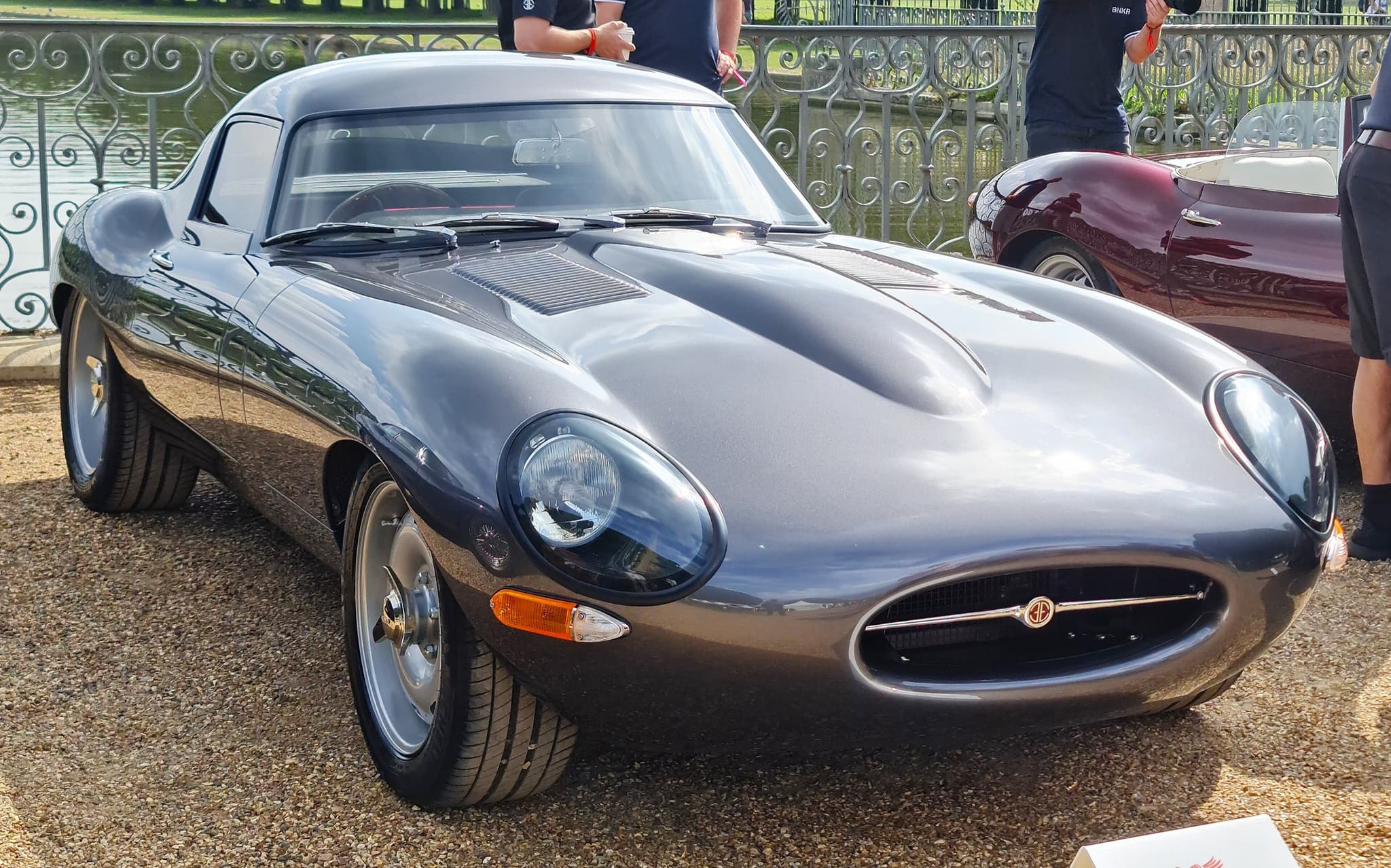
An E-Type replica is a car made to look like an E-Type that is not, or not wholly, one of the cars Jaguar built. Some are kit cars with names of their own; others recreate the famous competition cars on E-Type parts. Every real E-Type carries a car number from Jaguar's records, and that, with the car's own structure, is where telling them apart begins.
Restored and modified E-Types are not replicas: they are original cars, whatever has been done to them since, and the restomods and Eagle pages describe them.source 1source 2
The Challenger
The Challenger is a British kit car. Its owners' club describes it as "an authentic recreation of the 1961 Jaguar E Type Roadster": a glass-fibre copy of the 3.8 roadster bonded to a galvanised steel chassis, and, the club says, "Many Challengers use the original Jaguar running gear". About 250 were built "in the 1980s and into the early '90s", by the club's count, and at its 20th rally, on 13 May 2022, it said nearly half were still on the road. The club makes one claim about the car's origins:
Moulds for the car's body panels were taken from an original 1961 3.8 Litre E Type Roadster with written authorisation from Jaguar.
That is the club's account; Jaguar's written consent was not among the sources read, and neither was any record from the Challenger's maker. Whoever made it, a Challenger is a kit car, not a Jaguar, and its owners' club calls it a recreation.source 1source 3
Recreations and look-alikes
The E-Type's competition cars have been recreated, usually on E-Type parts, because the originals are so few: the Low Drag Coupé was a one-off, and the Lightweight a short run. A recreation of the Low Drag Coupé's shape heads this page. These are not Jaguar's own continuation Lightweights of 2014, which Jaguar built on numbers left unused from its 1963 sequence and which the Lightweight page describes; nor are they Eagle's Low Drag GT, which keeps its donor E-Type's identity.source 4source 5
How to tell a replica from a Jaguar E-Type
The numbers come first. Every E-Type Jaguar built has a car number in one of the factory's runs, which the chassis numbers page sets out: six digits beginning 85, 86, 87 or 88 for the 3.8, then the prefixes 1E for the Series 1 4.2, 1R and 2R for the Series 2, and 1S for the Series 3. Its engine and body carry numbers with prefixes of their own for each series. A replica's documents name another maker, or a kit.
The certificate is the next check. The Jaguar Heritage Trust's Heritage Certificate records what the factory built under a car number. It does not confirm that the car in front of you is that car, the Trust says; the numbers stamped on the car have to match it.
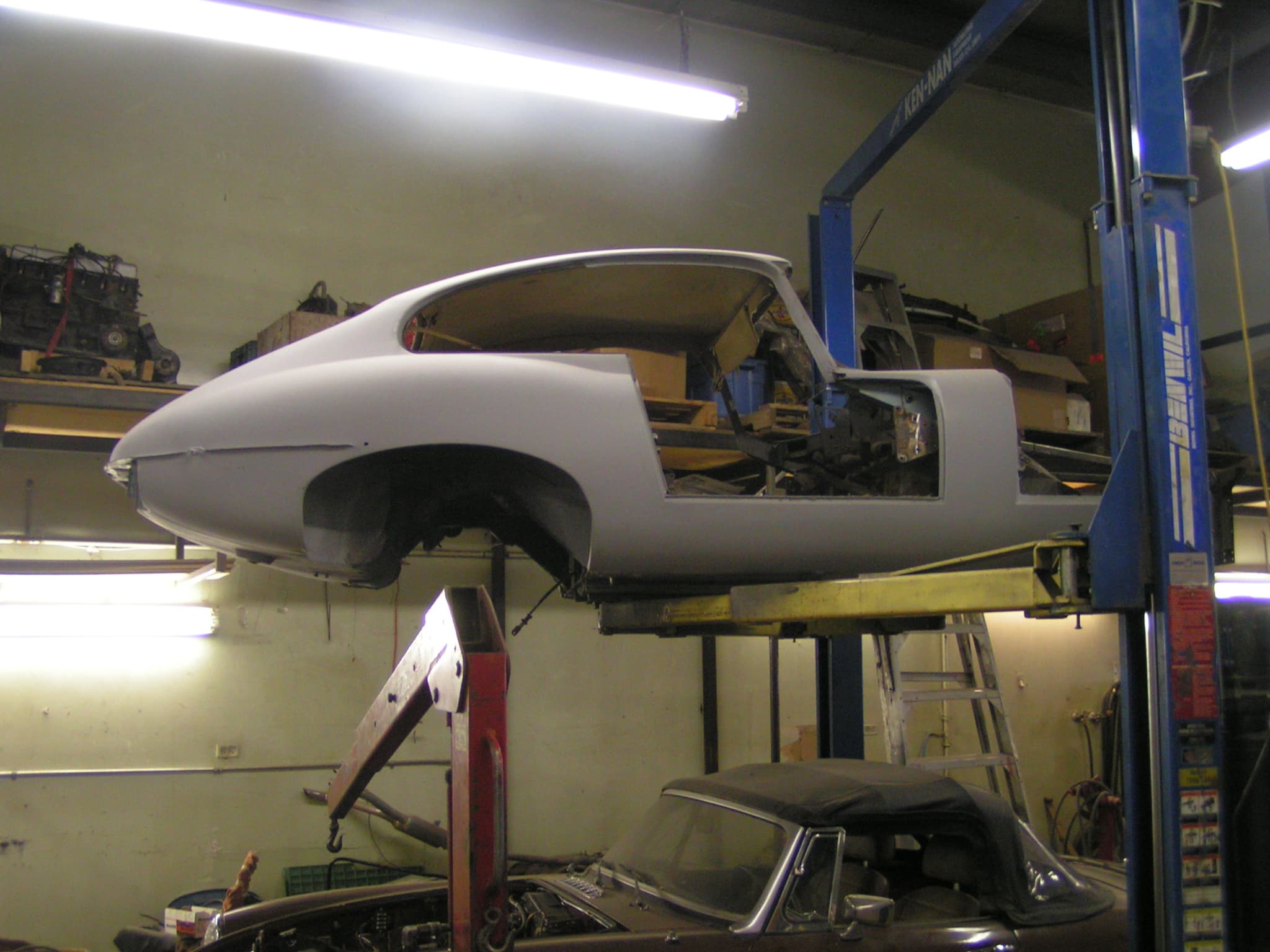
The structure tells too. A road-going E-Type is a steel monocoque with a frame of square steel tubes bolted to its front bulkhead, as Motor Sport described it in 1961. A glass-fibre body on a separate chassis is not built that way, whatever it looks like.
In Britain, the DVLA's rules decide what a car may be registered as. A kit-converted car keeps its original registration only if it has "2 original major parts along with the original unmodified" monocoque bodyshell; otherwise it takes an age-related number or a "Q" plate. A car rebuilt from period parts, which the DVLA calls a reconstructed classic, must be judged by an owners' club to be a true reflection of the marque, and for a car with a combined chassis and bodyshell, such as the E-Type, "must always be built with genuine period components from more than one vehicle, all over 40 years old".source 2source 6source 7source 8
Sources
Sources are given as plain text; their addresses are on the sources page.
- Primarymade at the time, by the maker or by people who were there
- Referenceserious later work: clubs, specialists, magazines, books
- Lincolnshire Life, "Challenger E-Type Owners Club event", Aug 2022 issue (online 26 Jul 2022), the Challenger and its owners' club; Lincolnshire Life, August 2022: the club's account of the car and its 20th rally. Reference
- Jaguar Daimler Heritage Trust, Research Guide No. 001F: Chassis Number Runs and Change Points by model – Jaguar E-type, Issue 3, January 2023, the car-number runs; pp. 1–2, the car-number runs and the engine and body prefixes. Primary
- Challenger E Type Owners Club, Challenger E Type Owners Club: home page, the club's home page. Reference
- Jaguar Land Rover (Jaguar media newsroom), "The Lightweight E-type is Reborn" (press release), 14 May 2014, the six remaining chassis numbers allocated in 1963. Primary
- Ben Oliver, "Eagle Low Drag GT (2014) review", CAR magazine (carmagazine.co.uk), updated 26 Jan 2015, 2014, the donor car and its VIN plate. Reference
- Jaguar Daimler Heritage Trust, "Heritage Certificates", what a certificate records and does not confirm. Primary
- Bill Boddy, "The New 3.8-Litre Jaguar E-Type G.T.", Motor Sport, Apr 1961, p. 35, p. 35, the monocoque and the front frame. Primary
- Driver and Vehicle Licensing Agency (GOV.UK), "Vehicle registration": "Kit-converted vehicles" and "Reconstructed classic vehicles", updated 23 Jan 2025, "Kit-converted vehicles" and "Reconstructed classic vehicles", updated 23 January 2025. Primary