Jaguar E-Type Chassis Numbers
An E-Type's car number, which most people now call its chassis number, says which series, body and steering side it was built as, and Jaguar's records hold three more numbers for it: the engine's, the body's and the gearbox's. How to read them all, where they are, and what a Heritage Certificate can and cannot prove.
About the pictureA Series 1 car of the type.
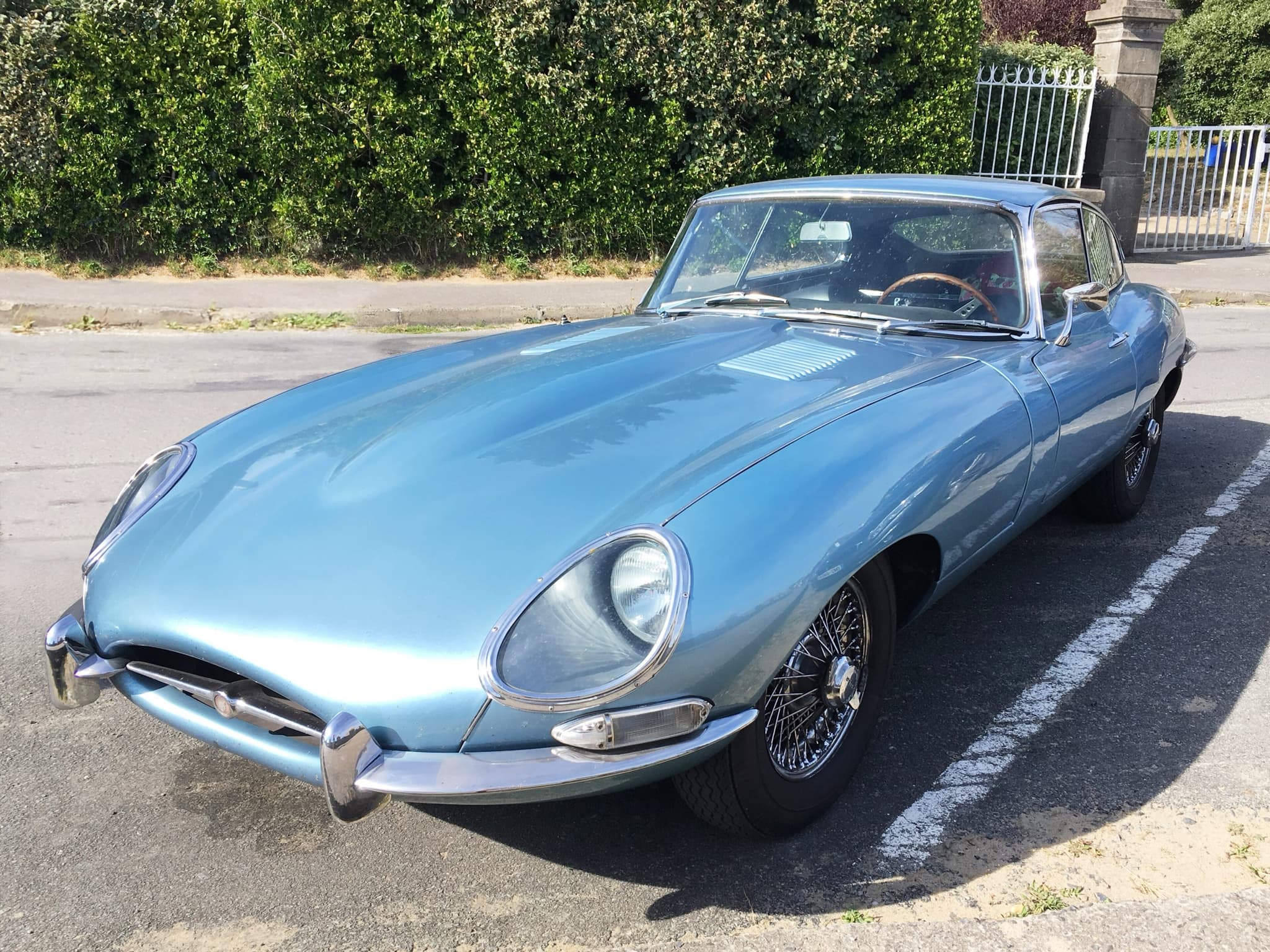
Jaguar called it the car number, and most buyers now say chassis number. Every E-Type also has an engine number, a body number and a gearbox (transmission) number, and the Jaguar Heritage Trust, which holds the factory's records, asks for all four when it researches a car. Read together, the numbers say what a car was built as, and they are where any check of an E-Type's identity begins.source 1source 2source 3
Reading a car number
Jaguar numbered the E-Type in blocks, one for each series, body and steering side, so a car number alone gives all three. In each series and body, the right-hand-drive block comes first and the left-hand-drive block starts higher.
The 3.8 of 1961 to 1964 had six-digit numbers with no letters, so a six-digit number beginning 85, 86, 87, 88 or 89 belongs to a 3.8 and nothing else. From the 4.2 of 1964 each series had a prefix: 1E for the Series 1 4.2, 1R for the Series 2 and 1S for the Series 3.
| Series | Body | Right-hand drive | Left-hand drive |
|---|---|---|---|
| 3.8 | Roadster | 850001 to 850943 | 875001 to 881886 |
| 3.8 | Coupé | 860001 to 861799 | 885001 to 890872 |
| Series 1 4.2 | Roadster | 1E 1001 to 1E 2183 | 1E 10001 to 1E 18367 |
| Series 1 4.2 | Coupé | 1E 20001 to 1E 21958 | 1E 30001 to 1E 35814 |
| Series 1 4.2 | 2+2 | 1E 50001 to 1E 51379 | 1E 75001 to 1E 79221 |
| Series 2 | Roadster | 1R 1001 to 1R 1776 | 1R 7001 to 1R 14853 |
| Series 2 | Coupé | 1R 20001 to 1R 21071 | 1R 25001 to 1R 28786 |
| Series 2 | 2+2 | 1R 35001 to 1R 36041 | 1R 40001 to 1R 44287 |
| Series 3 | Roadster | 1S 1001 to 1S 2872 | 1S 20001 to 1S 26120 |
| Series 3 | 2+2 | 1S 50001 to 1S 52116 | 1S 70001 to 1S 75183 |
The first numbers of most runs were issued in March 1961, but the right-hand-drive coupés began only in July, when deliveries at home started; the Series 3 roadster began with left-hand-drive cars in December 1970 and right-hand drive in February 1971, and both 2+2 runs began in 1970, in a month the Trust does not give. So a claim to be "the first E-Type" needs its run: each block had its own first car. The late cars called "Series 1½" have no prefix of their own; they are 1E cars, and the Series 2 page explains where they begin. How many cars each run held is on the production figures page.source 1source 4source 5source 6source 7
1S2872
- 1SThe prefix: a Series 3
- 2872The serial: in the block for right-hand-drive roadsters, the last number it used
Prefixes and suffixes
Letters before and after the number record how the car left the factory:
| Mark | Where | Meaning |
|---|---|---|
| P | Before the number | Power steering, on Series 1 and 2 cars so fitted; the Series 3 had it as standard |
| BW | After the number | A Borg-Warner automatic: Series 1 4.2 and Series 2 2+2 cars, and Series 3 cars |
| 2R | In place of 1R | A Series 2 built to American specification for the 1971 model year, from about April 1970 |
| UC, UD, UE | Before 1S | American specification, for the 1972, 1973 and 1974 model years |
The 2R cars sit inside the ordinary left-hand-drive runs: the Trust gives the change as about 2R 13621 for roadsters, in May 1970, and 2R 27981 for coupés, in April. A UD1S car is an American 1973 model; by the 1974 model year, its last, the E-Type was sold in America only as a roadster.
The engine and body numbers have prefixes of their own. The 3.8's engine numbers begin R, and RA from about February or March 1963; the Series 1 4.2's begin 7E, the Series 2's 7R and the V12's 7S. Bodies were numbered R for a 3.8 roadster and V for a 3.8 coupé, then 4E, 4R and 4S by series. Gearbox numbers have prefixes too, but no source read from the factory or the Trust lists them.source 1source 8source 7source 9
The first number of each year
The Trust lists the first car number each run used in each year of production, which dates a car to its year of building. The years are calendar years, not American model years, and the Trust warns that its change points "must be treated as a guide only".
The 3.8, 1961 to 1964:
| Run | 1961 | 1962 | 1963 | 1964 |
|---|---|---|---|---|
| Roadster, right | 850001 | 850328 | 850646 | 850808 |
| Roadster, left | 875001 | 876471 | 878863 | 880808 |
| Coupé, right | 860001 | 860134 | 861052 | 861434 |
| Coupé, left | 885001 | 885399 | 888035 | 889752 |
The Series 1 4.2, 1964 to 1968, with the Trust's "September 1967" change point:
| Run | 1964 | 1965 | 1966 | 1967 | Sept 1967 | 1968 |
|---|---|---|---|---|---|---|
| Roadster, right | 1E 1001 | 1E 1078 | 1E 1435 | 1E 1705 | 1E 1864 | 1E 1995 |
| Roadster, left | 1E 10001 | 1E 10441 | 1E 12348 | 1E 14472 | 1E 15980 | 1E 16653 |
| Coupé, right | 1E 20001 | 1E 20139 | 1E 21155 | 1E 21473 | 1E 21584 | 1E 21744 |
| Coupé, left | 1E 30001 | 1E 30454 | 1E 32474 | 1E 34072 | 1E 34583 | 1E 34984 |
| 2+2, right | – | 1E 50001 | 1E 50005 | 1E 50676 | 1E 50975 | 1E 51117 |
| 2+2, left | – | 1E 75001 | 1E 75010 | 1E 76986 | 1E 77709 | 1E 77860 |
One number in this table is not the Trust's. Its list has no record of the right-hand-drive 2+2's first number of 1966, and the one given comes from Alan Karpovitch's table in the judges' guide of the Jaguar Clubs of North America, which puts 1E 50001 to 1E 50004 in 1965. The left-hand-drive numbers in the September 1967 column are the ones Anders Clausager identifies, as the clubs cite him, as the start of the American cars' twin Zenith-Stromberg carburettors and the 1968 model year; the clubs add that no factory document dates the change.
The Series 2, 1968 to 1970:
| Run | 1968 | 1969 | 1970 |
|---|---|---|---|
| Roadster, right | 1R 1001 | 1R 1075 | 1R 1499 |
| Roadster, left | 1R 7001 | 1R 8126 | 1R 12201 |
| Coupé, right | 1R 20001 | 1R 20127 | 1R 20605 |
| Coupé, left | 1R 25001 | 1R 25601 | 1R 27572 |
| 2+2, right | 1R 35001 | 1R 35119 | 1R 35697 |
| 2+2, left | 1R 40001 | 1R 40799 | 1R 43437 |
| Run | 1970 | 1971 | 1972 | 1973 | 1974 |
|---|---|---|---|---|---|
| Roadster, right | – | 1S 1001 | 1S 1210 | 1S 1681 | 1S 2649 |
| Roadster, left | 1S 20001 | 1S 20005 | 1S 20169 | 1S 21689 | 1S 24476 |
| 2+2, right | 1S 50001 | 1S 50065 | 1S 50968 | 1S 51618 | – |
| 2+2, left | 1S 70001 | 1S 70524 | 1S 72662 | 1S 74351 | – |
Where the numbers are
The Trust's guide to finding each number covers every Jaguar; for the E-Type it gives these places.
The car number. On the Series 1 it is stamped on the right-hand cross-member of the front frame, above the damper mounting. The Series 2 adds an identification plate on the left-hand sill (rocker panel) in the engine bay. On the Series 3 the plate is on top of the scuttle, in the middle, and North American cars also carry the number on a plate seen through the windscreen (windshield) and on a label on the door pillar.
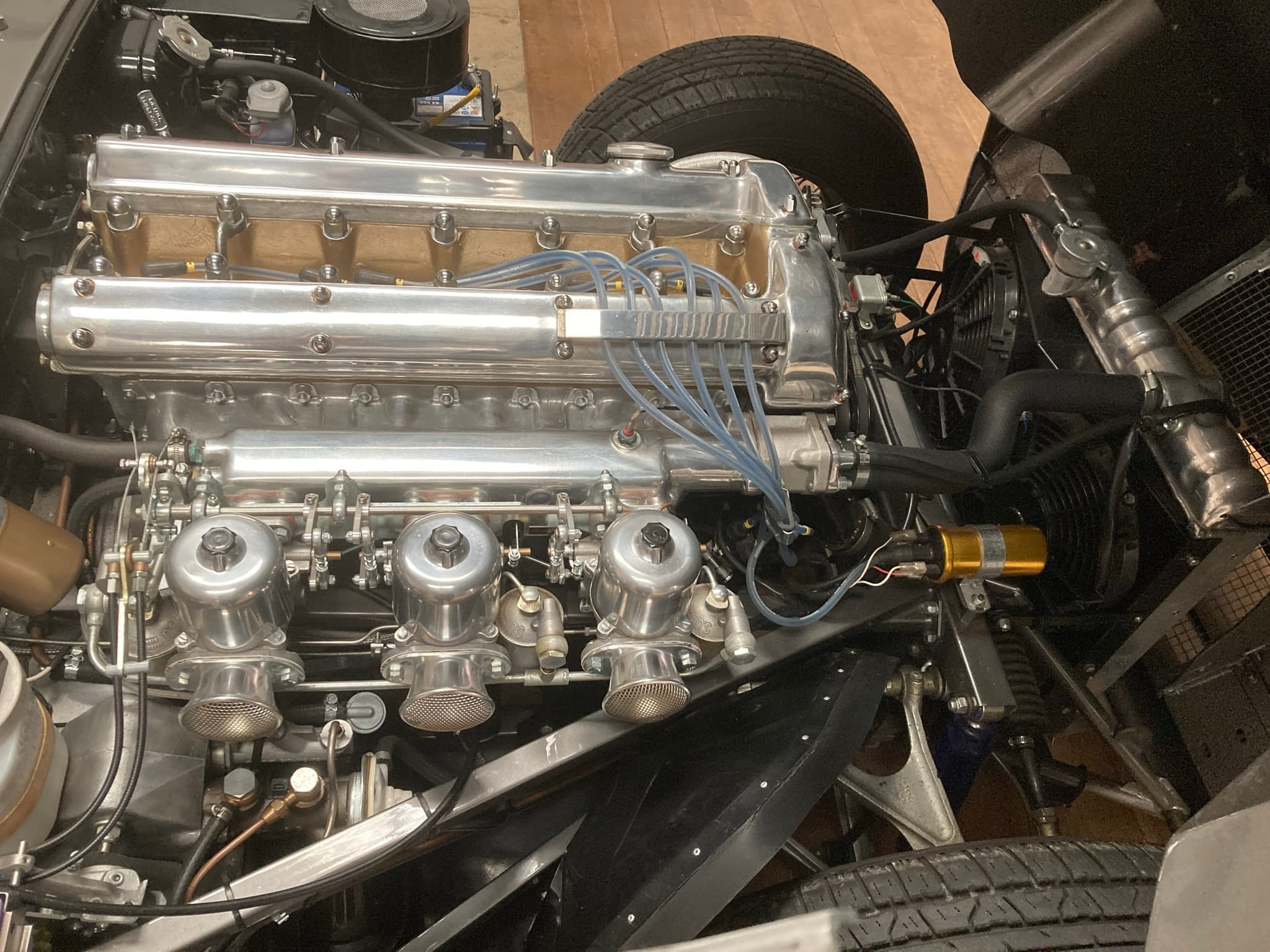
The engine number. On the Series 1 it is stamped on the right of the block above the oil filter, and on the front of the cylinder head, in its central valley. Series 2 engines of 1968 and 1969 have it in the same places; those of 1969 and 1970 have it only on the left of the bell-housing flange. On the V12 it is at the back of the engine, in the valley by the bell-housing flange.
The body number. On the Series 1 it is on the scuttle under the bonnet (hood) or on the left of the boot (trunk), and on 4.2s in the recess for the rear number plate (license plate). On the Series 2 a small plate sits behind the rear number plate; on the Series 3 roadster too, and on the 2+2 on the left inner wheel arch below the tailgate hinges.
The gearbox number. On a manual box it is on a shoulder at the left rear of the casing and on the rim of the top cover's core-plug hole; on an automatic, on a plate on the left of the casing.
The Trust adds that early cars may carry a different number on the tag in the boot from the one on the main plate, so a body number on an early car needs care. It can also be the best evidence there is: Motor Sport told in 1989 of a very early roadster whose identity, with its chassis plate missing, was traced from a body plate hidden under a switch.source 11source 12
Heritage Certificates
The Trust's certificate gives a car's entry in Jaguar's production records "exactly as it was recorded at the time of production": the original colour and trim, the dates of building and dispatch, the original destination and, where it was recorded, the first registration. It adds nothing the records do not hold, whatever other evidence says, and the Trust does not inspect cars. A separate service gives the original paint name and code. The Jaguar Clubs of North America, which judge E-Types at concours, print on every page of their judges' guide that a certificate "supersedes Jaguar color charts".
What a certificate cannot do, the Trust says plainly:
a Certificate is not in itself confirmation of the identity, provenance, originality or present condition of a particular vehicle. A Certificate does not represent proof of ownership of a vehicle.
A certificate says what the factory built under a number. "Matching numbers", in a buyer's language, means that the engine, body and gearbox numbers on the car agree with the ones recorded for its car number, and whether every certificate prints all three, no source read says. In Britain a car never registered there, or re-imported, needs a certificate and an inspection by an authorised club, such as the Jaguar Enthusiasts' Club, before the DVLA will register it. The buyers guide says how to read a certificate against a car.
Works and heritage cars by number
The factory's own cars of 1961 and the cars the Trust keeps have these numbers:
| Car | Car number | What it was |
|---|---|---|
| 9600 HP | 885002 | The coupé driven to Geneva in March 1961 and lent to The Autocar; body V1002 |
| 77 RW | 850003 | The roadster driven to Geneva overnight and lent to The Motor |
| The Geneva display coupé | 885005 | The car on Jaguar's stand in the hall, unveiled in March 1961 |
| HDU 555N | 1S 2872 | The last E-Type, built on 12 June 1974; body 4S 8989 |
Production
Production: how far the sources agree
- 15,498, 3.8L, the register's "Built" count (OTS 7,828 + FHC 7,670); Jaguar's 15,481 counts cars sold (motor-sport-1975-05-e-type-end-of-production)
- One good source.
- 15,481, 3.8L, Jaguar's figure, cars "sold", 1961-64
- One good source.
- 15,496, 3.8L, Skilleter's figures, OTS 7,827 + FHC 7,669
- One good source.
- 7,670, FHC, the register's "Built" count, 1,798 RHD + 5,872 LHD; Skilleter's 7,669 (motor-sport-1989-04-e-type-38-42-v12) agrees within one car (ERRATA-generations §2a)
- One good source.
- 7,669, FHC, Skilleter's figure
- One good source.
- 1,938, 3.8 Roadster (flat floor), "The first 2,616 (1,938 OTS and 678 FHC) 3.8L flat floor E-Types were produced"; Jaguar's Service Department Bulletin P.51 as reproduced by the JCNA draft guide; 357 RHD + 1,581 LHD
- One good source.
- 678, Flat Floor, "The first 2,616 (1,938 OTS and 678 FHC) 3.8L flat floor E-Types were produced"; Jaguar's Service Department Bulletin P.51 as reproduced by the JCNA draft guide; 175 RHD + 503 LHD
- One good source.
- 476, Outside Bonnet Latch, roadsters 850001-850091 RHD (91) and 875001-875385 LHD (385): 91 + 385 = 476 (our sum of the guide's ranges); SDB P.46 (January 1962) as reproduced by the JCNA draft guide (ERRATA-generations C2: 500 in all)
- One good source.
- 24, 3.8 Coupé (outside latch), coupés 860001-860004 RHD (4) and 885001-885020 LHD (20): 4 + 20 = 24 (our sum of the guide's ranges); SDB P.46 (January 1962) as reproduced by the JCNA draft guide (ERRATA-generations C2: 500 in all)
- One good source.
- 7,828, Roadster, the register's "Built" count, 942 RHD + 6,886 LHD; Skilleter's 7,827 (motor-sport-1989-04-e-type-38-42-v12) agrees within one car (ERRATA-generations §2a)
- One good source.
- 7,827, Roadster, Skilleter's figure
- One good source.
- 31,693, the register's "Built" count, its own "Series 1" row: 15,498 + 16,195, excluding the 6,726 Series 1½ cars (counted on series-1-5); Jaguar's series figures (15,481 3.8s "sold"; 22,908 4.2s, which include the Series 1.5) do not split at the same point (ERRATA-generations §2a)
- One good source.
- 1, Low Drag Coupé, "Six were planned, but ... only one was built" (EC1001, 1962)
- One good source.
- 1, Low Drag Coupé, built 1962
- One good source.
- 12, Lightweight, "Only 12 ... were eventually built, the last in 1964", of a project of February 1963 to build 18 "Special GT E-type Cars"; ERRATA-competition C1: twelve; the older counts (15 with three steel-centre cars, Motor Sport 1984; 13 on the register, with S850817) are rows
- Good sources agree.
- 15, Lightweight, 12 alloy-centre + 3 steel-centre (14 raced, 1 road car)
- One good source.
- 13, Lightweight, register entries incl. S850817, the Ropner road car
- One good source.
- 5,830, 4.2 Coupé, the register's "Built" count to the SDB P.59 open-headlamp numbers, 1,582 RHD + 4,248 LHD
- One good source.
- 3,616, the register's "Built" count to the open-headlamp change, 973 RHD + 2,643 LHD; Series 1 only (5,599 with the Series 1.5 2+2s, which the tree holds on its own node)
- One good source.
- 1,983, 2+2, XKEdata's "Series 1.5" count, from the SDB P.59 open-headlamp numbers (ERRATA-generations C5), 405 RHD + 1,578 LHD; the tree's 1,986 is not a reading
- One good source.
- 2,801, Roadster, XKEdata's "Series 1.5" count, from the SDB P.59 open-headlamp numbers (ERRATA-generations C5), 321 RHD + 2,480 LHD
- One good source.
- 6,726, Series 1½, the register's "Built" count, OTS 2,801, FHC 1,942, 2+2 1,983, from the SDB P.59 open-headlamp numbers (ERRATA-generations C5); about 6,232 from the Stromberg / September 1967 numbers (Karpovitch, JCNA appendix B) is a row
- One good source.
- about 6,232, Series 1½, from the Zenith-Stromberg / September 1967 numbers (Karpovitch, appendix B)
- One good source.
- 5,326, Series 2 2+2, the register's "Built" count, 1,040 RHD + 4,286 LHD; JDHT car-number spans 5,328 (our sum of RG001F's number spans, last - first + 1; ERRATA-generations §2a)
- One good source.
- 18,809, Series 2, the register's "Built" count, OTS 8,628, FHC 4,855, 2+2 5,326; Jaguar's 18,841 ("between 1968 and 1971") is a row
- One good source.
- 18,841, Series 2, Jaguar's figure, "between 1968 and 1971"
- One good source.
- 7,297, Series 3 V12 2+2, the register's "Built" count, 2,115 RHD + 5,182 LHD; JDHT spans 7,299 (our sum of RG001F's number spans, last - first + 1)
- One good source.
- 7,990, Roadster, the register's "Built" count, 1,871 RHD + 6,119 LHD, including the 50 Commemorative cars; JDHT spans 7,992 (our sum of RG001F's number spans, last - first + 1)
- One good source.
- 15,287, Series 3 V12, the register's "Built" count, OTS 7,990, 2+2 7,297; Jaguar's 15,292 is a row
- One good source.
- 15,292, Series 3 V12, Jaguar's figure, to 1975
- One good source.
- 6, Continuation, "Just six customer Lightweight E-types will be built", each "assigned one of the remaining chassis numbers originally allocated in 1963"; the prototype Car Zero "will not carry one of the six Lightweight chassis numbers" and is not counted; V2 with jlrna-2016-07-jaguar-classic-xkss-lightweight ("the famous 'Missing Six'")
- One good source.
- 72,584, Jaguar's figure, all E-Types, "produced": the sum of its market split (USA 49,032, Canada 2,439, other export 8,793, UK 12,320); the register's 72,515 and Motor Sport 1989's 72,507 are scoped rows (ERRATA-generations C4: "never one figure as 'the' total")
- One good source.
- 72,515, E-Type, register "Built" count, series x body x steering side; source of the counts not stated
- One good source.
- 72,507, E-Type, "examples of all series"
- One good source.
15,4983.8L, the register's "Built" count (OTS 7,828 + FHC 7,670); Jaguar's 15,481 counts cars sold (motor-sport-1975-05-e-type-end-of-production)
XKEdata (xke.collectordata.com), "Statistics"source 19
15,4813.8L, Jaguar's figure, cars "sold", 1961-64
Motor Sport, "Jaguar E-type: the end of production and end of an era – but not of a legend", May 1975, p. 29source 5
15,4963.8L, Skilleter's figures, OTS 7,827 + FHC 7,669
William Kimberley, "The Jaguar E-Type 3.8, 4.2 & V12", Motor Sport, Apr 1989, p. 81source 12
7,670FHC, the register's "Built" count, 1,798 RHD + 5,872 LHD; Skilleter's 7,669 (motor-sport-1989-04-e-type-38-42-v12) agrees within one car (ERRATA-generations §2a)
XKEdata (xke.collectordata.com), "Statistics"source 19
7,669FHC, Skilleter's figure
William Kimberley, "The Jaguar E-Type 3.8, 4.2 & V12", Motor Sport, Apr 1989, p. 81source 12
1,9383.8 Roadster (flat floor), "The first 2,616 (1,938 OTS and 678 FHC) 3.8L flat floor E-Types were produced"; Jaguar's Service Department Bulletin P.51 as reproduced by the JCNA draft guide; 357 RHD + 1,581 LHD
Jaguar Clubs of North America, Series 1 E-Type Judge's Guide (draft), part 1: Intro–Exterior, Draft, version of 21 Jul 2026source 3
678Flat Floor, "The first 2,616 (1,938 OTS and 678 FHC) 3.8L flat floor E-Types were produced"; Jaguar's Service Department Bulletin P.51 as reproduced by the JCNA draft guide; 175 RHD + 503 LHD
Jaguar Clubs of North America, Series 1 E-Type Judge's Guide (draft), part 1: Intro–Exterior, Draft, version of 21 Jul 2026source 3
476Outside Bonnet Latch, roadsters 850001-850091 RHD (91) and 875001-875385 LHD (385): 91 + 385 = 476 (our sum of the guide's ranges); SDB P.46 (January 1962) as reproduced by the JCNA draft guide (ERRATA-generations C2: 500 in all)
Jaguar Clubs of North America, Series 1 E-Type Judge's Guide (draft), part 1: Intro–Exterior, Draft, version of 21 Jul 2026source 3
243.8 Coupé (outside latch), coupés 860001-860004 RHD (4) and 885001-885020 LHD (20): 4 + 20 = 24 (our sum of the guide's ranges); SDB P.46 (January 1962) as reproduced by the JCNA draft guide (ERRATA-generations C2: 500 in all)
Jaguar Clubs of North America, Series 1 E-Type Judge's Guide (draft), part 1: Intro–Exterior, Draft, version of 21 Jul 2026source 3
7,828Roadster, the register's "Built" count, 942 RHD + 6,886 LHD; Skilleter's 7,827 (motor-sport-1989-04-e-type-38-42-v12) agrees within one car (ERRATA-generations §2a)
XKEdata (xke.collectordata.com), "Statistics"source 19
7,827Roadster, Skilleter's figure
William Kimberley, "The Jaguar E-Type 3.8, 4.2 & V12", Motor Sport, Apr 1989, p. 81source 12
31,693the register's "Built" count, its own "Series 1" row: 15,498 + 16,195, excluding the 6,726 Series 1½ cars (counted on series-1-5); Jaguar's series figures (15,481 3.8s "sold"; 22,908 4.2s, which include the Series 1.5) do not split at the same point (ERRATA-generations §2a)
XKEdata (xke.collectordata.com), "Statistics"source 19
1Low Drag Coupé, "Six were planned, but ... only one was built" (EC1001, 1962)
Damien Smith, "Cut and pace", Motor Sport, Mar 2005, p. 86source 20
1Low Drag Coupé, built 1962
collectordata.com (the XKEdata family of registers), Coventry Racers: Jaguar C-Type, D-Type, XKSS and Lightweight E-Type registersource 21
12Lightweight, "Only 12 ... were eventually built, the last in 1964", of a project of February 1963 to build 18 "Special GT E-type Cars"; ERRATA-competition C1: twelve; the older counts (15 with three steel-centre cars, Motor Sport 1984; 13 on the register, with S850817) are rows
Jaguar Land Rover (Jaguar media newsroom), "The Lightweight E-type is Reborn" (press release), 14 May 2014source 22; Motor Sport, "Jaguar E-type: the end of production and end of an era – but not of a legend", May 1975, p. 29source 5
15Lightweight, 12 alloy-centre + 3 steel-centre (14 raced, 1 road car)
Gordon Cruickshank, "Jaguar's Lightweight E Types", Motor Sport, Sep 1984, p. 33source 23
13Lightweight, register entries incl. S850817, the Ropner road car
collectordata.com (the XKEdata family of registers), Coventry Racers: Jaguar C-Type, D-Type, XKSS and Lightweight E-Type registersource 21
5,8304.2 Coupé, the register's "Built" count to the SDB P.59 open-headlamp numbers, 1,582 RHD + 4,248 LHD
XKEdata (xke.collectordata.com), "Statistics"source 19
3,616the register's "Built" count to the open-headlamp change, 973 RHD + 2,643 LHD; Series 1 only (5,599 with the Series 1.5 2+2s, which the tree holds on its own node)
XKEdata (xke.collectordata.com), "Statistics"source 19
1,9832+2, XKEdata's "Series 1.5" count, from the SDB P.59 open-headlamp numbers (ERRATA-generations C5), 405 RHD + 1,578 LHD; the tree's 1,986 is not a reading
XKEdata (xke.collectordata.com), "Statistics"source 19
2,801Roadster, XKEdata's "Series 1.5" count, from the SDB P.59 open-headlamp numbers (ERRATA-generations C5), 321 RHD + 2,480 LHD
XKEdata (xke.collectordata.com), "Statistics"source 19
6,726Series 1½, the register's "Built" count, OTS 2,801, FHC 1,942, 2+2 1,983, from the SDB P.59 open-headlamp numbers (ERRATA-generations C5); about 6,232 from the Stromberg / September 1967 numbers (Karpovitch, JCNA appendix B) is a row
XKEdata (xke.collectordata.com), "Statistics"source 19
about 6,232Series 1½, from the Zenith-Stromberg / September 1967 numbers (Karpovitch, appendix B)
Jaguar Clubs of North America, Series 1 E-Type Judge's Guide (draft): Appendices, Draft, version of 21 Jul 2026, pp. 167 ff.source 10
5,326Series 2 2+2, the register's "Built" count, 1,040 RHD + 4,286 LHD; JDHT car-number spans 5,328 (our sum of RG001F's number spans, last - first + 1; ERRATA-generations §2a)
XKEdata (xke.collectordata.com), "Statistics"source 19
18,809Series 2, the register's "Built" count, OTS 8,628, FHC 4,855, 2+2 5,326; Jaguar's 18,841 ("between 1968 and 1971") is a row
XKEdata (xke.collectordata.com), "Statistics"source 19
18,841Series 2, Jaguar's figure, "between 1968 and 1971"
Motor Sport, "Jaguar E-type: the end of production and end of an era – but not of a legend", May 1975, p. 29source 5
7,297Series 3 V12 2+2, the register's "Built" count, 2,115 RHD + 5,182 LHD; JDHT spans 7,299 (our sum of RG001F's number spans, last - first + 1)
XKEdata (xke.collectordata.com), "Statistics"source 19
7,990Roadster, the register's "Built" count, 1,871 RHD + 6,119 LHD, including the 50 Commemorative cars; JDHT spans 7,992 (our sum of RG001F's number spans, last - first + 1)
XKEdata (xke.collectordata.com), "Statistics"source 19
15,287Series 3 V12, the register's "Built" count, OTS 7,990, 2+2 7,297; Jaguar's 15,292 is a row
XKEdata (xke.collectordata.com), "Statistics"source 19
15,292Series 3 V12, Jaguar's figure, to 1975
Motor Sport, "Jaguar E-type: the end of production and end of an era – but not of a legend", May 1975, p. 29source 5
6Continuation, "Just six customer Lightweight E-types will be built", each "assigned one of the remaining chassis numbers originally allocated in 1963"; the prototype Car Zero "will not carry one of the six Lightweight chassis numbers" and is not counted; V2 with jlrna-2016-07-jaguar-classic-xkss-lightweight ("the famous 'Missing Six'")
Jaguar Land Rover (Jaguar media newsroom), "Jaguar Land Rover Special Operations Reveals 'New' Lightweight E-type" (press release), 12 Aug 2014source 24
72,584Jaguar's figure, all E-Types, "produced": the sum of its market split (USA 49,032, Canada 2,439, other export 8,793, UK 12,320); the register's 72,515 and Motor Sport 1989's 72,507 are scoped rows (ERRATA-generations C4: "never one figure as 'the' total")
Motor Sport, "Jaguar E-type: the end of production and end of an era – but not of a legend", May 1975, p. 29source 5
72,515E-Type, register "Built" count, series x body x steering side; source of the counts not stated
XKEdata (xke.collectordata.com), "Statistics"source 19
72,507E-Type, "examples of all series"
William Kimberley, "The Jaguar E-Type 3.8, 4.2 & V12", Motor Sport, Apr 1989, p. 81source 12
Sources
Sources are given as plain text; their addresses are on the sources page.
- Primarymade at the time, by the maker or by people who were there
- Referenceserious later work: clubs, specialists, magazines, books
- Jaguar Daimler Heritage Trust, Research Guide No. 001F: Chassis Number Runs and Change Points by model – Jaguar E-type, Issue 3, January 2023, pp. 1–2, chassis, engine and body numbers for every run; pp. 1–2, the first and last numbers of each run; pp. 1–2, the general notes: P, BW, 2R, UC, UD and UE; engine and body prefixes; pp. 1–2, the year rows and the "September 1967" row; "a guide only". Primary
- Jaguar Daimler Heritage Trust, "Heritage Certificates", the numbers an applicant supplies; what a certificate records and does not confirm; inspection; the DVLA. Primary
- Jaguar Clubs of North America, Series 1 E-Type Judge's Guide (draft), part 1: Intro–Exterior, Draft, version of 21 Jul 2026, the index: "Commission Plate"; the launch cars: the Geneva display coupé and the New York show cars; p. 5, flat floors; pp. 5, 9, outside bonnet latches. Reference
- Paul Skilleter, Jaguar Sports Cars, Haynes (first published by G. T. Foulis, 1975), 1988 reprint, 1975, the car-number table. Reference
- Motor Sport, "Jaguar E-type: the end of production and end of an era – but not of a legend", May 1975, p. 29, p. 29, "the very last one" and its body number; para 4; "Only 12 full lightweights". Primary
- Jaguar Daimler Heritage Trust, "1974 Jaguar E-type Series 3 V12 OTS HDU 555N: The Last E-type Built", the last car, built on 12 June 1974; HDU 555N. Primary
- XKEdata (xke.collectordata.com), "Enter data" (car-number entry page), the prefix list; "six digit number starting with '8'"; the prefix list. Reference
- Paul Skilleter, The Jaguar E-type: A Collector's Guide, Motor Racing Publications, 1979, the engine numbers, "R or RA" and "7E"; 9600 HP as 885002. Reference
- Chris Cowin, "History: Exporting British cars to the USA – Part Two", AROnline, 31 May 2025, updated 21 Oct 2025, 1974: the convertible only. Reference
- Jaguar Clubs of North America, Series 1 E-Type Judge's Guide (draft): Appendices, Draft, version of 21 Jul 2026, pp. 167 ff., Appendix B, Karpovitch's table of the 4.2 2+2 in 1965 and 1966; Appendix D, the change points of 1967; the page footer: "supersedes Jaguar color charts"; appendix B. Reference
- Jaguar Daimler Heritage Trust, Research Guide No. 002: Vehicle numbers locator Guide, Issue 7, October 2026, pp. 8–9, the E-Type rows. Primary
- William Kimberley, "The Jaguar E-Type 3.8, 4.2 & V12", Motor Sport, Apr 1989, p. 81, p. 81, the body plate under a switch; para 6; para 3. Reference
- Jaguar Daimler Heritage Trust, "Paint Codes", the paint-code service. Primary
- XKEdata (xke.collectordata.com), "About This Site" (with FAQ), "About This Site": the build sheets. Reference
- XKEdata (xke.collectordata.com), Car page 885002 (9600 HP), the register's entry. Reference
- XKEdata (xke.collectordata.com), Car page 850003 (77 RW), the register's entry. Reference
- Jaguar Daimler Heritage Trust, "1961 Jaguar E-type 77 RW: The First E-type OTS", the Trust's page on 77 RW. Primary
- XKEdata (xke.collectordata.com), Car page 1S2872 (5.3 open two-seater, HDU 555N), the register's entry. Reference
- XKEdata (xke.collectordata.com), "Statistics", statistics, Series 1 3.8; statistics, Series 1; statistics, Series 1 4.2; statistics, Series 1 4.2 2+2; statistics, Series 1.5; statistics, Series 2 2+2; statistics, Series 2; statistics, Series 3 2+2; statistics, Series 3 OTS; statistics, Series 3; statistics, totals. Reference
- Damien Smith, "Cut and pace", Motor Sport, Mar 2005, p. 86, para 7. Reference
- collectordata.com (the XKEdata family of registers), Coventry Racers: Jaguar C-Type, D-Type, XKSS and Lightweight E-Type register, car page EC1001; model search. Reference
- Jaguar Land Rover (Jaguar media newsroom), "The Lightweight E-type is Reborn" (press release), 14 May 2014, editors' notes; para 2. Primary
- Gordon Cruickshank, "Jaguar's Lightweight E Types", Motor Sport, Sep 1984, p. 33, paras 4, 7. Reference
- Jaguar Land Rover (Jaguar media newsroom), "Jaguar Land Rover Special Operations Reveals 'New' Lightweight E-type" (press release), 12 Aug 2014, text. Primary