Jaguar E-Type Engine
Three engines drove the E-Type: Jaguar's twin-cam XK six as the 3.8 and the 4.2, and from 1971 the V12. How each was made, what the American cars had instead, and what owners found.
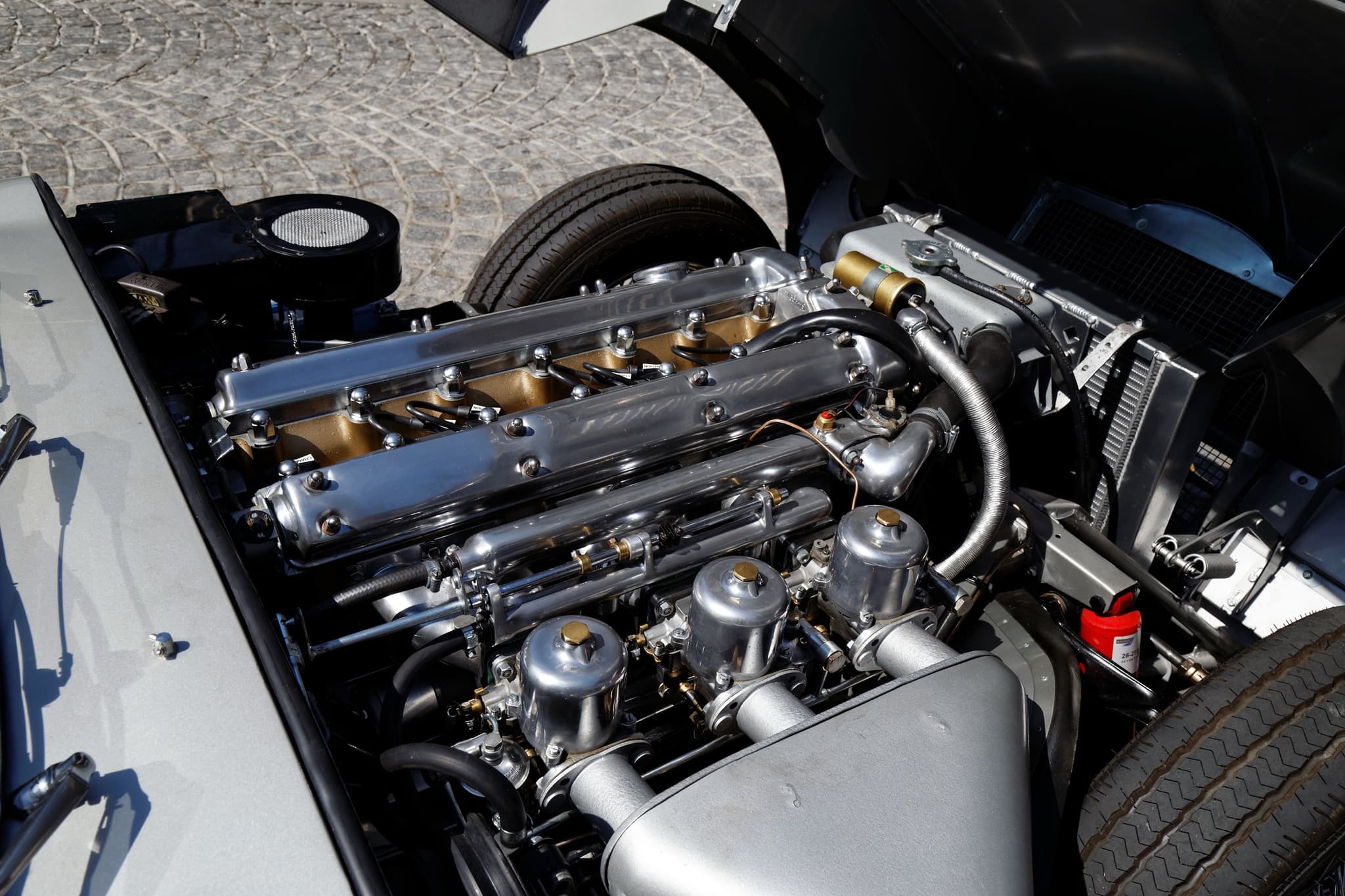
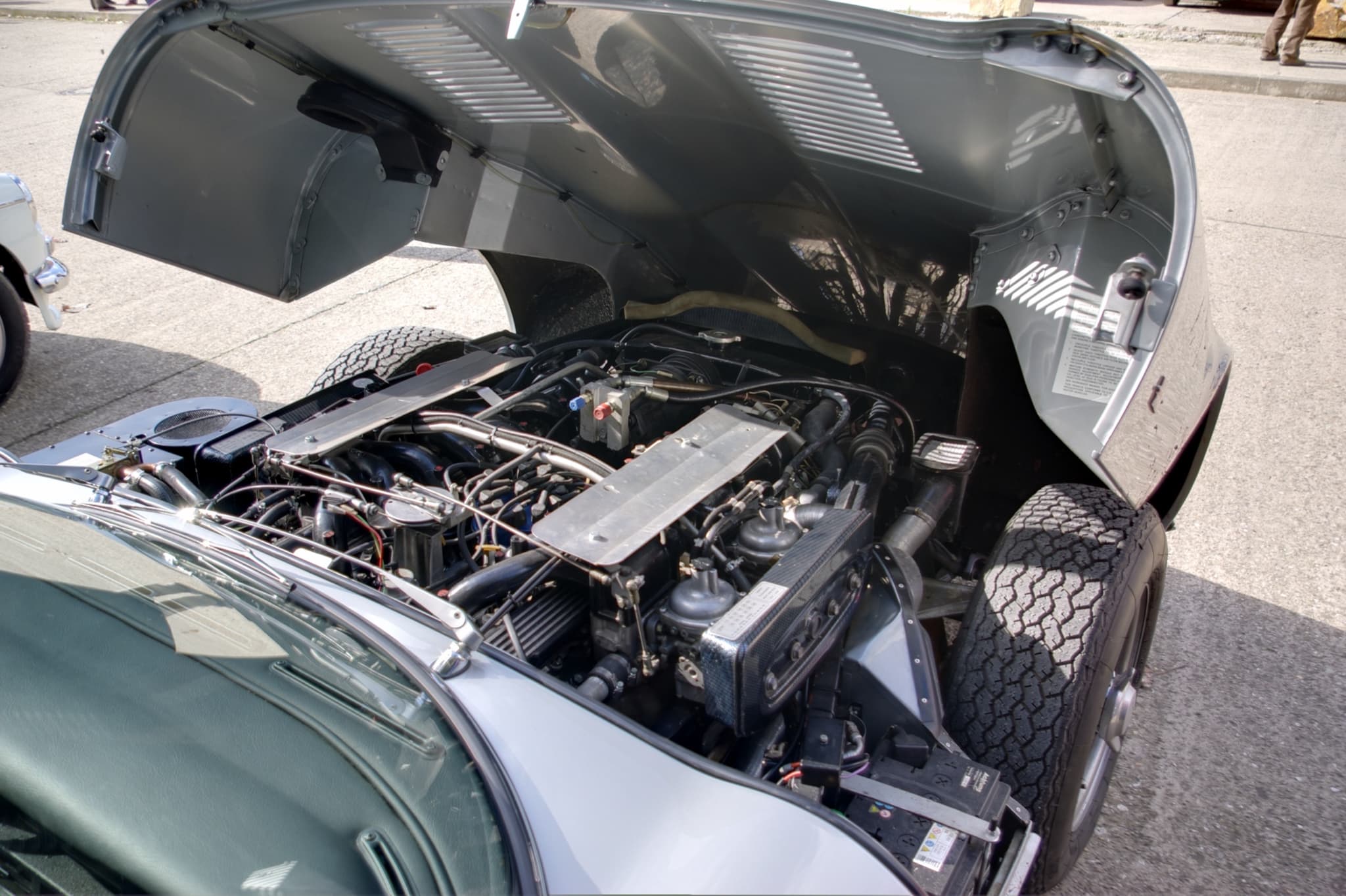
Under the E-Type's long bonnet (hood) there were only ever two kinds of engine. For 10 years it was Jaguar's twin-overhead-camshaft XK six, the engine of the XK120 of 1948, first as the 3.8 and from 1964 as the 4.2. Then, in 1971, came a V12 that Jaguar had designed for building in quantity, and the E-Type had it before Jaguar's saloons (sedans) did.
The figures for every engine, each with the rating its source used, are on the specifications page; this page tells how the engines were made and what changed.source 1source 2source 3
The XK six
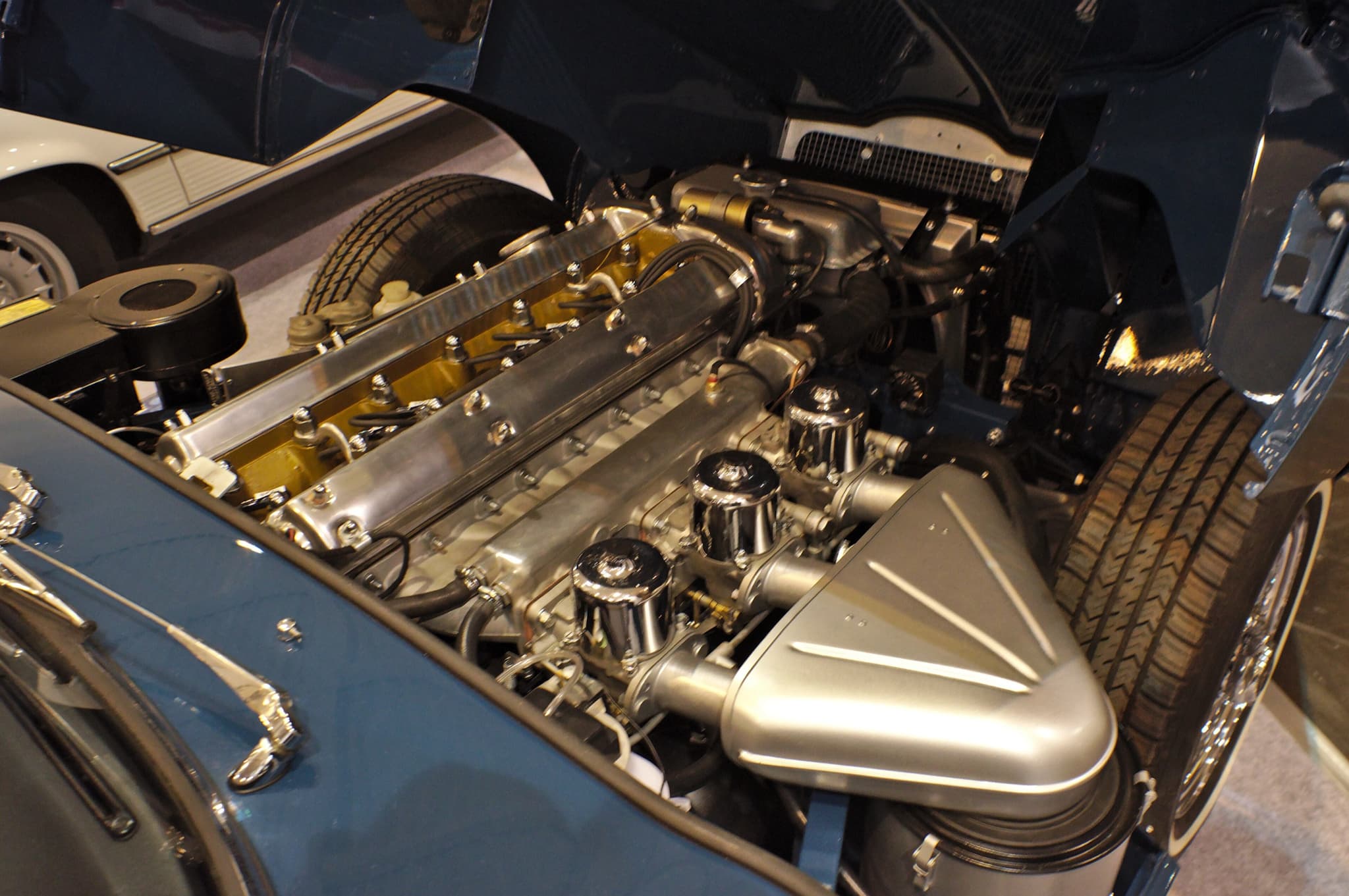
Car and Driver told the XK's story in December 1961. Jaguar began twin-cam engines after the war, lettering its experiments XA, XB and on, and chief engineer William Heynes was not satisfied until they reached K; it was "an engine which has now been in production for over 13 years. Its basic design is unaltered". The E-Type took it from the XK150S, with three SU carburettors under a common air box, and Car and Driver's pictures showed two differences from the engine of Jaguar's saloons: an aluminium sump instead of a pressed-steel one, and an inlet manifold reshaped to fit under the E-Type's low bonnet. The Mk X saloon of October 1961 then gained what the magazine called "E-Type goodies", the straight-port head, three SUs and the higher compression.
The cooling had a separate header tank and a Lucas electric fan that switched itself on as the water warmed. A lower compression ratio was there for countries with poor petrol (gas), and Denis Jenkinson of Motor Sport chose it for his 4.2 so that he "could motor anywhere in Europe without worrying about petrol standards". The 3.8's engine numbers begin R, or RA from early 1963.
Its weakness when new was oil. Car and Driver found "the oil consumption seemed extraordinarily high", and Jaguar's service department put it down to the "more generous clearances and tolerances" of an engine derived, it said, from the D-type's. Jenkinson's new 4.2 of 1965 was no better at first: its oil consumption in its first 16,000 km (10,000 miles) was "appalling", he wrote, then "heavy but reasonable".
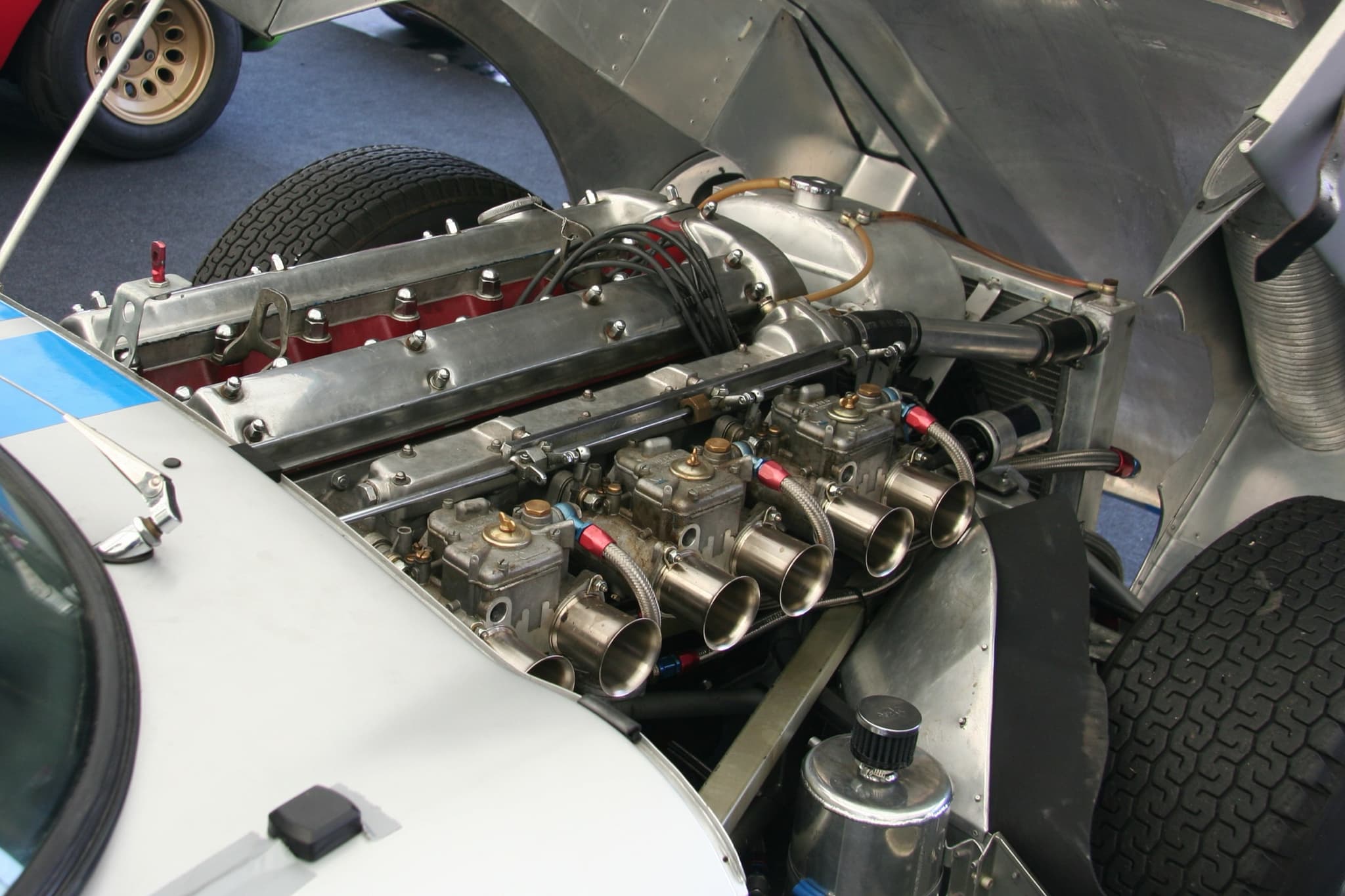
The XK six had a racing life as well, and Car and Driver reported in 1961 that the factory had raised the 3.8's power a good deal for competition, with fuel injection. The Lightweight page tells the factory's own racing engines.source 4source 1source 5source 6source 7source 8
The 4.2
The bigger engine of October 1964 was more than a bored-out 3.8, as Motor Sport's testers explained:
The 4.2 engine is a good deal more than just a bored-out 3.8 as it is not really possible to get more than 4-litres by straight cylinder boring. The cylinders have been repositioned somewhat, numbers 2 and 5 remaining in their original position, with 3 and 4 moving together and 1 and 6 moving towards the ends of the block.
The crankshaft was new, stiffer, with thicker webs, its balance weights moved and a new damper, and the pistons were new; water flowed more freely round the bores. The head stayed as it was, with a new inlet manifold whose straighter tracts the new brake servo made room for, and the same three carburettors. A Lucas alternator replaced the dynamo and a pre-engaged starter came with it. The engine numbers now began 7E.
The power did not rise. "Power output has not been increased", the magazine wrote, though the peak came at lower engine speed. What rose was the torque, and with it the engine's flexibility, and it ran more quietly when worked hard.
American engines and the Series 2
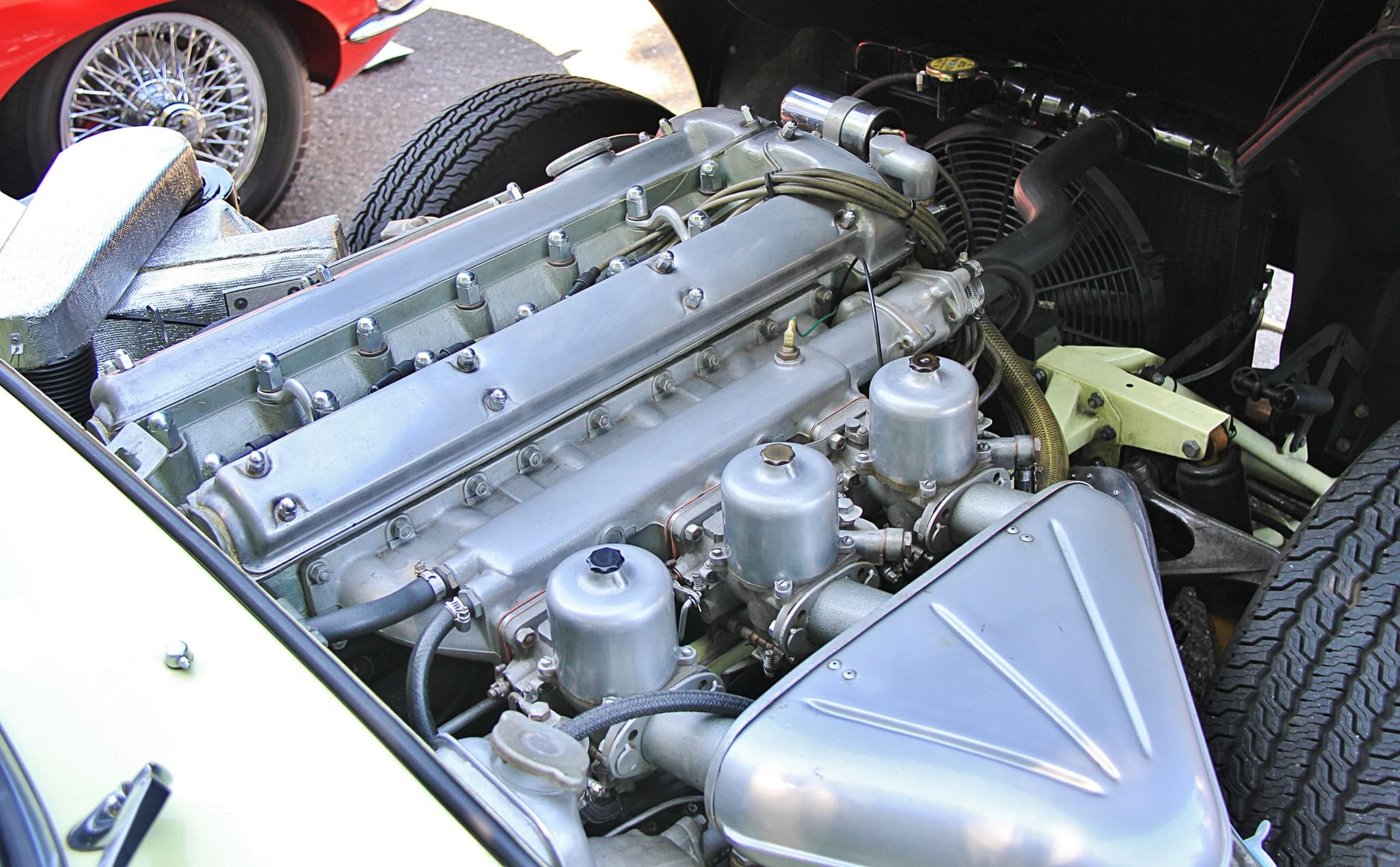
America's rules on exhaust emissions arrived for the 1968 model year, and the American E-Type changed first. Anders Clausager, as the Jaguar Clubs of North America cite him, dates the change to the car numbers in the Jaguar Heritage Trust's "September 1967" row. From there, left-hand-drive cars for America swapped their three SUs for a pair of Zenith-Stromberg carburettors, with emission controls. They lost power: Gunnell's Standard Catalog of Jaguar rates the American six at 246 hp, without saying how the figure was measured, and no factory figure was found.
British cars kept the old arrangement. Jaguar's British brochure for the Series 2 gives "Three S.U. carburetters" for all three bodies, so the Strombergs were an American fitting, not a Series 2 one; whether Canadian or Swedish cars had them, no source read says. The Series 2's engine numbers begin 7R, and the Trust's guide moves the engine number to the bell-housing flange on cars of 1969 and 1970.
Jaguar also cured the old thirst for oil. Jenkinson's 1970 roadster, he wrote in 1971, "does not use oil at all, unlike the early ones which used more oil than petrol. Jaguar cured the oil consumption by attention to valve-gear and piston rings, but at the cost of more friction and a small power loss." He liked its cooling too: "The 1970 'E'-type had a much more satisfactory radiator layout."source 11source 7source 12source 13source 14source 15
The V12
Jaguar's first V12 was a racing engine. In the early 1960s William Heynes and C. W. L. Baily designed a four-camshaft V12 of 5 litres with fuel injection, but Motor Sport reported in 1971 that it "would have been unduly bulky for the E-type, and costly to produce". Walter Hassan and Harry Mundy designed the production engine instead, "easier to make in quantity", and tests on a single cylinder decided its layout: one overhead camshaft on each bank, driven by a long chain, with the valves in line, which saved cost, space and weight. Motor Sport compared it with the Coventry-Climax racing engines the two men knew.
Its two banks of cylinders sat at 60 degrees in an aluminium block with wet iron liners, under aluminium heads, on seven main bearings, and four Zenith-Stromberg carburettors outside the vee fed it; its exhaust was cleaned for the American, Canadian and Swedish markets from the start. The Lucas Opus transistorised ignition appeared, Motor Sport wrote, "for the first time on a volume-production car". Complete with its ancillaries and emission equipment it weighed only about 36 kg (80 lb) more than a 4.2 six in the same trim. Jaguar built it in a new machine shop at Radford, "equipped at a cost of nearly £3-million", with a first target of 170 to 180 engines a week on one shift, and tested every engine there before it went to Browns Lane. The engine numbers begin 7S.
Jenkinson drove it for Motor Sport's issue of April 1971:
The smoothness, silence and silky running of the new V12 Jaguar engine is really impressive and even when you go round the back and listen at the four megaphone-type exhaust tail pipes there is only the merest whisper of sound while the engine is ticking over.
Bill Boddy's test car of 1972 had faults to report, fouled plugs after slow running, a sticking throttle linkage and cooling fans that lost their thermostatic control, but its engine "wafts the car along with turbine-like smoothness". The six was announced alongside it for the Series 3, but Motor Sport reported in 1975 that only one was built as such; the V12 page tells that story.
Motor Sport had expected the V12 to reach Jaguar's saloons, and Boddy ended his test with a request: "Now, Sir William, for those of us who have to tolerate saloons, what about an XJ12?" The history page follows the engine into the Jaguars that came after the E-Type.source 3source 14source 16source 17source 18source 7
Sources
Sources are given as plain text; their addresses are on the sources page.
- Primarymade at the time, by the maker or by people who were there
- Referenceserious later work: clubs, specialists, magazines, books
- Bill Boddy, "The New 3.8-Litre Jaguar E-Type G.T.", Motor Sport, Apr 1961, p. 35, p. 35, the engine; p. 35, "triple-carburetter form"; the cooling. Primary
- Motor Sport, "The 4.2-Litre Jaguar E-type" ("A lengthy road test of the 150 m.p.h. E-Type"), Jan 1965, p. 23, p. 23, the 4.2 engine; p. 23, the re-spaced cylinders, the manifold, the alternator; "Power output has not been increased". Primary
- Bill Boddy, "The new Jaguar V12", Motor Sport, Apr 1971, p. 61, p. 61, the V12; pp. 61–63, the origins, design, specification and the Radford machine shop. Primary
- Car and Driver, "Road Research Report: Jaguar XK-E" and "Dual Test: Jaguar XK-E vs. 1962 Corvette", Dec 1961 (vol. 7), the history of the XK engine; the data-page caption on the sump and manifold; the Mk X; oil consumption; the racing tune. Primary
- Bill Boddy, "By E-Type To Monaco", Motor Sport, Jul 1962, p. 59, the SU HD8 carburettors. Primary
- Denis Jenkinson, "Two years with the Jaguar E-type", Motor Sport, Apr 1967, p. 22, p. 22, the 8:1 pistons and the oil consumption. Primary
- Jaguar Daimler Heritage Trust, Research Guide No. 001F: Chassis Number Runs and Change Points by model – Jaguar E-type, Issue 3, January 2023, the engine-number prefixes; p. 1, the September 1967 change point; the 7S engine prefix. Primary
- Paul Skilleter, The Jaguar E-type: A Collector's Guide, Motor Racing Publications, 1979, the engine numbers, "R or RA". Reference
- Motor Sport, "New cars" (Earls Court), Nov 1964, p. 13, p. 13, the 4.2's crankshaft, pistons and water flow. Primary
- Richard Heseltine, "Jaguar E-type", Motor Sport, Mar 2007, p. 80, p. 80, the 4.2's torque. Reference
- Jaguar Cars Ltd, Coventry, Jaguar "E" Type range Series 2 (sales brochure), UK, 10/1968, the engine specification; the engine: "Three S.U. carburetters". Primary
- Jaguar Clubs of North America, Series 1 E-Type Judge's Guide (draft): Appendices, Draft, version of 21 Jul 2026, pp. 167 ff., Appendix D, the Zenith-Stromberg numbers after Clausager. Reference
- John Gunnell, Standard Catalog of Jaguar, Krause Publications, 2007, the E-Type's American rating. Reference
- Denis Jenkinson, "Driving the V12 Jaguar", Motor Sport, Apr 1971, p. 64, p. 64, the oil-consumption cure and the radiator layout; p. 64, the engine on the road; the six-cylinder Series 3. Primary
- Jaguar Daimler Heritage Trust, Research Guide No. 002: Vehicle numbers locator Guide, Issue 7, October 2026, pp. 8–9, the Series 2 engine number. Primary
- Bill Boddy, "On the road with the V12 E-type Jaguar", Motor Sport, Jan 1972, p. 36, p. 36, the engine in use and its faults; the closing line. Primary
- Motor Sport, "Jaguar E-type: the end of production and end of an era – but not of a legend", May 1975, p. 29, p. 29, the Series 3 six. Primary
- British Leyland Motors Inc., Leonia, New Jersey, "The Ultimate Cat": Jaguar V-12 E-type (sales brochure), USA, 1971, the specification page. Primary