Jaguar E2A
Jaguar's one-off racing prototype of 1960, the link between the D-type and the E-Type. It raced at Le Mans for Briggs Cunningham, won at Bridgehampton, and is the only survivor of Jaguar's two experimental cars, E1A and E2A.
About the pictureThe Le Mans circuit during the 2008 Le Mans Classic, with no E-Type in view
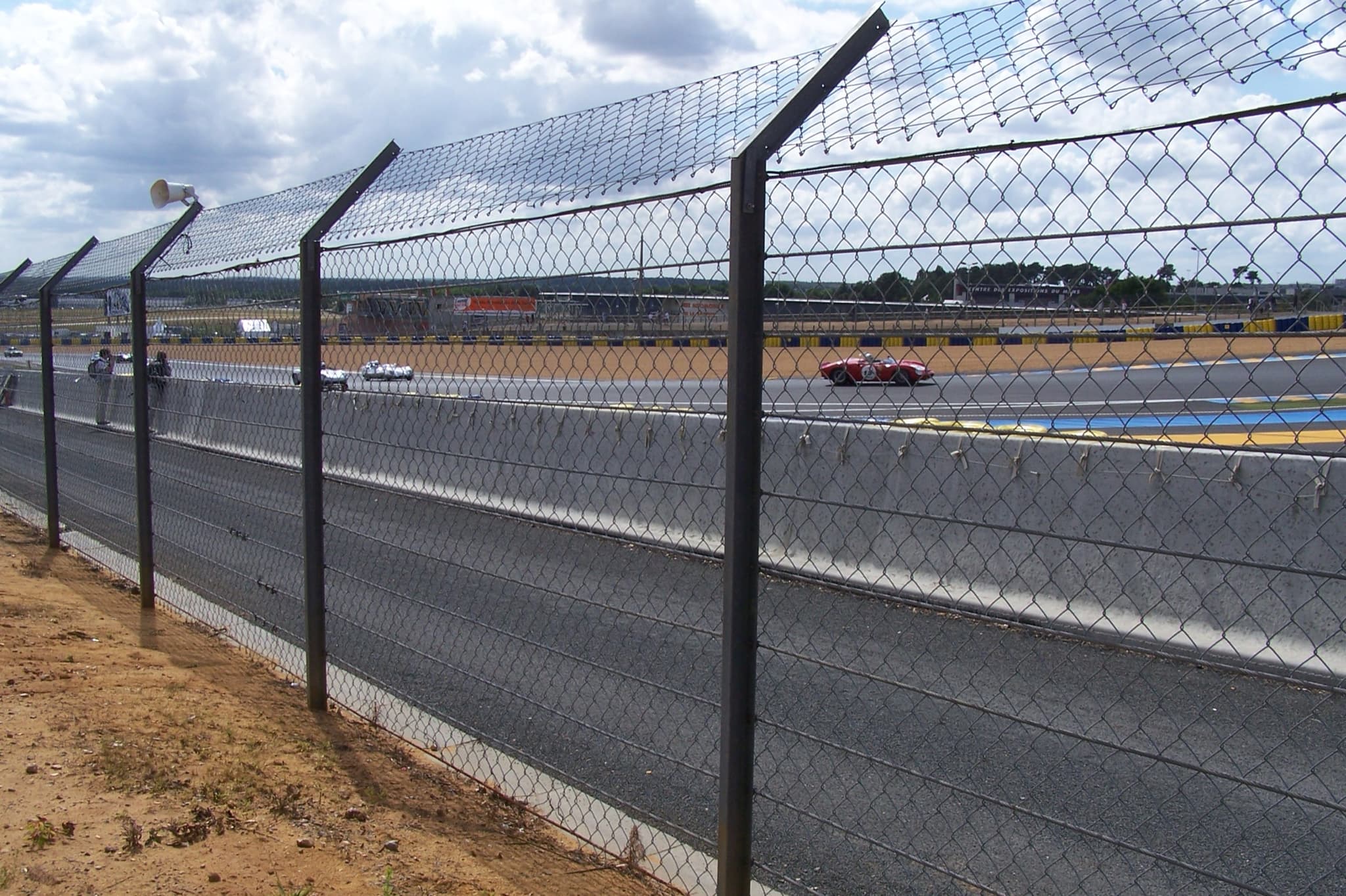
In June 1960, nine months before the E-Type was shown at Geneva, a white car with two dark blue stripes started the Le Mans 24 Hours as No. 6, entered by Briggs Cunningham for Dan Gurney and Walt Hansgen. It looked like a D-type with a longer nose. It was E2A, Jaguar's experimental racing car of 1960, and it belonged to the factory, not to the man whose colours it wore.
Its race record, its registration and its later life, stop by stop, are in the car's history below. The other prototypes, E1A and the development cars, are on the prototypes page.source 1source 2source 3
A racing car between the D-type and the E-Type
Sources for E2A
François Prins and Tony Merrygold, "The Story of the E2A: E for Exciting Experiment", Jaguar Daimler Heritage Trustsource 1; racingsportscars.com, "Jaguar E 2A – All Results"source 3; racingsportscars.com, Le Mans 24 Hours 1960, resultssource 4; Adam Cooper, "Dan Gurney: The worst car I ever drove – Jaguar E2A Prototype" ("Original sinner"), Motor Sport, Mar 2000, p. 56source 5; Motor Sport, News item on E2A, the 1960 Le Mans prototype, Aug 2008, p. 116source 2; Jaguar Daimler Heritage Trust, "E-Type Evolution Exhibition"source 6
Ted Brookes ran its build in the Experimental Department, in eight weeks at the start of 1960. Beside the D-type look it had two doors, intakes above the rear wheels and a D-type fin behind the driver's head, on a structure Motor Sport calls semi-monocoque, and the independent rear suspension the E-Type would have.
It carried the registration VKV 752, which E1A had been given in 1957, and it wears it still. A young Jaguar apprentice, David Hobbs, spun it at Silverstone during a test, by his own account, with the company's engineers watching.source 1source 2source 7source 8
Le Mans, 1960
Cunningham wanted to run at Le Mans and had no car, so Jaguar lent him E2A, and it raced in his colours.
Gurney did not like it at first.
I don't want to upset people, but up until we got them to change it, I'd say the worst car I drove was the prototype E-type I shared with Walter Hangsen at Le Mans in 1960.
The change was to the rear suspension's setting, from toe-out to toe-in, and Gurney said it "transformed it into a fine car". In the race a fuel leak cost eight minutes at a stop on the third lap; later an injector pipe fractured, the start of the trouble that ended its race. The Le Mans page has the race, and the car's history below how it ended.source 1source 3source 4source 5
America, 1960
For its American races E2A was given a 3.8 engine, and the taller engine needed a long central bulge in the bonnet (hood), which, the Trust writes, became "the signature of the E-type". Its American results are in its history below.
The season had a purpose beyond the results: Cunningham recalled it, in the Trust's history, as "a great chance to publicise the (forthcoming) new E-Type". The America page follows the production cars that came after it.source 1source 3source 9
Lent, not sold
After the racing
Back at Jaguar, E2A tested brakes and, by the Trust's account, served as a decoy for the XJ13 in 1966. It was saved from scrapping by Roger Woodley, who looked after customers' competition cars at Jaguar and persuaded Lofty England to sell it. The buyer's family recalled the terms: Lofty agreed to sell "on the strict understanding it was not to be used competitively".source 1source 9source 2source 6
Where it has been
- 1960
Completed by the Experimental Department
27 February 1960. Built from 1 January 1960 as a one-off racing car between the D-type and the coming E-Type: a D-type-like body with a longer nose, independent rear suspension, and a 3-litre aluminium-block XK engine with Lucas fuel injection, of nearly 300 bhp, for the 3-litre prototype limit at Le Mans. It was ready for road testing on 27 February 1960
François Prins and Tony Merrygold, "The Story of the E2A: E for Exciting Experiment", Jaguar Daimler Heritage Trustsource 1
- 1960
3rd at the Le Mans test
9 April 1960. Unpainted, and carrying VKV 752, the registration E1A had been given in 1957, it was 3rd at the April test day with Walt Hansgen and Ed Crawford. Jaguar lent the car to Briggs Cunningham for the race, and it was then painted in his white with blue stripes; it was never sold to him
François Prins and Tony Merrygold, "The Story of the E2A: E for Exciting Experiment", Jaguar Daimler Heritage Trustsource 1; racingsportscars.com, "Jaguar E 2A – All Results"source 3
- 1960
Retired from the Le Mans 24 Hours
26 June 1960. Dan Gurney and Walt Hansgen drove it as No. 6 for Cunningham. A fuel-injection fault, a fractured injector pipe and a fuel leak, led to head-gasket failure and a burnt piston, and it retired after 89 laps, at 1.35 in the morning. Gurney later said that it handled badly until its rear wheels were set to toe in before the race
racingsportscars.com, Le Mans 24 Hours 1960, resultssource 4; François Prins and Tony Merrygold, "The Story of the E2A: E for Exciting Experiment", Jaguar Daimler Heritage Trustsource 1; Adam Cooper, "Dan Gurney: The worst car I ever drove – Jaguar E2A Prototype" ("Original sinner"), Motor Sport, Mar 2000, p. 56source 5
- 1960
Won at Bridgehampton
28 August 1960. For its American races it had a 3.8-litre engine, whose height gave E2A the long central bonnet bulge later seen on the E-Type. Walt Hansgen won the SCCA race at Bridgehampton, the car's only win
François Prins and Tony Merrygold, "The Story of the E2A: E for Exciting Experiment", Jaguar Daimler Heritage Trustsource 1; racingsportscars.com, "Jaguar E 2A – All Results"source 3
- 1960
- 1960
10th at Riverside
16 October 1960. Jack Brabham drove it in the Los Angeles Times Grand Prix, entered by Jaguar's New York distributors
racingsportscars.com, "Jaguar E 2A – All Results"source 3; François Prins and Tony Merrygold, "The Story of the E2A: E for Exciting Experiment", Jaguar Daimler Heritage Trustsource 1
- 1960
14th at Laguna Seca
23 October 1960. Bruce McLaren drove it in the Pacific Grand Prix, its last race of 1960
racingsportscars.com, "Jaguar E 2A – All Results"source 3
- 1966
A decoy for the XJ13, then sold
Back at Jaguar, which declined to sell it to Cunningham, it was used to test Dunlop's Maxaret anti-lock brakes. According to the JDHT, in 1966 it lapped MIRA without its fin and painted British Racing Green as a decoy for the secret XJ13. Jaguar sold it in the late 1960s for the photographer Guy Griffiths's Camden collection, on condition that it was not raced, and repainted it in Cunningham's colours
François Prins and Tony Merrygold, "The Story of the E2A: E for Exciting Experiment", Jaguar Daimler Heritage Trustsource 1
- 2008
Left the Griffiths family
Motor Sport reported in August 2008 that the car, in the same family since the late 1960s, was to change hands. The JDHT later recorded an owner living in Switzerland, with the car kept in the UK and raced at the Goodwood Revival
Motor Sport, News item on E2A, the 1960 Le Mans prototype, Aug 2008, p. 116source 2; François Prins and Tony Merrygold, "The Story of the E2A: E for Exciting Experiment", Jaguar Daimler Heritage Trustsource 1
- 2021
In the E-Type Evolution exhibition
March 2021. The JDHT showed it, still carrying VKV 752, in its exhibition for the E-Type's 60th anniversary at the British Motor Museum, Gaydon, from March to June 2021
Jaguar Daimler Heritage Trust, "E-Type Evolution Exhibition"source 6
Results
A yellow year marks a win.
- 1960
- 1960
- 1960
- 1960
- 1960
- 1960
Sources
Sources are given as plain text; their addresses are on the sources page.
- Referenceserious later work: clubs, specialists, magazines, books
- Databaseresults and listings, entry by entry
- François Prins and Tony Merrygold, "The Story of the E2A: E for Exciting Experiment", Jaguar Daimler Heritage Trust, race table, 9 April 1960; race table, 26 June 1960; race table; the American races. Reference
- Motor Sport, News item on E2A, the 1960 Le Mans prototype, Aug 2008, p. 116, p. 116; p. 116, "semi-monocoque". Reference
- racingsportscars.com, "Jaguar E 2A – All Results", 9 April 1960, Le Mans test; 28 August 1960, Bridgehampton; 11 September 1960, Road America; 16 October 1960, Riverside; 23 October 1960, Laguna Seca; 9.4.1960, Le Mans test, 3rd; 28.8.1960, Bridgehampton, 1st; 11.9.1960, Road America 500, 3rd; 16.10.1960, Riverside, 10th; 23.10.1960, Laguna Seca, 14th. Database
- racingsportscars.com, Le Mans 24 Hours 1960, results, No. 6; results, No. 6, 89 laps. Database
- Adam Cooper, "Dan Gurney: The worst car I ever drove – Jaguar E2A Prototype" ("Original sinner"), Motor Sport, Mar 2000, p. 56, p. 56. Reference
- Jaguar Daimler Heritage Trust, "E-Type Evolution Exhibition". Reference
- François Prins, "The Story of the E1A: The Experimental Car That Preceded The E-Type", Jaguar Daimler Heritage Trust. Reference
- Simon Taylor, "Lunch with… David Hobbs", Motor Sport, Jan 2011. Reference
- collectordata.com (the XKEdata family of registers), Coventry Racers: Jaguar C-Type, D-Type, XKSS and Lightweight E-Type register, car page E2A: Bonhams' 2008 catalogue text, Hansgen's notes; car page E2A: the family's account. Reference
- Matthew Franey, "Cd Players", Motor Sport, Oct 1998, p. 74. Reference