Jaguar E-Type at Le Mans
Four Le Mans races, 1960 to 1964, and nine cars, from the prototype E2A to two low-drag Lightweights. The best result was 4th and 5th in 1962.
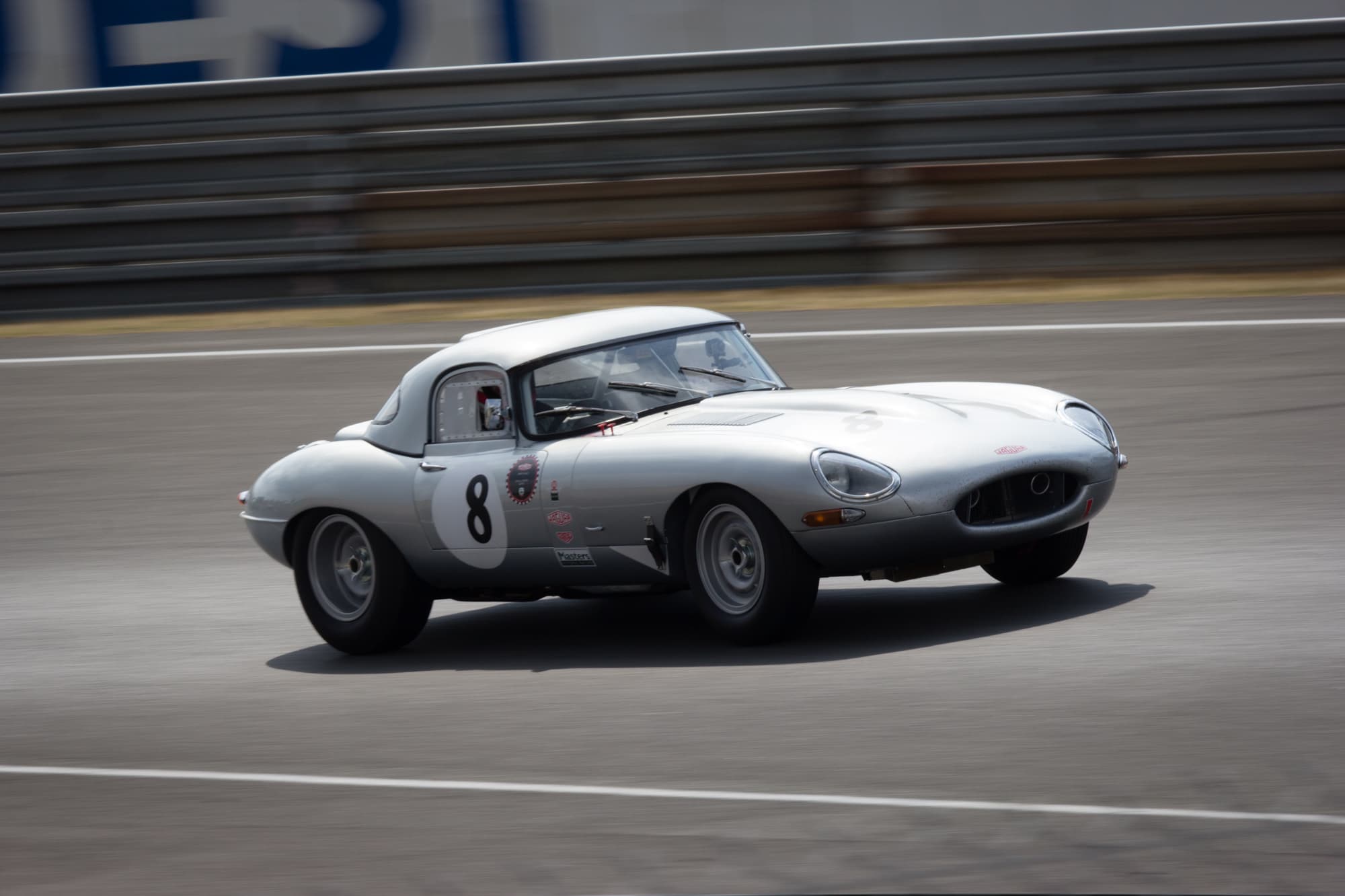
In the 17th hour of the 1963 race, Briggs Cunningham's Lightweight lost its brakes at the end of the Mulsanne Straight and went into the straw bales. It was repaired and sent back out, and it finished 9th. That was the E-Type's Le Mans in miniature: a private American entry, a works-built car, and a long way from the winning Ferrari.
The E-Type ran at Le Mans four times in period, in 1960 and from 1962 to 1964: nine cars in all, from the prototype E2A to two Lightweights with low-drag bodies. None was entered by Jaguar itself. Three finished, all in the top ten.source 1source 2source 3source 4source 5
1960: E2A
E2A was Jaguar's racing prototype of 1960, a fuel-injected car built from the start of the year, with a D-type-like body and a longer nose. Unpainted, it was 3rd at the Le Mans test day on 9 April with Walt Hansgen and Ed Crawford. Jaguar then lent it to Cunningham, the American entrant, who painted it in his white with blue stripes.
In the race, on 25–26 June, Dan Gurney and Hansgen drove it as No. 6, in the S3.0 sports-car class. It retired after 89 laps, at 1.35 in the morning, with engine failure that began with a fuel-injection fault. The only other Jaguar in the race, Ecurie Ecosse's D-type, also retired, and Ferrari won with a 250 Testa Rossa. Gurney's verdict on the car, and its American races that autumn, are on the E2A page.source 6source 7source 1source 8
1962: 4th and 5th
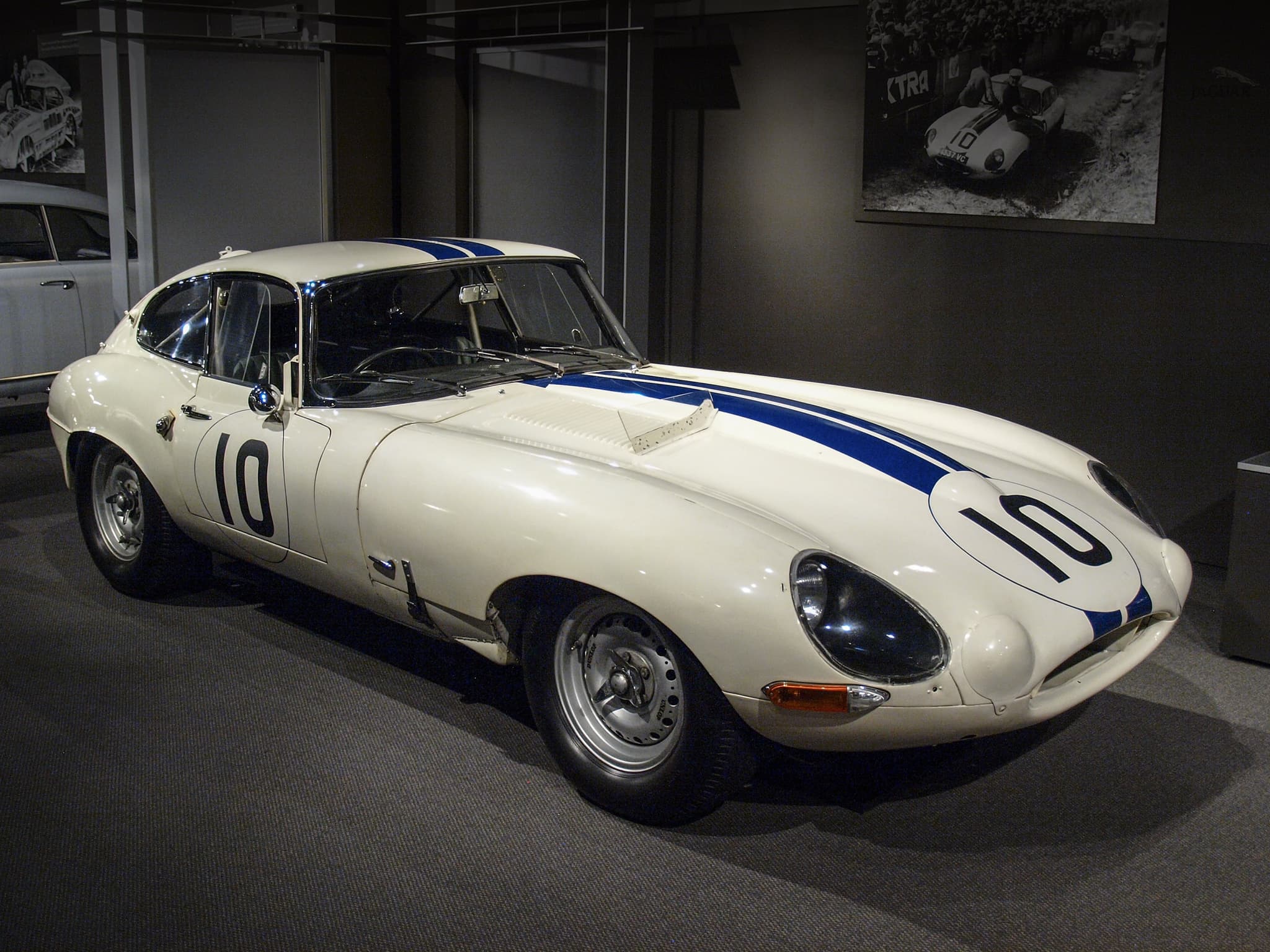
Three E-Types started in 1962, all private entries. Cunningham shared a fixed-head coupé with Roy Salvadori as No. 10. Peter Sargent entered No. 9, a roadster, for Sargent and Lumsden, and Maurice Charles entered No. 8 for Charles and Coundley.
As faster cars dropped out, the two leading E-Types moved up. Near the end Sargent and Lumsden's car developed gearbox (transmission) trouble, and Motor Sport reported that it "dropped back to fifth behind the similar car of Cunningham and Salvadori". Both covered 310 laps. They finished 4th and 5th overall and 1st and 2nd in the GT class for cars up to 4 litres, behind Phil Hill and Olivier Gendebien's Ferrari prototype and two Ferrari 250 GTOs. Charles and Coundley's car retired with engine failure after 53 laps.
1963: Cunningham's Lightweights
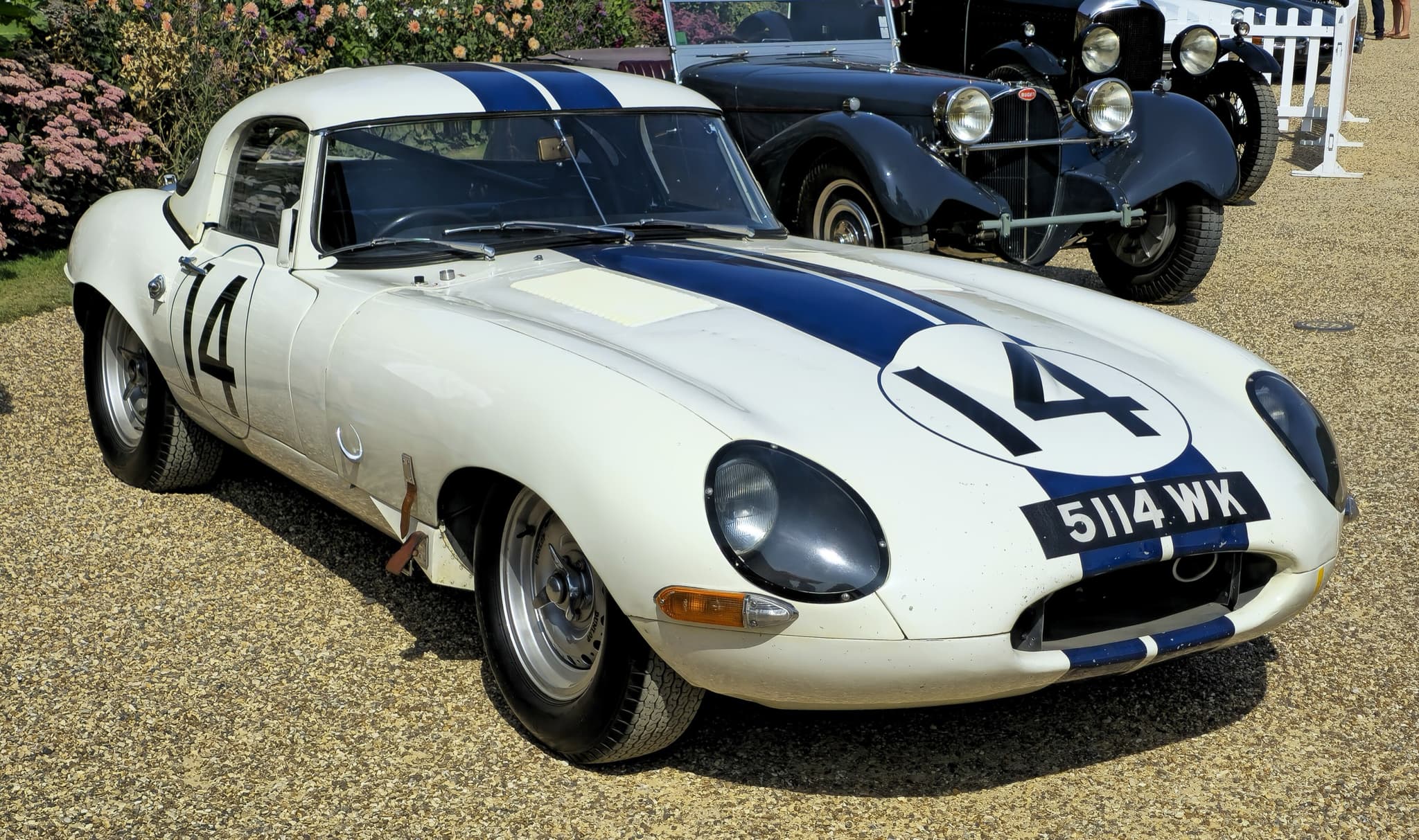
For 1963 Cunningham entered three new Lightweights, which Motor Sport described as "three new lightweight Jaguar E-types, with hard-tops": Cunningham and Grossman in No. 15, Salvadori and Richards in No. 16, and Pabst and Hansgen in No. 14.
Hansgen and Pabst's car went out in the second hour with a broken gearbox, after 8 laps. In the fifth hour Salvadori crashed on oil in No. 16, in an accident in which a driver of another car died. Cunningham and Grossman's car ran on and was 7th in the 15th hour, before its brakes failed.
The Jaguar was repaired with bits from another car and Briggs Cunningham rejoined the race, to much applause from the crowds.
It finished 9th, after 283 laps, and 2nd in the class for the largest GT cars, GT+3.0, behind the AC Cobra of Sanderson and Bolton. 1963 was Cunningham's last Le Mans as a driver. One thing is easily confused: Sargent and Lumsden's entry that year, No. 17, was a Lister-Jaguar coupé, not an E-Type.source 3source 5
1964: the low-drag Lightweights
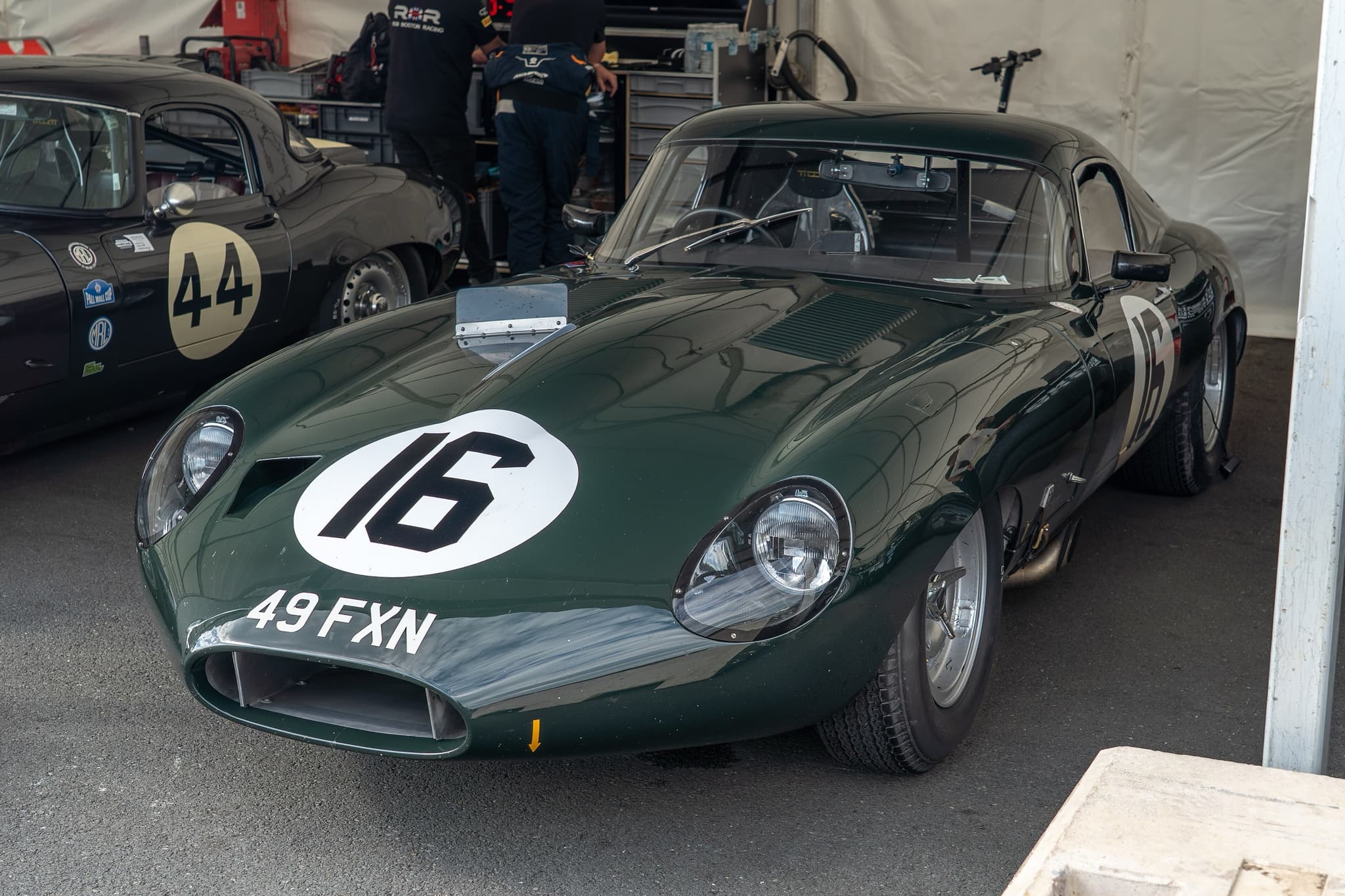
Two private Lightweights came in 1964, both with low-drag roofs and tails. Peter Lindner's, registered 4868 WK, had been rebodied by the factory, the only Lightweight it rebodied this way, Motor Sport wrote in 2011; Lumsden and Sargent's 49 FXN had a low-drag coupé body too. At the test day on 19 April they were 6th and 7th, the fastest of the GT cars up to 4 litres.
In the race Lindner and Peter Nöcker drove No. 16 and retired with a failed head gasket after 149 laps; Lumsden and Sargent's No. 17 retired with gearbox failure after 80 laps. What happened to Lindner's car later that year is on its own page. No later E-Type entry at Le Mans appears in racingsportscars' list: 1964 was the last of the E-Type's Le Mans races in period. It came back to the circuit in historic racing, on the historic racing page.source 11source 4source 12source 13source 14
Rivals at Le Mans
Ferrari won all four races. In 1960 a 250 Testa Rossa won; in 1962 the 330 TRI/LM won and 250 GTOs were 2nd and 3rd, ahead of both E-Types; in 1963 Ferraris filled the first six places, and the AC Cobra was 7th, ahead of the Lightweight; and in 1964 Ferrari prototypes were 1st to 3rd, with Shelby's Cobra Daytona Coupé 4th and the best GT car, and two 250 GTO 64s 5th and 6th.
Speed on the Mulsanne Straight was the difference. Jenkinson reckoned the larger Ferrari coupés of 1963 had 385 b.h.p. and Ferrari's works cars about 350.
… whereas the Jaguars and Cobras were under 300 b.h.p.
Of the nine cars that started there in period, the two that finished highest, in 1962, were built before the Lightweights existed.source 1source 2source 3source 4source 5
Sources
Sources are given as plain text; their addresses are on the sources page.
- Primarymade at the time, by the maker or by people who were there
- Referenceserious later work: clubs, specialists, magazines, books
- Databaseresults and listings, entry by entry
- racingsportscars.com, Le Mans 24 Hours 1960, results, No. 6; No. 6; the winner; the Ecurie Ecosse D-type; results. Database
- racingsportscars.com, Le Mans 24 Hours 1962, results, results; results, 4th and 5th; GT 4.0; retirements, No. 8; results, 1st–3rd. Database
- racingsportscars.com, Le Mans 24 Hours 1963, results, results and retirements; results, 7th and 9th; retirements, Nos 14, 16 and 17; results, 1st–7th. Database
- racingsportscars.com, Le Mans 24 Hours 1964, results, retirements; results; retirements, Nos 16 and 17; results, 1st–6th. Database
- Denis Jenkinson, "The 24 Hours of Le Mans (June 15/16th)" ("Ferraris all the way"), Motor Sport, Jul 1963, p. 14, the 17th to 19th hours; the entry; the second, fifth, 15th and 17th hours; para. 27; para. 3. Primary
- François Prins and Tony Merrygold, "The Story of the E2A: E for Exciting Experiment", Jaguar Daimler Heritage Trust. Reference
- racingsportscars.com, "Jaguar E 2A – All Results", 9 April 1960, Le Mans test. Database
- Adam Cooper, "Dan Gurney: The worst car I ever drove – Jaguar E2A Prototype" ("Original sinner"), Motor Sport, Mar 2000, p. 56, p. 56. Reference
- Motor Sport, "Le Mans 24-Hour Race", Aug 1962, p. 12, paras 3–4. Primary
- Gordon Cruickshank, "Jaguar's Lightweight E Types", Motor Sport, Sep 1984, p. 33, p. 33. Reference
- racingsportscars.com, Le Mans Test 1964, test results, 6th and 7th. Database
- Motor Sport, "Famous E-type to star at show", Aug 2011, p. 20. Reference
- Shihanki Elpitiya and Tony Merrygold, "Peter Lindner: Racing Driver Who Died Driving His Own Lightweight E-type", Jaguar Daimler Heritage Trust. Primary
- racingsportscars.com, "Jaguar E-Type – All Results", every Le Mans row, 1960–64. Database